
Social Media Marketing: What It Is, Benefits and 7 Steps
Social media marketing is promoting a product, service or brand on social networks so that people notice it, discuss it and pass it on. The Cambridge Business English Dictionary defines it as advertising products, services or brands online by attracting the interest of groups of people who discuss them and make suggestions about them. Checked against Cambridge Business English Dictionary: social media marketing To do it, set a goal, pick the networks your audience already uses, post content made for each network on a schedule, and check the results against the goal every month.
This social media marketing guide is the map: what the term means, the benefits that dated figures support, which platforms suit which audiences, a 7-step process and how to measure it. If you run a small business, the social media marketing for small business playbook adds costs and ad minimums for that case.
Table of Contents
- What is social media marketing?
- What are the benefits of social media marketing?
- Which social media platforms should you market on?
- What content works in social media marketing?
- How to do social media marketing in 7 steps
- How do you measure social media marketing?
- Organic vs paid social media marketing: what’s the difference?
- Which tools make social media marketing manageable?
- Every guide in this social media marketing hub
- Social media marketing FAQ
What is social media marketing?
In practice, social media marketing means posting, replying and advertising on networks such as YouTube, Facebook, Instagram, TikTok and LinkedIn, so that people notice a brand and pass it on. In the classic 4 Ps of the marketing mix, it sits under promotion.
Two definitions are worth knowing:
- The dictionary definition. Cambridge’s Business English Dictionary defines social media marketing as methods for advertising products, services or brands using the internet, by attracting the interest of groups of people who discuss them and make suggestions about them online. Checked against Cambridge Business English Dictionary: social media marketing It is the dictionary we use because Merriam-Webster has no entry for the phrase and Collins sends it to a spellcheck page. Checked against Merriam-Webster: social media marketing (no entry)
- The marketing-standards definition. The Marketing Accountability Standards Board (MASB) dictionary, citing the IAB glossary and a 2009 4As guide, calls it a tactic that taps into the growth of social networks by encouraging people to adopt and pass along content a brand created, or to add the brand to their social circle. Checked against MASB Universal Marketing Dictionary: Social media marketing
Other names you will see. Cambridge gives new media marketing as another name for the same thing. Checked against Cambridge Business English Dictionary: social media marketing You will also see the abbreviation SMM: here is what SMM means and where it shows up. SNS marketing is another label for the same work.
Do not confuse it with social marketing. Cambridge defines social marketing as the use of marketing methods to change people’s behaviour in areas such as health and education. Checked against Cambridge Business English Dictionary: social marketing A stop-smoking campaign is social marketing whether or not it runs on social media. Social marketing vs social media marketing sets the two side by side.
Social media marketing also overlaps with content marketing, which the Content Marketing Institute defines as a strategic approach focused on creating and distributing valuable, relevant and consistent content to attract and retain a clearly defined audience and, ultimately, to drive profitable customer action. Checked against Content Marketing Institute: What Is Content Marketing?Press report Social networks are one place that content goes; content marketing strategies for social media covers the overlap.
What are the benefits of social media marketing?
The main benefits are reach where people already spend time, a direct route to brand discovery, and a paid layer you can switch on once you know which posts work. Each benefit below carries dated figures from primary research, a company filing or an official statistics office.
- Reach at a very large scale. DataReportal’s Digital 2027 report counted 5.81 billion (start of October 2026) social media user identities worldwide. Checked against DataReportal: Digital 2027 Global Overview Report (We Are Social and Meltwater; analysis by Simon Kemp at Manochi), 21 Oct 2026 User identities may not be unique people, because one person can hold several accounts. The report combines its own estimates with partners’ data such as GWI surveys and Similarweb app data. Checked against DataReportal: Digital 2027 Global Overview Report (We Are Social and Meltwater; analysis by Simon Kemp at Manochi), 21 Oct 2026
- A route to brand discovery. In GWI’s survey of internet users aged 16 and over, reported by DataReportal, 30.4% (Q2 2026) said they discover new brands, products and services through social media ads, close behind search engines (32%) and TV ads (30.6%). Checked against DataReportal: Digital 2027 Global Overview Report (We Are Social and Meltwater; analysis by Simon Kemp at Manochi), 21 Oct 2026 Respondents could pick more than one channel.
- A place people go for information. 59% (Aug 24–30, 2026) of U.S. adults told Pew Research Center they get news from social media at least sometimes. Checked against Pew Research Center: Social Media and News Fact Sheet (19 Oct 2026) People use these feeds to learn things, not only to pass time, which leaves room for useful brand posts.
- A channel your competitors already use. Eurostat reports that 63.57% (2025 survey year) of EU enterprises with 10 or more employees used some form of social media, against 34.19% in 2014. Checked against Eurostat: Social media use by type, internet advertising and size class of enterprise (isoc_cismt), data updated 27 Feb 2026
- One place to build your image, hire and answer customers. In Eurostat’s 2023 data, 50.72% of EU enterprises with 10 or more employees used social media to develop their image or market products, 36.2% to recruit and 30.52% to obtain or respond to customer opinions, reviews or questions. Checked against Eurostat: Social media use by purpose and size class of enterprise (isoc_cismp), data updated 17 Jul 2025 These are uses firms report, not measured results.
- A paid layer when you need it. The IAB’s Internet Advertising Revenue Report, conducted by PwC, put U.S. social media ad revenue at $117.7 billion (calendar year 2025), ahead of search at $114.2 billion. Checked against IAB: Internet Advertising Revenue Report, Full Year 2025, conducted by PwC (news release, 16 Apr 2026) On Meta’s apps, a post that already works can be boosted into an ad, as the organic vs paid table below shows.
What these figures do not show is the effect of social media marketing on any one business’s sales or loyalty. We found no dated primary research measuring that across businesses, so the list stops at reach, discovery and use. Your own numbers, measured against your own goal, are the only proof that counts for you.
Which social media platforms should you market on?
Market where your audience already is. In Pew Research Center’s 2026 survey of U.S. adults, YouTube and Facebook were the most widely used, Instagram and TikTok skewed young and LinkedIn skewed toward college graduates. The survey covered 5,511 U.S. adults, fielded from 30 January to 18 June 2026 online, by mail or by phone, with a margin of error of ±1.8 percentage points. Checked against Pew Research Center: Social Media Fact Sheet (19 Oct 2026)
| Platform | U.S. adults who ever use it (2026) | Ages 18–29 | Ages 65+ | College graduates | High school or less | What brands typically use it for (our summary) |
|---|---|---|---|---|---|---|
| YouTube | 84% | 95% | 65% | 90% | 77% | Tutorials, reviews and longer video people search for |
| 70% | 69% | 59% | 70% | 67% | Pages, local businesses, events and ads | |
| 51% | 79% | 21% | 59% | 42% | Reels, carousels and products that photograph well | |
| TikTok | 37% | 65% | 11% | 28% | 43% | Short vertical video for younger audiences |
| 31% | 41% | 13% | 51% | 13% | B2B, hiring and expertise from founders and staff | |
| 25% | 40% | 6% | 36% | 12% | Taking part in topic communities on their terms | |
| X | 18% | 31% | 7% | 22% | 14% | News, live events and short text updates |
Checked against Pew Research Center: Social Media Fact Sheet (19 Oct 2026).
Checked against Pew Research Center: Social Media Fact Sheet (19 Oct 2026).
Checked against Pew Research Center: Social Media Fact Sheet (19 Oct 2026).
Pinterest is missing from Pew’s 2026 tables: its last reading is 36% of U.S. adults in June 2024, and brands typically use it for ideas people save while planning a purchase (our summary).
Read the table with two cautions. Pew measures whether U.S. adults ever use a platform, not how often, and it describes adults in general, not your customers. Checked against Pew Research Center: Social Media Fact Sheet (19 Oct 2026) Before you choose, define your target audience and ask a few customers where they spend time. If you sell to other businesses, B2B social media marketing covers LinkedIn-first plans.
Global scale is reported in different units, so the numbers cannot be ranked against each other:
- Meta reported in October 2026 that Family daily active people, unique people using at least one of Facebook, Instagram, Messenger or WhatsApp each day, averaged 3.64 billion in September 2026. That is family-wide, not per app. Checked against Meta Investor Relations: Meta Reports Third Quarter 2026 Results (21 October 2026)
- LinkedIn says, as of November 2026, it has more than 1.4 billion members. Members are registered accounts, not active users. Checked against LinkedIn Pressroom: About Us (Statistics)
- Pinterest reported 661 million monthly active users for the quarter ended 30 September 2026. Checked against Pinterest, Inc. Form 8-K exhibit: Third Quarter 2026 Results (29 October 2026), SEC EDGAR
For every platform figure with its date and method, see social media statistics, every figure dated.
What content works in social media marketing?
Content made for the people you want to reach, in the format each network rewards: short vertical video, images and carousels, text posts and links, sized and written for that network. A post that would be useful even if no algorithm existed is the right starting point.
Google Search Central puts that test into words for search: people-first content is created primarily for people, not to manipulate rankings. Checked against Google Search Central: Creating helpful, reliable, people-first content The same test works for a social post. Would someone in your audience save it, send it to a friend or come back to it?
The formats that cover most needs:
- Short vertical video for TikTok, Instagram Reels and YouTube Shorts, and longer video for YouTube. Video marketing covers planning, formats and what each network counts as a view.
- Images and carousels for Instagram, Facebook, LinkedIn and Pinterest: a step-by-step, a before-and-after, a checklist.
- Text posts for X, Threads, Bluesky and LinkedIn, where a clear opinion or a useful tip can travel without media.
- Other people’s voices. Customers, staff and creators often say it better than the brand. The IAB says U.S. creator advertising spend reached $37 billion in 2025 and is projected to reach $44 billion in 2026. Checked against IAB: Internet Advertising Revenue Report, Full Year 2025, conducted by PwC (news release, 16 Apr 2026) Brand ambassador programs shows how to set one up with the disclosure rules.
To stop the calendar from becoming random, group your posts under three to five recurring themes: content pillars shows how. Skip engagement bait, follow-for-follow schemes and anything that tries to game a feed: the platforms’ own rules forbid or demote these, as what never to do to chase reach shows.
For campaigns built to be shared on purpose, see viral marketing strategies that stay inside the rules.
How to do social media marketing in 7 steps
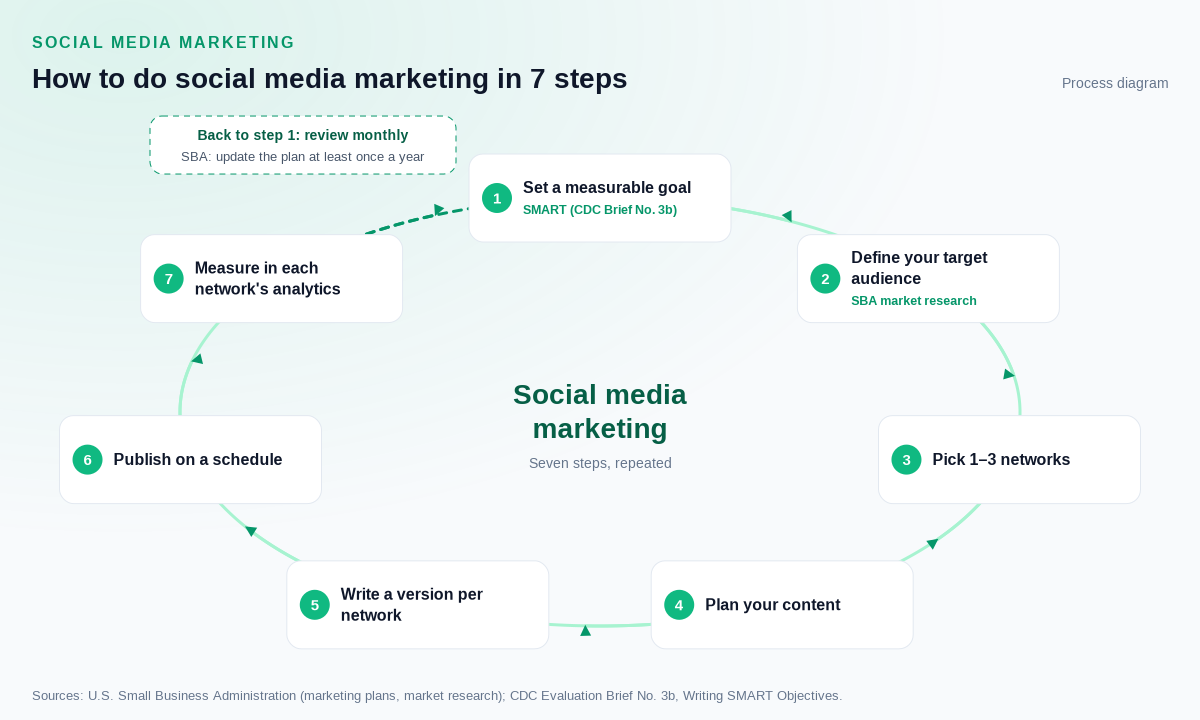
Set a measurable goal, define your target audience, pick one to three networks, plan your content, write a version for each network, publish on a schedule and review the results every month. The steps draw on the U.S. Small Business Administration’s marketing-plan sections, which include a target market, goals, an action plan listing the channels you will use, a budget and a plan to measure and update, with the plan maintained at least once a year. Checked against U.S. Small Business Administration: Manage your business — Marketing and sales
| Step | What you decide | Guide |
|---|---|---|
| 1. Set a measurable goal | What you want from social media, by when, and how you will count it | Free social media strategy template |
| 2. Define your target audience | Who you are talking to, what they need and where they spend time | Define your target audience |
| 3. Pick one to three networks | Which networks that audience uses, from the table above | Platform table |
| 4. Plan your content | Themes, formats and a calendar | Content marketing strategies and the content calendar template |
| 5. Write a version for each network | Length, format and size per network | Video marketing |
| 6. Publish on a schedule | How often you post and when each campaign runs | Plan a social media campaign |
| 7. Measure and adjust | Which numbers show progress, and what you change | Social media KPIs |
Step 1: Set a measurable goal
Write one goal you can count, with a date. The CDC’s evaluation brief on SMART objectives spells the letters as Specific, Measurable, Achievable, Realistic and Time-phased, the last meaning the objective says when it will be measured or met. Checked against CDC Healthy Youth: Evaluation Brief No. 3b — Writing SMART Objectives (PDF) Other sources expand the letters differently, so pick one version and use it consistently. The SBA’s examples of common goals are more email subscribers, a bigger market share or sales up by a set percentage. Checked against U.S. Small Business Administration: Manage your business — Marketing and sales The free social media strategy template puts the goal on one page with the rest of the plan.
Step 2: Define your target audience
Describe the people you want to reach before you write a post. The SBA advises gathering demographic information such as age, wealth, family and interests, and answering questions about demand, market size and location. Checked against U.S. Small Business Administration: Plan your business (Market research and competitive analysis) The MASB dictionary’s definition of market segmentation gives you four ways to group people: demographics, geography, behaviour and psychographic factors. Checked against MASB Universal Marketing Dictionary: Market segmentation The target audience guide turns that into a one-paragraph description, and a buyer persona turns it into a person you can write for.
Step 3: Pick one to three networks
Start with the networks your audience uses most, and only as many as you can post to well. Use the platform table above as a first filter, then check it against what your own customers tell you. One network done consistently teaches you more than five done occasionally.
If Instagram is your first network, our Instagram marketing strategy guide plans it step by step.
Step 4: Plan your content
Decide your themes and formats, then put dates on them. A calendar shows the gaps before your audience does. Content marketing strategies for social media covers what to plan, and the content calendar template gives you the grid.
Step 5: Write a version for each network
Adapt each post to the network it goes to: length, format, size and tone. The text limits alone vary widely:
| Placement | Character limit | Counted in | Source |
|---|---|---|---|
| Instagram · Caption | 2,200 characters | UTF-16 code units Outfeed-enforced | Instagram Graph API: IG User Media |
| TikTok · Video caption | 2,200 characters | UTF-16 code units | TikTok Content Posting API: direct post reference |
| LinkedIn · Post text | 3,000 characters | UTF-16 code units Outfeed-enforced | LinkedIn Help: Post and share updates |
| X (Twitter) · Post text | 280 weighted characters 25,000 for X Premium subscribers (longer posts) | X-weighted characters (emoji 2, links 23) | X Developer Platform: Counting characters |
| Facebook · Page post text Outfeed-enforced | 63,206 characters | UTF-16 code units | Outfeed's publishing code |
| Threads · Post text | 500 characters | UTF-16 code units Outfeed-enforced | Threads API: overview |
| YouTube · Video description | 5,000 bytes | UTF-8 bytes | YouTube Data API: Videos resource |
| Pinterest · Pin description | 800 characters | Not published by the platform | Pinterest Help: Review Pin specs |
| Bluesky · Post text | 300 characters (graphemes) | graphemes (an emoji counts 1) | AT Protocol lexicon: app.bsky.feed.post |
Outfeed-enforced: enforced by Outfeed's publishing code.
A caption that fits Instagram can be cut off on X, and a video framed for YouTube may not suit a vertical feed. Video marketing covers the video side network by network.
Step 6: Publish on a schedule
Post on a rhythm you can keep, and plan bursts around launches and dates that matter to your audience. A schedule turns the calendar from step 4 into posts that actually go out, and frees the rest of the week for replies. For a launch or a seasonal push, plan a social media campaign with its own goal and end date.
Step 7: Measure and adjust
Once a month, compare results with the goal from step 1, then change one thing. The SBA says to compare marketing costs with the revenue they bring in and to measure the same way every time, noting that some tactics are hard to measure. Checked against U.S. Small Business Administration: Manage your business — Marketing and sales It also says marketing plans should be maintained annually at minimum. Checked against U.S. Small Business Administration: Manage your business — Marketing and sales The social media KPIs guide matches metrics to goals.
How do you measure social media marketing?
Measure against the goal from step one in each network’s own analytics, and use the metric names the networks use now. Meta announced in November 2024 that views replace impressions for photo, text and Stories posts, and in February 2026 told developers it planned to replace legacy reach with a viewers metric. On Instagram, that analytics lives in Instagram Insights.
The two classic terms first. The MASB dictionary defines an impression (or view) as a single display of online content to a user’s web-enabled device, with each ad display counted as one impression whether or not anyone clicks. Checked against MASB Universal Marketing Dictionary: Impression (Internet) Reach, in the same dictionary, is the number or percentage of individuals in a defined population who receive at least one exposure to an advertisement, also called unduplicated audience. Checked against MASB Universal Marketing Dictionary: Reach
The platforms have since renamed things:
- Views replaced impressions on Meta. Meta said on 14 November 2024 that Views would be the single distribution metric for all content types, calculated the same way across Facebook and Instagram, counting the times a reel or video was played or a photo or text post was on screen, and that for Stories, photo and text posts Views replace Impressions. Checked against Meta for Creators: Introducing Views to simplify content distribution metrics (14 Nov 2024) Here is what impressions mean on Instagram now.
- Viewers are replacing legacy reach. In February 2026, Meta told developers it planned to retire the Post and Page Reach metrics in its Graph API, called them legacy metrics no longer shown in its Insights tools, and pointed to Media Views and Media Viewers, with a Viewers metric replacing legacy reach. Checked against Meta for Developers blog: Introducing Graph API v25.0 and Marketing API v25.0 (18 Feb 2026)
- Older terms survive in help pages. Facebook’s Help Center still defines organic reach as people who had an unpaid post from the Page enter their screen and paid reach as people who had a paid post from the Page enter their screen, and notes the two won’t always add up to post reach because one person can be counted in both. Checked against Facebook Help Center: About organic, paid and post reach on Facebook
- Other networks keep their own names. YouTube counts a thumbnail impression when a thumbnail is shown for more than 1 second with at least 50% of it visible. Checked against YouTube Help: Check your YouTube thumbnail impressions and watch time See YouTube impressions and impressions CTR. X and LinkedIn have their own definitions in X impressions and LinkedIn impressions.
Whatever the names, the method is the same: pick the two or three numbers that move with your goal, read them on the same day each month, and compare what you spent with what came back, as the SBA advises. Checked against U.S. Small Business Administration: Manage your business — Marketing and sales Social media KPIs has the formulas.
Organic vs paid social media marketing: what’s the difference?
Organic social is what you post for free to your followers and to the feeds that recommend it; paid social is ads you pay to show to an audience you choose, from a boosted post to a full Ads Manager campaign. Start organic, and add paid once a few posts have proved themselves.
On Meta’s apps the options look like this:
| Organic post | Boosted post | Ads Manager campaign | |
|---|---|---|---|
| What it is | A post on your Page or account, shown to followers and in recommendations | An ad made from a post, Story or Reel you already published | An ad built from scratch in Meta Ads Manager |
| What you pay | Nothing but time | Your ad budget; boosted posts are still ads | Your ad budget |
| Who sees it | People the feeds choose to show it to | An audience you set, with fewer options | An audience you set, with more placements and advanced audiences |
| Goals | Whatever you post for | A goal you pick when boosting | One of six objectives: Awareness, Traffic, Engagement, Leads, App promotion and Sales |
Checked against Meta Business Help Center: The difference between boosted posts and Meta ads.
Checked against Meta Business Help Center: How to choose an ad objective in Meta Ads Manager.
Organic reach changes for reasons you only partly control. Facebook says many factors affect a Page’s organic reach, including how people engage with the Page’s content, how they engaged with similar content before, content quality, time of day and whether people are on a phone or a computer, and that it is normal for reach to change. Checked against Facebook Help Center: About organic, paid and post reach on Facebook
Paid social is a busy market. Meta reported that ad impressions across its apps rose 10% year over year in the third quarter of 2026 and the average price per ad rose 14%. Checked against Meta Platforms, Inc. Form 8-K EX-99.1: Meta Reports Third Quarter 2026 Results (21 Oct 2026), SEC EDGAR Whatever you run, the content has to be honest: in the United States, the FTC’s guide for small business says advertising must be truthful and non-deceptive, claims must be backed by evidence and ads cannot be unfair. Checked against Federal Trade Commission: Advertising FAQ's — A Guide for Small Business That is general information about regulator guidance, not legal advice.
For the next level of detail, see how Facebook ads work and the wider guide to social media advertising.
Which tools make social media marketing manageable?
Start with each network’s free native tools and add one scheduler once posting to several networks takes too long; listening, analytics and inbox tools are separate categories.
| Category | What it does | Fits if |
|---|---|---|
| Native tools | Each network’s own composer and analytics, plus scheduling where the network offers it | You post to one or two networks |
| Scheduler | Plans and publishes posts to several networks from one place | Posting network by network takes too long |
| Analytics | Collects results across networks into reports | You report to a client or a manager |
| Social listening | Tracks mentions of your brand and topics | You need to hear what people say when they don’t tag you |
| Social inbox | Gathers comments and messages in one queue | You get more replies than you can handle in each app |
Social media management tools compares tools across these categories, and the best social media scheduler guide narrows the scheduling choice.
Where Outfeed AI fits, in two answers:
What each plan includes is on Outfeed’s plans page. If those answers fit steps 5 and 6 of your plan, start with Outfeed AI.
Every guide in this social media marketing hub
Each question a beginner asks next has its own guide, grouped here by topic.
Audience
Strategy
- Instagram marketing strategy: a step-by-step plan
- Social media marketing funnel: content for every stage
- Viral marketing strategies: what works and why
Content
- Content marketing strategies for social media
- Video marketing
- Content pillars
- Social media post ideas
- What curated content is and how to curate it
- Power words for captions and headlines
People
- Brand ambassador programs
- Influencer marketing strategy
- Employer branding on social media
- What a social media manager does and a social media manager job description
Metrics
- Instagram impressions and views
- YouTube impressions
- Reach vs impressions (and views)
- Social media KPIs
Context
- Social media statistics
- Social media trends: what is changing on each platform
- How to find trending topics online
- How social media algorithms work
- How to go viral without breaking platform rules
Small business
Social media marketing FAQ
What does social media marketing mean for a business?
It is using social networks such as YouTube, Facebook, Instagram, TikTok and LinkedIn to get people interested in a product, service or brand, so they notice it, talk about it and pass it on. Cambridge’s Business English Dictionary defines it as advertising products, services or brands online by attracting the interest of groups of people who discuss them and make suggestions about them. Checked against Cambridge Business English Dictionary: social media marketing
What are the 7 steps of social media marketing?
Set a measurable goal, define your target audience, choose one to three networks, plan your content, write a version of each post for each network, publish on a schedule and review results every month against the goal. The SBA says a marketing plan should be maintained at least once a year. Checked against U.S. Small Business Administration: Manage your business — Marketing and sales The 7-step table links a guide for each step.
Which social media platform is best for marketing?
The one your audience uses. In Pew Research Center’s 2026 survey of U.S. adults, YouTube and Facebook were the most widely used, Instagram and TikTok were used far more by adults under 30 than by older adults, and LinkedIn was used far more by college graduates. Checked against Pew Research Center: Social Media Fact Sheet (19 Oct 2026) Checked against Pew Research Center: Social Media Fact Sheet (19 Oct 2026) The platform table has the figures. Start with one or two networks that match your customers.
Is social media marketing the same as social marketing?
No. Social media marketing promotes products, services or brands on social networks. Social marketing, in Cambridge’s definition, is the use of marketing methods to change people’s behaviour in areas such as health and education. Checked against Cambridge Business English Dictionary: social marketing
How do you measure social media marketing?
Compare results with the goal you set, using each network’s own analytics. Check the current metric names first: Meta announced in November 2024 that views replace impressions for photo, text and Stories posts Checked against Meta for Creators: Introducing Views to simplify content distribution metrics (14 Nov 2024), and in February 2026 told developers it planned to replace legacy reach with a viewers metric. Checked against Meta for Developers blog: Introducing Graph API v25.0 and Marketing API v25.0 (18 Feb 2026)