
Viral Marketing Strategies: What Works and Why
Viral marketing is marketing in which information about a product spreads from person to person, especially online, and the viral marketing strategies that work do one of two things: build sharing into the product itself, or make content people choose to pass on. Checked against Cambridge Business English Dictionary: viral marketing Neither comes with a guarantee. This guide is part of our social media marketing playbook: what the research says, the two kinds of viral marketing, nine strategies, four campaigns that took off, and why most plans fail.
Table of Contents
- What is viral marketing?
- What makes content go viral? What the research found
- Two kinds of viral marketing: product loops and shareable content
- Viral marketing strategies: 9 that brands use
- Viral marketing examples (and what made them spread)
- Why do most viral marketing plans fail?
- How do you measure a viral campaign?
- What to do in the first 48 hours after a post takes off
- Viral marketing FAQ
What is viral marketing?
Viral marketing is promotion that relies on people passing information about a product to each other, usually online and on social media. Cambridge’s business dictionary defines it as a marketing activity in which information about a product spreads between people, especially on the internet. Checked against Cambridge Business English Dictionary: viral marketing Oxford adds that consumers are encouraged to share it, especially on social media, and says the name comes from the idea of information being passed on like a computer virus. Checked against Oxford Learner's Dictionaries: viral marketing (noun) Merriam-Webster stresses speed: marketing designed to spread information very rapidly by making it likely to be passed from person to person. Checked against Merriam-Webster Dictionary
Who coined the term is disputed. The venture firm Draper Fisher Jurvetson (DFJ) says it coined “viral marketing” in a 1997 newsletter, inspired by how Hotmail spread after its 1996 launch. Checked against Draper Fisher Jurvetson, 'What is Viral Marketing?' by Steve Jurvetson (Internet Archive capture)Archived copy, 22 April 2002 Merriam-Webster gives 1989 as the phrase’s first known use. Checked against Merriam-Webster Dictionary A 1996 Fast Company article is often credited too, but we could not read it to confirm its wording or date. Checked against Fast Company (not readable in this pass)Not verified
For the everyday sense of the word, see what ‘viral’ means on social media.
Viral marketing vs buzz marketing vs guerrilla marketing
Cambridge’s definitions of viral and buzz marketing overlap closely; guerrilla marketing names a kind of tactic, not a way of spreading.
| Term | Cambridge’s definition, in short | Source |
|---|---|---|
| Viral marketing | Information about a product spreads between people, especially on the internet | Checked against Cambridge Business English Dictionary: viral marketing |
| Buzz marketing | Selling a product by getting people to talk about it to other people, especially over the internet | Checked against Cambridge Business English Dictionary: buzz marketing |
| Guerrilla marketing | Marketing that is original, unusual and not expensive, usually involving giving or showing things to people in public places | Checked against Cambridge Dictionary: guerrilla marketing (Advanced Learner's and Business English) |
What makes content go viral? What the research found
Content that stirs high-arousal emotions such as awe, anger or anxiety tends to spread further, but most content never spreads far at all.
- High-arousal emotion. Berger and Milkman studied every New York Times article published over three months, plus experiments. Positive content was more viral than negative, content evoking awe, anger or anxiety was more viral, and low-arousal content such as sadness was less viral. Surprising, interesting and practically useful articles were also shared more. Checked against Berger & Milkman, 'What Makes Online Content Viral?', Journal of Marketing Research 49(2):192-205 (2012) “Viral” there means emailed news articles, not reach on a social platform.
- Moral and emotional words. In 563,312 social media messages about gun control, same-sex marriage and climate change, each extra moral-emotional word raised a message’s spread by about 20% (PNAS, 2017). Checked against Brady, Wills, Jost, Tucker & Van Bavel, 'Emotion shapes the diffusion of moralized content in social networks', PNAS 114(28):7313-7318 (2017) These were political messages, not brand posts.
- Out-group words. Across 2,730,215 Facebook and Twitter posts from news media and US congressional members, each term referring to the political out-group raised the odds of a post being shared by 67% (PNAS, 2021). Checked against Rathje, Van Bavel & van der Linden, 'Out-group animosity drives engagement on social media', PNAS 118(26) (2021) Treat that as a warning about divisive wording, not as advice.
- Most things never cascade. In about a billion Twitter sharing events from July 2011 to June 2012, about 99% of adoptions came from the original poster or their immediate followers. Checked against Goel, Anderson, Hofman & Watts, 'The Structural Virality of Online Diffusion', Management Science 62(1):180-196 (2016) Popularity was largely driven by the size of the largest single broadcast, not long person-to-person chains. Checked against Goel, Anderson, Hofman & Watts, 'The Structural Virality of Online Diffusion', Management Science (2016)
Jonah Berger, co-author of the first study, describes “six basic principles” behind word of mouth in his book Contagious. Checked against Jonah Berger (author's site): Contagious: Why Things Catch OnVendor's own description In a 2013 interview he named them with the acronym STEPPS: social currency, triggers, emotion, public, practical value and stories. Checked against Knowledge at Wharton: 'Contagious': Jonah Berger on Why Things Catch On (13 March 2013)Vendor's own description STEPPS summarises Berger’s research in a popular book; use it as a checklist for ideas, not a guarantee.
Two kinds of viral marketing: product loops and shareable content
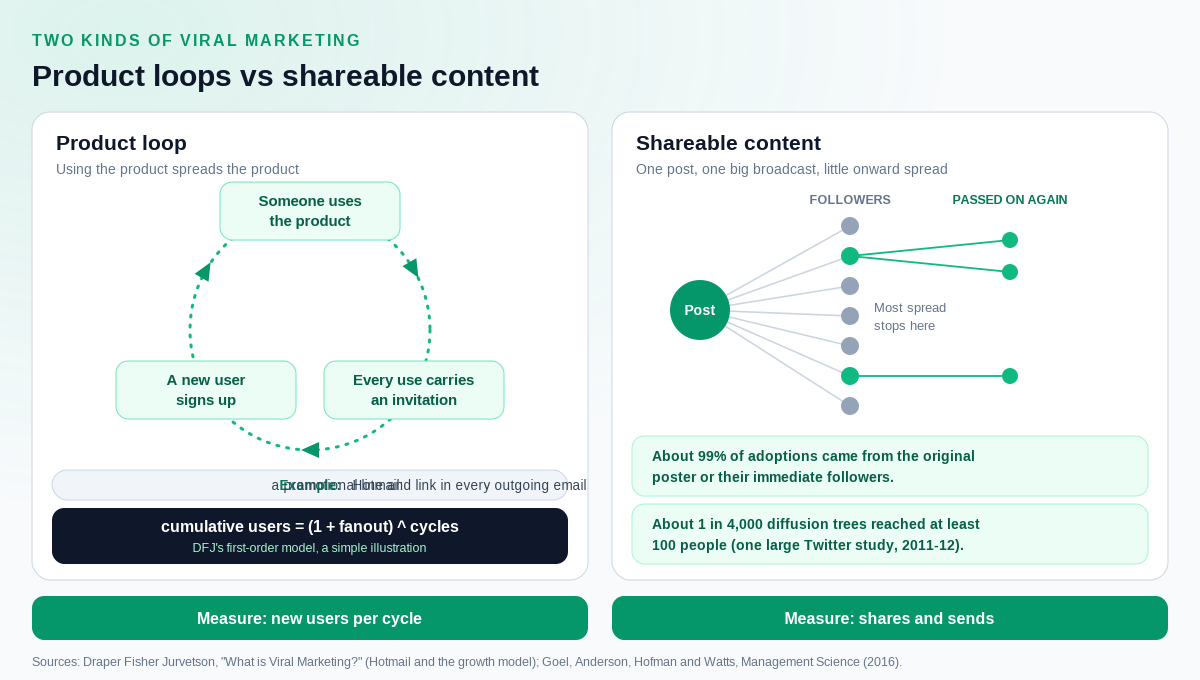
A product loop spreads because using the product invites other people; shareable content spreads mainly when people decide to pass it on.
Product loops. DFJ says Tim Draper persuaded Hotmail to add a promotional line with a clickable link to every email its users sent, and that Hotmail grew from zero to 12 million users in 18 months on an advertising budget of $50,000. Checked against Draper Fisher Jurvetson, 'What is Viral Marketing?' by Steve Jurvetson (Internet Archive capture)Archived copy, 22 April 2002 DFJ invested in Hotmail, so treat that as the investor’s own account. Its essay also gives a “first-order model” for this kind of spread: cumulative users = (1 + fanout) ^ cycles, where cycles is the number of times the product has been used since launch. Checked against Draper Fisher Jurvetson, 'What is Viral Marketing?' by Steve Jurvetson (Internet Archive capture)Archived copy, 22 April 2002 It is an illustration, not a law.
Shareable content. A post reaches its first audience, usually your followers, and goes further when people pass it on. In the Twitter study above, big hits mostly came from one large broadcast, not from long chains of sharing. Checked against Goel, Anderson, Hofman & Watts, 'The Structural Virality of Online Diffusion', Management Science (2016)
Which one fits you:
| Product loop | Shareable content | |
|---|---|---|
| Spreads through | People using the product | People choosing to share a post |
| Fits | Products people use with others: email, invites, shared documents, anything that produces a result worth showing | Brands that publish posts: shops, services, creators, local businesses |
| Example | Hotmail’s line in every email | Dove’s Real Beauty Sketches film |
| What to measure | New users per cycle | Shares, sends and reposts |
Many businesses only have the second option, and most strategies below are about content.
Viral marketing strategies: 9 that brands use
These viral marketing strategies either build sharing into the product (loop) or make a post people want to pass on (content); none of them guarantees reach. For platform playbooks, see how to go viral on TikTok and how to go viral on Instagram.
1. Build sharing into the product (loop)
Make every use of the product carry an invitation. Hotmail did this with a promotional line and link in each email its users sent. Checked against Draper Fisher Jurvetson, 'What is Viral Marketing?' by Steve Jurvetson (Internet Archive capture)Archived copy, 22 April 2002 Modern versions: a share link on a finished result, or an invite to collaborate.
2. Aim for a high-arousal emotion (content)
Plan posts around awe, surprise or real usefulness rather than mild or sad feelings. In Berger and Milkman’s study, content evoking awe, anger or anxiety was shared more, and low-arousal content less. Checked against Berger & Milkman, 'What Makes Online Content Viral?', Journal of Marketing Research 49(2):192-205 (2012) Awe and usefulness are the safer levers for a brand.
3. Give people something that says something about them (content)
People talk about things that make them look good; Berger calls this social currency. Checked against Knowledge at Wharton: 'Contagious': Jonah Berger on Why Things Catch On (13 March 2013)Vendor's own description Spotify Wrapped is the clearest case: Spotify gives users share cards to send through Spotify Messages or post to their own social channels. Checked against Spotify Newsroom: How Our 2025 Wrapped Campaign Turns Your Year in Listening Into a Global CelebrationVendor's own description You can’t copy Wrapped as-is, since it is built from each user’s listening data, but the idea scales down: a personal result or a year in review customers want to show.
4. Make a challenge people can join, safely (content)
A challenge spreads when joining is easy and each person passes it on. The ALS Association says three young men living with ALS took the Ice Bucket Challenge in summer 2014 and inspired over 17 million people to dump ice water on their heads and donate. Checked against The ALS Association: Ice Bucket Challenge (Internet Archive capture)Archived copy, 22 May 2026 It was led by participants, not built by a brand. Keep yours safe: TikTok’s Community Guidelines don’t allow content that promotes dangerous challenges, and content likely to be imitated and cause significant physical harm is removed. Checked against TikTok Community Guidelines: Mental and Behavioral Health (released 25 August 2026, effective 24 September 2026) More on formats in our guide to TikTok challenges.
5. Use the platform’s own remix tools (content)
Let people build on your post with the tools each app provides. A TikTok Duet posts a video side by side with another creator’s Checked against TikTok Help Center: Duets, and a Stitch uses part of someone’s video inside a new one. Others can do either with your video only if your account is public and you allow it. Checked against TikTok Help Center: Stitch Meta tells businesses to use Reels features such as Reels Camera and Remix in the Instagram app to put their spin on trends, or start their own. Checked against Instagram for Business: Captivate new customers with Instagram Ads (Reels section)
6. Open with a hook (content)
Put the payoff or the question in the first seconds. TikTok’s Creator Academy calls the first few seconds the most critical for hooking viewers. Checked against TikTok Creator Academy: Understanding and engaging with your audience YouTube says the opening seconds are when viewers decide to stay or move on, and that the intro should deliver on the title’s promise. Checked against YouTube Help: Understand your content performance for YouTube's recommendation system For openings, try the free hook generator.
7. Make it easy to send (content)
On Instagram, sends matter a little more than likes for reaching people who don’t follow you. Instagram’s head, Adam Mosseri, said likes are slightly more important for reaching followers and sends slightly more important for reaching non-followers. Checked against Adam Mosseri, Head of Instagram (own Instagram account) He said “slightly”, and gave no weights. Ideas that invite a send: a tip one friend needs, a joke about a shared situation, a plan to make together.
8. Work with creators, and disclose it (content)
If you pay or gift creators to post, say so clearly. The FTC says a material connection the audience wouldn’t expect, such as payment or free products, must be disclosed clearly and conspicuously. Checked against eCFR: 16 CFR § 255.5(a) Disclosure of material connections FTC staff say to put the disclosure with the endorsement itself, not only in a bio or behind “more”, and to use plain words like “ad” or “sponsored”. Checked against FTC: Disclosures 101 for Social Media Influencers On TikTok, turn on the content disclosure setting for paid partnerships; TikTok says doing so won’t affect distribution. Checked against TikTok Help Center: Promoting a brand, product, or service
9. Post a native version for each network (content)
Re-make the idea for each app instead of reposting the same file everywhere. Meta tells creators to avoid reels visibly recycled from other apps, with third-party watermarks. Checked against Meta for Creators: Reels Best Practices: Tips & tricks to succeed on Reels TikTok treats videos with someone else’s visible watermark as unoriginal, which may be removed from the For You feed. Checked against TikTok Creator Academy: Understanding TikTok's Originality Policy
Viral marketing examples (and what made them spread)
Four viral marketing examples, from an email footer to a year-end share card, each with the figure the organisation itself reported.
| Campaign | Year | Kind | What spread it | Figure the organisation reported | Source |
|---|---|---|---|---|---|
| Hotmail | 1996 launch | Loop | A promotional line and link in every email users sent | DFJ says: zero to 12 million users in 18 months, on a $50,000 advertising budget | Checked against Draper Fisher Jurvetson, 'What is Viral Marketing?' by Steve Jurvetson (Internet Archive capture)Archived copy, 22 April 2002 Checked against Draper Fisher Jurvetson, 'What is Viral Marketing?' by Steve Jurvetson (Internet Archive capture)Archived copy, 22 April 2002 |
| ALS Ice Bucket Challenge | 2014 | Content (participant-led challenge) | People filming themselves taking the challenge and donating | The ALS Association says: over 17 million people took part, and the challenge raised $115 million for its mission | Checked against The ALS Association: Ice Bucket Challenge (Internet Archive capture)Archived copy, 22 May 2026 |
| Dove Real Beauty Sketches | 2013 | Content (online film) | Shares of the film | Dove said in May 2013, citing Unruly’s chart: more than 114 million views and more than 3,707,407 shares less than a month after launch. Guinness World Records: 124,875,719 views as of 2 November 2013 | Checked against Dove / Unilever Canada release on Newswire.ca, 21 May 2013Vendor's own description Checked against Guinness World Records: Most viewed online video advertisementPress report |
| Spotify Wrapped | 2025 | Content built into the product | Personal share cards users send or post | Spotify says: more than 300 million engaged users and more than 630 million shares on social media | Checked against Spotify Newsroom: How Our 2025 Wrapped Campaign Turns Your Year in Listening Into a Global CelebrationVendor's own description Checked against Spotify Newsroom: Spotify Reports Fourth Quarter 2025 EarningsVendor's own description |
Every figure is the organisation’s own claim, not an audited result. Dove’s May 2013 claim that the film had become “the number one viewed online video ad of all time” held only at that date, and the ALS figure is the Association’s own count.
Why do most viral marketing plans fail?
Because going viral is rare and cannot be guaranteed, and the shortcuts people use to fake it break platform rules. The odds first:
- It is rare. In the 2011-12 Twitter study, only about 1 in 4,000 sharing trees reached 100 people or more. Checked against Goel, Anderson, Hofman & Watts, 'The Structural Virality of Online Diffusion', Management Science 62(1):180-196 (2016)
- There is no finish line. None of the Merriam-Webster, Cambridge, Oxford Learner’s or Dictionary.com definitions sets a number of views or shares that makes something viral. Checked against Merriam-Webster Dictionary, Cambridge Dictionary, Oxford Learner's Dictionaries and Dictionary.com
- There is no timeline. No platform source we read says how long going viral takes or how likely it is. Checked against Absence finding across the platform sources in this ledgerNot verified
- There is no published formula. Platforms describe their ranking signals but don’t publish weights; only X’s open-source code exposes weight parameters. Checked against Absence finding across the platform sources in this ledgerNot verified
Shortcuts that sink a plan:
- Engagement bait. Meta’s guidelines target Facebook posts that explicitly ask for votes, shares, comments, tags or likes, other than for a specific call to action such as finding missing people, raising money or sharing a petition. Checked against Meta Transparency Center: Content Distribution Guidelines, Engagement Bait
- Reposting other people’s work. Meta wants to combat repeated reposting of other creators’ content without permission or meaningful changes. Checked against Meta for Creators blog: Combating unoriginal content (July 2025)
- Buying views, likes or followers. TikTok bans services that artificially boost engagement Checked against TikTok Community Guidelines: Integrity and Authenticity — Deceptive Behaviors and Fake Engagement (effective 24 September 2026), YouTube bans artificially increasing views or likes and may terminate channels Checked against YouTube Help: Fake engagement policy, X bans paying for metric inflation Checked against X Help Center: Authenticity, and Pinterest bans buying or selling engagement. Checked against Pinterest Policy: Community Guidelines (Spam) Instagram began removing inauthentic likes, follows and comments from accounts using third-party apps in 2018. Checked against About Instagram: Reducing Inauthentic Activity on Instagram (19 November 2018)
- Engagement pods and bots. LinkedIn said in March 2026 it is acting against engagement pods and comment automation. Checked against LinkedIn Pressroom: How LinkedIn Is Improving the Feed to Show More Relevant, Authentic Professional Content
- Fake influence. In the US, the FTC’s rule makes it unlawful to buy or sell fake indicators of social media influence, such as followers or views, for a commercial purpose. Checked against eCFR: 16 CFR Part 465 — Rule on the Use of Consumer Reviews and Testimonials, § 465.8
Aim for steady, shareable work and treat a breakout as a bonus; our guide on how to go viral on social media covers what each platform says it rewards.
How do you measure a viral campaign?
Measure content by how often people pass it on, a loop by how many new users each cycle brings, and site visits with tagged links.
- Content: count shares, sends and reposts alongside views, in each network’s own analytics where it reports them.
- Loops: DFJ’s model gives a rough check. Its essay says early Hotmail and ICQ users each brought in about two new users a month. Checked against Draper Fisher Jurvetson, 'What is Viral Marketing?' by Steve Jurvetson (Internet Archive capture)Archived copy, 22 April 2002 As illustrative arithmetic only: a fanout of 2 over 3 cycles gives (1 + 2) ^ 3 = 27 users for each starting user. It is a simplification, not a forecast.
- Site traffic: tag every link you share with UTM parameters. Google Analytics says to always use utm_source, utm_medium and utm_campaign Checked against Google Analytics Help: URL builders: Collect campaign data with custom URLs, and that values are case-sensitive, so keep them lowercase. Checked against Google Analytics Help: URL builders: Collect campaign data with custom URLs Build them with the free UTM generator.
What to do in the first 48 hours after a post takes off
When a post starts to spread, stay in the conversation, check it is accurate, and give your other networks a version of their own. The 48 hours is our suggestion, not a platform rule: no platform publishes a timeline for going viral. Checked against Absence finding across the platform sources in this ledgerNot verified
- Reply to comments. TikTok’s Creator Academy recommends replying with videos, text replies or likes. Checked against TikTok Creator Academy: Understanding and engaging with your audience
- Check the facts in the post, and correct any mistake openly.
- Write follow-ups for your other networks while attention is high, re-made for each one rather than copied.
Draft your follow-up posts with Outfeed AI
Viral marketing FAQ
What is viral marketing?
Marketing in which information about a product spreads from person to person, especially on the internet. Cambridge’s business dictionary defines it that way Checked against Cambridge Business English Dictionary: viral marketing, and Oxford adds that consumers are encouraged to share it, especially on social media. Checked against Oxford Learner's Dictionaries: viral marketing (noun)
What are examples of viral marketing?
Hotmail’s promotional line in every outgoing email after its 1996 launch, the ALS Ice Bucket Challenge in 2014, Dove’s Real Beauty Sketches film in 2013 and Spotify Wrapped. The figures each organisation reported are in the examples table.
Can you guarantee a campaign will go viral?
No. A study of about a billion Twitter diffusion events from 2011 to 2012 found that only about 1 in 4,000 diffusion trees reached 100 people Checked against Goel, Anderson, Hofman & Watts, 'The Structural Virality of Online Diffusion', Management Science 62(1):180-196 (2016), and no platform says how long going viral takes or how likely it is. Checked against Absence finding across the platform sources in this ledgerNot verified
Who coined the term viral marketing?
It is disputed. The venture firm Draper Fisher Jurvetson says it coined the term in a 1997 newsletter about Hotmail Checked against Draper Fisher Jurvetson, 'What is Viral Marketing?' by Steve Jurvetson (Internet Archive capture)Archived copy, 22 April 2002, but Merriam-Webster gives 1989 as the phrase’s first known use. Checked against Merriam-Webster Dictionary
Is buying views or joining engagement pods a viral marketing strategy?
No. TikTok Checked against TikTok Community Guidelines: Integrity and Authenticity — Deceptive Behaviors and Fake Engagement (effective 24 September 2026), YouTube Checked against YouTube Help: Fake engagement policy, X Checked against X Help Center: Authenticity and Pinterest Checked against Pinterest Policy: Community Guidelines (Spam) ban fake or bought engagement, Instagram removes inauthentic likes and follows Checked against About Instagram: Reducing Inauthentic Activity on Instagram (19 November 2018), LinkedIn said in March 2026 it is acting against engagement pods Checked against LinkedIn Pressroom: How LinkedIn Is Improving the Feed to Show More Relevant, Authentic Professional Content, and the FTC’s rule on reviews and testimonials makes it unlawful to buy or sell fake indicators of social media influence for a commercial purpose. Checked against eCFR: 16 CFR Part 465 — Rule on the Use of Consumer Reviews and Testimonials, § 465.8