
Reach vs Impressions (and Views): What's the Difference?
Reach vs impressions comes down to people versus times. Reach counts the unique people (or accounts) who saw your content at least once; impressions count every time it was displayed, so one person who saw a post three times adds one to reach and three to impressions. Checked against MASB Universal Marketing Dictionary: Reach Checked against MASB Universal Marketing Dictionary: Impression (Internet)
The labels have moved since most guides were written. Meta now reports Views on Facebook and Instagram, Instagram adds Viewers, YouTube’s impressions are thumbnail impressions, and LinkedIn says Members reached. This page gives each network’s current wording from its own help pages. For where these numbers sit in a wider plan, see our social media marketing guide.
Table of Contents
- Reach vs impressions: what’s the difference?
- What are impressions on social media?
- What is reach on social media?
- How do reach, impressions and frequency fit together?
- Views vs impressions: what changed on Meta, YouTube and X?
- How does each platform define reach and impressions?
- How do you increase reach and impressions?
- Which should you track: reach, impressions or views?
- Reach vs impressions FAQ
Reach vs impressions: what’s the difference?
Reach is a count of people; impressions are a count of displays. MASB’s Universal Marketing Dictionary defines reach as the individuals who receive at least one exposure, also called the unduplicated audience, and an impression as a single display of online content to a user’s web-enabled device. Checked against MASB Universal Marketing Dictionary: Reach Checked against MASB Universal Marketing Dictionary: Impression (Internet)
That is the whole difference between reach and impressions: repeats. Impressions vs reach side by side:
| Reach | Impressions | |
|---|---|---|
| What it counts | Unique people or accounts who saw it at least once | Every time it was displayed |
| Repeat views | Counted once | Each one counted |
| Labels you will see | Reach, Viewers, Members reached, Total audience, Unique viewers | Impressions, Views (on Meta) |
| Best for | How many people you got in front of | How often they saw it |
Checked against MASB Universal Marketing Dictionary: Reach.
Checked against MASB Universal Marketing Dictionary: Impression (Internet).
What are impressions on social media?
Social media impressions are the number of times your content was on screen. Every display counts, including repeats to the same person, and a click is not needed. MASB counts each ad display as one impression whether or not it is clicked, and notes the industry’s move from served to viewable impressions. Checked against MASB Universal Marketing Dictionary: Impression (Internet)
Each network words it slightly differently:
- Meta ads: impressions are the times your ads were on screen. Meta counts an ad’s first time on screen per instance, so scrolling away and back is one impression, but on screen twice in a day is two. A video does not have to start playing, and invalid traffic such as bots is excluded. Checked against Meta Business Help Center: Impressions
- LinkedIn: the number of times your post was displayed on screen, which LinkedIn says is an estimate and may not be precise. Checked against LinkedIn Help: Combined post analytics
- Pinterest: the number of times your Pins or ads were on screen. Checked against Pinterest Help: Pinterest Analytics
On Meta, ads are usually bought on impressions: Meta says advertisers are usually charged for the impressions an ad receives unless another charge is chosen at creation Checked against Meta Business Help Center: How Meta charges for ads, and it calculates CPM as amount spent divided by impressions, multiplied by 1,000. Checked against Meta Business Help Center: CPM (Cost per 1,000 Impressions)
For the platform details, see impressions on Instagram and impressions on X.
What is reach on social media?
Reach is the number of unique people or accounts that saw your content at least once. However many times someone sees a post, they count once. Checked against MASB Universal Marketing Dictionary: Reach
Three things to know before you compare reach numbers:
- It is often an estimate. Meta defines ad reach as the Meta Accounts that saw your ads at least once, estimated from sampled data. Checked against Meta Business Help Center: Reach TikTok says the same of its ad reach: it is estimated through sampling, is not additive across ad groups or demographic breakdowns, and should not be compared directly with third-party audience reporting. Checked against TikTok Business Help Center: About the reach metric (last updated November 2024)
- Organic and paid reach overlap. Facebook’s Help Center defines post reach as people who saw any of your posts at least once, split into organic (an unpaid post entered their screen) and paid. The two won’t always add up to post reach, because one person can be counted in both. Checked against Facebook Help Center: About organic, paid and post reach on Facebook
- “Unique” means different things. LinkedIn’s Members reached counts distinct members and Pages who viewed your post, without repeat views. Checked against LinkedIn Help: Combined post analytics; Recent changes to viewers demographics YouTube’s unique reach estimates the individual people who saw your video or channel, so three people watching together on one TV count as one view but add three to unique reach. Checked against YouTube Help: Understand your YouTube content performance
How do reach, impressions and frequency fit together?
Frequency links them: frequency is impressions divided by reach, so impressions equal reach multiplied by frequency. MASB defines frequency as the average number of exposures received by the people who were reached. Checked against MASB Universal Marketing Dictionary: Frequency
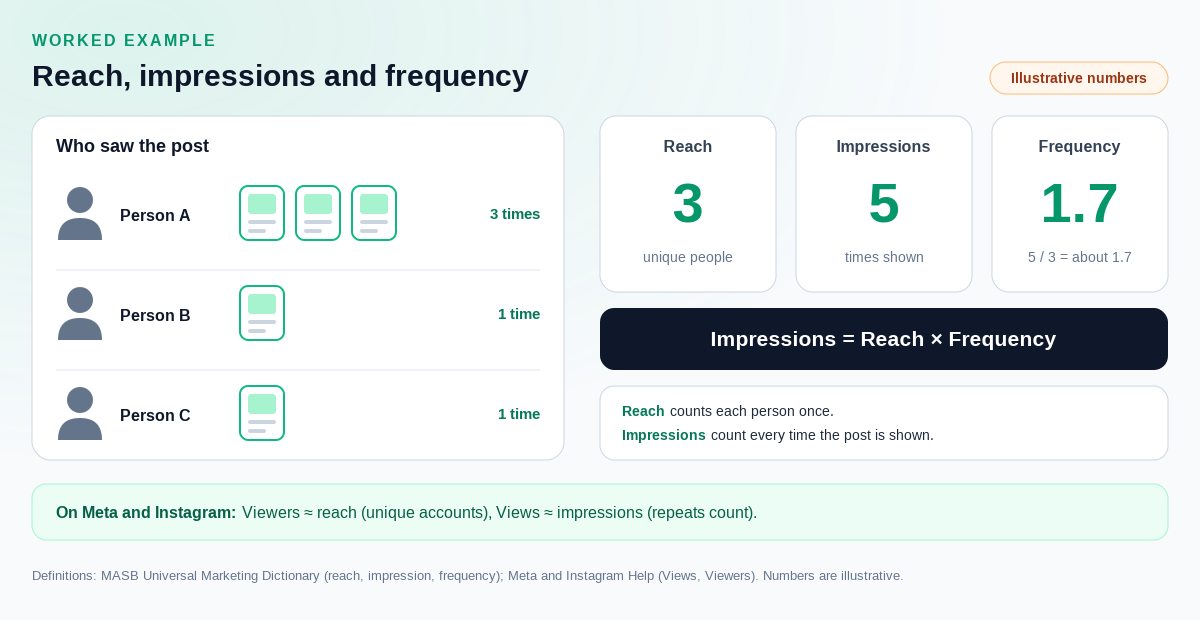
A worked example with illustrative numbers:
- Person A sees your post three times; persons B and C see it once each.
- Reach is 3, because three different people saw it.
- Impressions are 5, because it was displayed five times.
- Frequency is 5 divided by 3, or about 1.7.
Because everyone counted in reach saw the post at least once, impressions can’t be lower than reach when both count the same thing. TikTok’s ad reporting uses the same model: reach is unique accounts exposed at least once, impressions count every exposure, and frequency is the average number of times an account was exposed. Checked against TikTok Business Help Center: About the reach metric (last updated November 2024)
Views vs impressions: what changed on Meta, YouTube and X?
On Facebook and Instagram, Views now do the job impressions did: they count every display, repeats included. On YouTube the two are separate metrics, and on X the public number is a view count. The details by network:
Meta: Views replace impressions
Meta said on 14 November 2024 that Views would be the single distribution metric for all content types, calculated the same way across Facebook and Instagram, and that for Stories, photo and text posts, Views replace Impressions. Checked against Meta for Creators: Introducing Views to simplify content distribution metrics (14 Nov 2024) On reels and videos, Plays were renamed Views with no change to how they are calculated. Checked against Meta for Creators: Introducing Views to simplify content distribution metrics (14 Nov 2024)
Views can run higher than old impression counts. Meta’s example: one person viewing a photo three separate times in a day counts as three views instead of one impression. Checked against Meta for Creators: Introducing Views to simplify content distribution metrics (14 Nov 2024)
Instagram’s Help Center defines Views as the times your content was played or displayed, and Viewers as the unique accounts that saw it on screen at least once; it says Views is still being gradually introduced. Checked against Instagram Help Center: About Instagram insights For reels, Viewers counts accounts that saw the reel on screen whether or not it played. Checked against Instagram Help Center: About Instagram insights
The developer side followed:
- Instagram’s API added views and deprecated impressions, applying to all API versions from 21 April 2025. Checked against Meta for Developers: Instagram Platform changelog (21 January 2025 entry)
- Facebook’s Page Insights API deprecated impressions, replaced by views, from 15 November 2025. Checked against Meta for Developers blog: Page Insights API Updates (15 Aug 2025)
- Meta said in February 2026 it planned to deprecate legacy Post and Page reach metrics in June 2026, calling them no longer surfaced in its Insights tools, with a Viewers metric replacing legacy reach; we could not confirm in Meta’s changelog that the removal happened. Checked against Meta for Developers blog: Introducing Graph API v25.0 and Marketing API v25.0 (18 Feb 2026)
YouTube: impressions are thumbnails
A YouTube impression is a thumbnail shown on YouTube for more than 1 second with at least 50% of it visible. Thumbnails on external sites, the mobile website, YouTube Kids, YouTube Music, cards, end screens and notifications don’t count. Checked against YouTube Help: Check your YouTube thumbnail impressions and watch time From 24 August 2026, YouTube counts a view from the first frame on every format and calls the old definition an “engaged view”. Checked against YouTube Official Blog: What are 'Engaged' Views on YouTube? (19 Aug 2026)
So a video can have more views than impressions when much of its traffic comes from outside YouTube. Checked against YouTube Help: Impressions & click-through-rate FAQs More in our guide to YouTube impressions.
X: views are public, impressions sit in analytics
X’s view count is the total number of times a post has been viewed. Checked against X Help Center: View countsArchived copy, 1 October 2026 View the archived copy Any logged-in person counts, follower or not; repeat views count, your own views count, and embedded posts don’t add views. Checked against X Help Center: View countsArchived copy, 1 October 2026 View the archived copy
TikTok ads: video views are plays
TikTok Ads Manager counts a video view each time an ad video starts to play, excluding replays, and reports 2-second and 6-second views separately. Checked against TikTok Ads Manager Help: Video play metrics
How does each platform define reach and impressions?
Every network has its own name for the unique count and the total count. Read the label before you compare two networks.
| Network | Unique count (reach) | Total count | Where to see it |
|---|---|---|---|
| Viewers | Views | Insights | |
| Viewers (Meta’s planned replacement for legacy reach) | Views | Insights | |
| TikTok | Unique and returning viewers (organic); Reach (ads) | Impressions, video views (ads) | Analytics; Ads Manager |
| YouTube | Unique viewers, unique reach | Impressions (thumbnails); views | YouTube Studio Analytics (Insights on desktop) |
| Members reached | Impressions | Me > Posts & Activity > View analytics | |
| X | — | Views (public); impressions | Post Activity Dashboard |
| Total audience | Impressions | Pinterest Analytics (business account) | |
| Threads | Viewers | Views | Insights on threads.com |
| Bluesky | — | — | No built-in analytics documented |
Checked against Instagram Help Center: About Instagram insights.
Checked against Meta for Developers blog: Introducing Graph API v25.0 and Marketing API v25.0 (18 Feb 2026).
Checked against TikTok Creator Academy: Analytics introduction.
Checked against TikTok Business Help Center: About the reach metric (last updated November 2024).
Checked against YouTube Help: Understand your YouTube content performance.
Checked against YouTube Help: Analytics in YouTube Studio.
Checked against LinkedIn Help: View post analytics for your content.
Checked against X Business: Post and Video Activity Dashboards.
Checked against Pinterest Help: Pinterest Analytics.
Checked against Pinterest Help Center (Business): Review Pinterest Analytics.
Checked against Instagram Help Center: View insights on Threads.
Checked against GitHub: bluesky-social/social-app issue #7387 (read via the GitHub REST API).Not verified
A few notes the table can’t hold:
- TikTok: the Creator Academy says the Analytics Viewers page shows unique and returning viewers. Checked against TikTok Creator Academy: Analytics introduction
- LinkedIn splits impressions into In network (members who follow or are connected to you) and Out of network, as percentages. Checked against LinkedIn Help: Combined post analytics More on LinkedIn impressions.
- X keeps per-post impressions in the free Post Activity Dashboard at analytics.x.com, defaulting to the last 28 days. Checked against X Business: Post and Video Activity Dashboards
- Pinterest counts a video view at 2 seconds with 50% of the video in view. Checked against Pinterest Help: Pinterest Analytics
- Threads post insights also split follower and non-follower views. Checked against Instagram Help Center: View insights on Threads
- Bluesky doesn’t document a built-in analytics dashboard or view counts; a request for view counts is open on its app repository. Checked against GitHub: bluesky-social/social-app issue #7387 (read via the GitHub REST API)Not verified
How do you increase reach and impressions?
Give each network what it says it ranks on, stay eligible for recommendation, and post when your own followers are active; no network promises a set amount of reach. Four levers, each tied to what the platform itself has published:
- Make posts people send. Instagram’s head, Adam Mosseri, said likes are slightly more important for reaching followers and sends slightly more important for reaching people who don’t follow you. Checked against Adam Mosseri, Head of Instagram (own Instagram account)
- Hook viewers early. TikTok’s Creator Academy calls the first few seconds the most critical for hooking viewers. Checked against TikTok Creator Academy: Understanding and engaging with your audience
- Stay recommendable. On Instagram, a professional account can check Account Status to see whether its content may be recommended to non-followers; if it isn’t eligible, none of its content is, though followers still see it. Checked against Instagram Help Center: Recommendation eligibility on Instagram Meta also tells creators to avoid reels visibly recycled from other apps. Checked against Meta for Creators: Reels Best Practices: Tips & tricks to succeed on Reels
- Post when your followers are online. Instagram’s Total followers insights include most active times once you have at least 100 followers. Checked against Instagram Help Center: About Instagram insights (Viewers, Accounts engaged, Total followers) Our guide to the best time to post on Instagram shows how to read them.
For how each feed ranks posts, see social media algorithms; for what it takes for a post to spread well past your followers, see how to go viral.
Which should you track: reach, impressions or views?
Track the one that matches your goal. Our suggestion: reach (or Viewers) for awareness, impressions and frequency when repeat exposure matters, and views alongside watch time for video performance.
- Awareness: reach, Viewers or Members reached, because the question is how many different people you got in front of.
- Recall and ad frequency: impressions and frequency, to see whether the same people are seeing you too often or not enough.
- Content performance: views on Meta, X and YouTube, read alongside watch time, since a view on its own says little about attention.
Is there a good number? We found no official Instagram or Meta benchmark for a good number of views, impressions or viewers, or a typical reach rate. Checked against Instagram Help Center: About Instagram insightsNot verified Compare a post with your own recent posts over the same timeframe instead.
Reach also tells you how many people saw a post, not who they were; for that, see audience demographics. For which numbers belong in a report, see social media KPIs, and for where reach sits in the journey from awareness to purchase, the social media marketing funnel.
Plan and schedule your posts with Outfeed AI
Reach vs impressions FAQ
Which is better, reach or impressions?
Neither. Reach tells you how many different people saw a post, and impressions tell you how many times it was shown. Checked against MASB Universal Marketing Dictionary: Reach Checked against MASB Universal Marketing Dictionary: Impression (Internet) Use reach for awareness goals, and impressions with frequency when repeat exposure matters.
Can impressions be lower than reach?
Not when both count the same thing: impressions equal reach multiplied by frequency, and everyone counted in reach saw the content at least once. Checked against MASB Universal Marketing Dictionary: Frequency YouTube numbers can look odd for a different reason: its impressions count only thumbnails shown on YouTube, so a video with a lot of outside traffic can have more views than impressions. Checked against YouTube Help: Impressions & click-through-rate FAQs
How do you calculate frequency from reach and impressions?
Divide impressions by reach. Checked against MASB Universal Marketing Dictionary: Frequency If 3 people saw a post 5 times in total (an illustrative example), the frequency is 5 divided by 3, or about 1.7.
When did Instagram replace impressions with views?
Meta said in November 2024 that Views would replace Impressions for Stories, photo and text posts Checked against Meta for Creators: Introducing Views to simplify content distribution metrics (14 Nov 2024), and it deprecated impressions in the Instagram API from 21 April 2025. Checked against Meta for Developers: Instagram Platform changelog (21 January 2025 entry) Instagram’s Help Center now defines Views and Viewers instead. Checked against Instagram Help Center: About Instagram insights
Is a view the same as an impression?
Not always. On Facebook and Instagram, Views count every time content is played or on screen, repeats included, so they work like impressions. Checked against Meta for Creators: Introducing Views to simplify content distribution metrics (14 Nov 2024) On YouTube, an impression is a thumbnail shown on YouTube and a view is counted separately. Checked against YouTube Help: Check your YouTube thumbnail impressions and watch time