
Social Media Marketing Funnel: Content for Every Stage
A social media marketing funnel is the path from someone first seeing your brand on social media to buying from you and coming back, split into stages so each post has one job. This guide uses four stages: awareness, consideration, conversion and loyalty. For each one you pick the formats, the call to action and the number that tells you it worked.
This guide is the organic version for small teams: a stage-by-network matrix, the model’s real history, an Instagram and Facebook sales funnel, and a UTM scheme so each stage shows up in Google Analytics. It is part of our social media marketing hub.
Table of Contents
- What is a social media marketing funnel?
- Where did the marketing funnel come from?
- Awareness: which posts reach new people?
- Consideration: which posts build trust?
- Conversion: which posts and links drive action?
- Loyalty and advocacy: which posts keep customers?
- Which formats fit each funnel stage on each network?
- How to build an Instagram or Facebook sales funnel
- How do you track a social media funnel?
- Plan a week of funnel posts with Outfeed
- Social media funnel FAQ
What is a social media marketing funnel?
It is the business funnel applied to social media: the stages a customer moves through from first hearing of you to buying, with fewer people left at each stage. Cambridge Dictionary defines a funnel in business, also called a conversion, marketing or sales funnel, as the process a customer goes through from first hearing about a product, for example through a search or an ad, to buying it, with a smaller number of customers at each stage. Checked against Cambridge Dictionary: funnel (noun, BUSINESS) A social media funnel or social media sales funnel means the same thing: your posts doing that work.
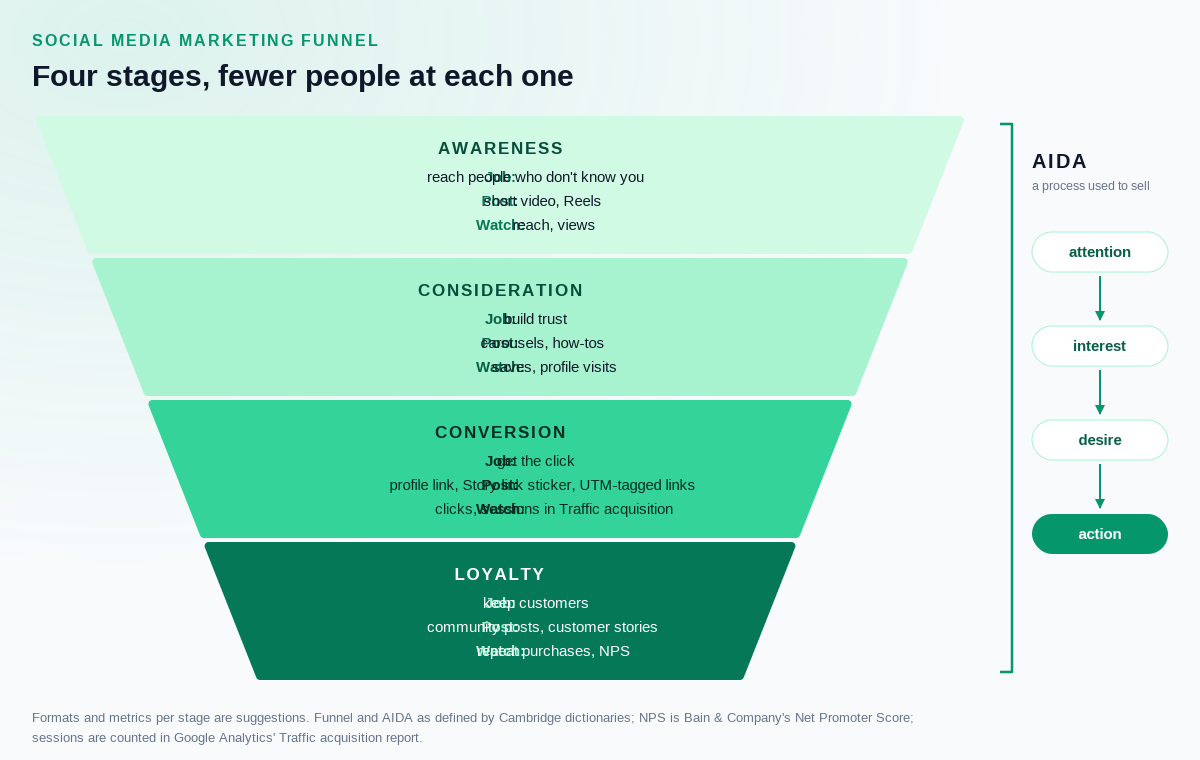
Fewer people remain at each stage, so post more at the top than at the bottom, and give each stage its own measure of success.
Where did the marketing funnel come from?
Its stages echo AIDA, a sales formula more than a century old: attention, interest, desire, action. The Cambridge Business English Dictionary defines AIDA as the process of getting a customer’s attention, making them interested, making them want the product and then making them buy it. Checked against Cambridge Business English Dictionary: AIDA
In “Theories of Selling” (1925), psychologist Edward K. Strong Jr. wrote that E. St. Elmo Lewis formulated the slogan “Attract attention, maintain interest, create desire” in 1898 and later added a fourth term, “get action”. Checked against Strong, E. K. Jr., 'Theories of Selling', Journal of Applied Psychology 9(1):75-86 (1925), Internet Archive scanArchived copy, 28 July 2021 Strong adds that A. F. Sheldon was apparently responsible for a fifth step, “secure satisfaction”, listed in his 1911 Art of Selling: the loyalty stage is older than it looks. Checked against Strong, E. K. Jr., 'Theories of Selling', Journal of Applied Psychology 9(1):75-86 (1925), Internet Archive scanArchived copy, 28 July 2021 We found no text printed by Lewis himself with the 1898 slogan, so the credit rests on Strong’s account. Checked against Search of Internet Archive and Crossref (no Lewis original found)Not verified
A later model, by Robert Lavidge and Gary Steiner in the Journal of Marketing (1961), described advertising as moving people up steps from unaware to aware, knowledge, liking, preference, conviction and purchase. Checked against Lavidge, R. J. & Steiner, G. A., Journal of Marketing 25(6):59-62 (1961), Internet Archive scanArchived copy, 26 July 2021 They grouped the steps into information, favourable attitudes and action, which in our reading maps onto today’s top, middle and bottom of the funnel. Checked against Lavidge, R. J. & Steiner, G. A., Journal of Marketing 25(6):59-62 (1961), Internet Archive scanArchived copy, 26 July 2021
Funnel or flywheel? HubSpot offers its flywheel (attract, engage, delight) as an alternative to the linear funnel, with happy customers driving referrals and repeat sales. Checked against HubSpot: The FlywheelVendor's own description That is one vendor’s framework; the loyalty stage below gives the funnel the same loop.
Awareness: which posts reach new people?
Awareness posts are built to be shown to people who don’t follow you yet: short video, Reels and posts that make sense to a stranger. Meta for Business frames the first Instagram goal in the customer journey as growing awareness, and suggests posts, Stories and Reels for it. Checked against Meta for Business: Instagram (Captivate new customers with Instagram Ads) On TikTok, the company said in 2020 that follower count is not a direct factor in its recommendation system, though accounts with more followers are likely to get more views. Checked against TikTok Newsroom: How TikTok recommends videos #ForYou (18 June 2020)
- Job: get seen by the right strangers.
- Formats: short vertical video, Reels, a single strong image.
- Call to action: none, or a soft one (“follow for part two”).
- Metric: reach or views; reach vs impressions explains which network counts what.
Consideration: which posts build trust?
Consideration posts answer the questions a possible customer has before deciding: how it works, who it is for, and whether you know your subject.
- Job: turn a viewer into a follower who trusts you.
- Formats: carousels (an Instagram carousel can hold up to 20 photos and videos Checked against Instagram Help Center: Share a post with multiple photos or videos on Instagram), how-tos, comparison posts, LinkedIn posts that explain your thinking.
- Call to action: “save this for later”, “read the full guide”.
- Metric: saves, shares and profile visits.
For format ideas you can adapt, see Instagram post ideas.
Conversion: which posts and links drive action?
Conversion posts ask for one action and give a link that works on that network. On Instagram, the documented place for clickable links outside Stories is your profile, which takes up to 5 websites. Checked against Instagram Help Center: Add a website to your Instagram profile In Stories, the Link sticker lets anyone who can see the story tap through to a URL. Checked against Instagram Help Center: Using stickers on Instagram (Link) + About Instagram link-sticker announcement Since October 2021 every account can use it, except new accounts and accounts that repeatedly break the Community Guidelines. Checked against About Instagram: Share Links in Instagram Stories to Everyone (2021-10-27) TikTok lists a profile website link among the features of Verified Business Accounts. Checked against TikTok Help Center: Account types on TikTok — Verified Business Accounts
The paid layer sits here too: Meta Ads Manager has six campaign objectives: Awareness, Traffic, Engagement, Leads, App promotion and Sales. Checked against Meta Business Help Center: How to choose an ad objective in Meta Ads Manager On LinkedIn, Lead Gen Forms pre-fill a member’s contact details when they click an ad’s call to action and cost nothing beyond the ad spend. Checked against LinkedIn Help (Marketing Solutions): Lead Gen Forms The wider picture is in social media advertising.
A call to action that asks for a click or a purchase is not engagement bait. Meta defines engagement bait on Facebook as posts that explicitly ask for votes, shares, comments, tags, likes or other reactions, with exceptions such as finding missing people, raising money or sharing a petition. Checked against Meta Transparency Center: Content Distribution Guidelines, Engagement Bait “Shop the range at the link in our profile” asks for none of those; “comment YES for the price” does. For wording that gets the click honestly, see power words for calls to action.
- Metric: link clicks on the network, then sessions and sales in your own analytics.
Loyalty and advocacy: which posts keep customers?
Loyalty posts give existing customers a reason to come back and to tell others. MASB’s marketing dictionary, citing the AMA, defines brand loyalty as the degree to which a consumer consistently buys the same brand within a product class. Checked against MASB Universal Marketing Dictionary: Brand Loyalty
- Formats: community questions, customer stories shared with permission, tips for getting more from what they bought.
- Call to action: “share how you use it”, “reply with your question”.
- Metric: repeat purchases, and a Net Promoter Score if you survey customers. Bain’s Net Promoter System asks how likely someone is to recommend you on a 0 to 10 scale; the score is the percentage of promoters (9 or 10) minus the percentage of detractors (0 to 6). Checked against Net Promoter System (Bain & Company): Measuring Your Net Promoter ScoreVendor's own description
Loyal customers also meet you by email, in store and on your site; omnichannel marketing keeps those in step.
Which formats fit each funnel stage on each network?
Use each network for the stage it does best; no network has to cover all four. The matrix is our suggestion and names formats only. Meta, TikTok and YouTube publish no comparison of reach by format that we could find, so treat it as a starting point to test, not a ranking. Checked against Absence finding (Instagram ranking explainer, Meta system cards, YouTube and TikTok sources in this ledger)Not verified
| Network | Awareness | Consideration | Conversion | Loyalty |
|---|---|---|---|---|
| Reels | Carousels | Profile links, Story link sticker | Customer stories, replies to comments | |
| TikTok | Short videos | How-to series | Profile website link (Verified Business Accounts) | Behind-the-scenes, answers to comments |
| YouTube | Shorts | Tutorials and reviews | Links in the description | Videos answering customer questions |
| Reels, Page posts | How-to posts, events | Link posts, Shops | Groups and Page community posts | |
| Posts from founders and staff | Explainer posts | Link posts, Lead Gen Forms (ads) | Customer stories | |
| X | Short posts | Threads of tips | Posts with a link | Replies to customers |
| Threads | Short posts | Longer tip posts | Posts with a link | Replies to customers |
| Image Pins | Boards of ideas | Pins with a destination link | Boards for existing customers | |
| Bluesky | Short posts | Threads of tips | Posts with a link | Replies to customers |
How to build an Instagram or Facebook sales funnel
An Instagram sales funnel, like a Facebook sales funnel, follows the three goals Meta sets out for Instagram: grow awareness, get new customers, then build relationships. Meta for Business frames Instagram goals across the customer journey that way, with clicks to your website or visits to your location as the “new customers” step and subscriptions, appointments and questions through Instagram Direct as the relationship step. Checked against Meta for Business: Instagram (Captivate new customers with Instagram Ads)
| Step | What to do on Instagram or Facebook |
|---|---|
| 1. Set up | Use an Instagram Business account, which Instagram says unlocks in-app ad creation, shopping tools, contact information on the profile and DMs for customer conversations Checked against Instagram for Business: Instagram Business account (getting started) |
| 2. Awareness | Post Reels and feed posts made for people who don’t follow you yet |
| 3. Consideration | Post carousels and how-tos that answer buying questions |
| 4. Conversion | Point to your profile links or a Story link sticker; if you sell products, a Shop lists them across Facebook and Instagram Checked against Meta Business Help Center: About Shops on Facebook and Instagram, and since September 2025 every Shop sends buyers to your website to check out Checked against Meta Business Help Center: About changes to Shops and checkout on Facebook and Instagram |
| 5. Paid boost | Boost a post that already works: open it, tap Boost, then set the goal, audience, budget and duration Checked against Instagram Help Center: Boost a post on Instagram |
Steps 2 and 3 are our suggestion; the others restate Meta’s pages. For more control than a boost, an Ads Manager campaign uses one of the six objectives above. Checked against Meta Business Help Center: How to choose an ad objective in Meta Ads Manager
How do you track a social media funnel?
Read on-platform stages (reach, saves, profile visits) in each network’s own analytics, and tag every link with UTM parameters so the bottom of the funnel shows up in Google Analytics. Google says to always use utm_source, utm_medium and utm_campaign when you add parameters to a URL. Checked against Google Analytics Help: URL builders: Collect campaign data with custom URLs UTM values are case-sensitive, so Google recommends lowercase, one consistent utm_source per platform and one utm_medium per channel; missing parameters show as “(not set)”. Checked against Google Analytics Help: URL builders: Collect campaign data with custom URLs
A naming scheme that puts the stage in utm_content (example):
| Stage | utm_source | utm_medium | utm_campaign | utm_content |
|---|---|---|---|---|
| Awareness | social | spring-launch | awareness-reel | |
| Consideration | social | spring-launch | consideration-carousel | |
| Conversion | social | spring-launch | conversion-story-link | |
| Loyalty | social | spring-launch | loyalty-customer-story |
A tagged link then looks like https://example.com/spring?utm_source=instagram&utm_medium=social&utm_campaign=spring-launch&utm_content=conversion-story-link. Build them with our free UTM builder to keep the spelling consistent.
Google Analytics shows the results in Reports > Acquisition > Traffic acquisition, where Session campaign and Session source / medium show which campaign brought each session. Checked against Google Analytics Help: [GA4] Traffic acquisition report
Plan a week of funnel posts with Outfeed
A funnel only works if every stage gets posts every week, so plan the week as a set: two awareness, two consideration, one conversion and one loyalty post (our suggestion).
If that matches how you want to run your funnel, plan your first week of posts in Outfeed AI.
Social media funnel FAQ
What are the stages of a social media marketing funnel?
This guide uses four: awareness, consideration, conversion and loyalty, with advocacy as part of loyalty. They echo the older AIDA model of attention, interest, desire and action. Checked against Cambridge Business English Dictionary: AIDA
How do you build a social media sales funnel?
Decide what each stage should do, pick a format for it on each network, give every post one call to action, and tag every link with UTM parameters so you can see in Google Analytics which stage brought the visit. Checked against Google Analytics Help: [GA4] Traffic acquisition report
What content works at each stage of the funnel?
Short video and Reels to reach new people, carousels and how-to posts to build trust, link posts and profile links to drive action, and community posts and customer stories to keep customers coming back. The matrix above breaks it down by network.
How do you track a social media funnel?
Use each network’s own analytics for reach and engagement, and UTM-tagged links for visits and sales on your site. Google Analytics shows tagged visits in its Traffic acquisition report. Checked against Google Analytics Help: [GA4] Traffic acquisition report
Who invented the AIDA model?
The earliest source we could read, a 1925 article by Edward K. Strong, credits E. St. Elmo Lewis: it says Lewis formulated “attract attention, maintain interest, create desire” in 1898 and later added “get action”. Checked against Strong, E. K. Jr., 'Theories of Selling', Journal of Applied Psychology 9(1):75-86 (1925), Internet Archive scanArchived copy, 28 July 2021 We found no text printed by Lewis himself. Checked against Search of Internet Archive and Crossref (no Lewis original found)Not verified