
Marketing Mix Meaning: The 4 Ps and 7 Ps Explained
Marketing mix meaning, in one sentence: the set of choices a business controls when it sells something, usually summed up as the 4 Ps of product, price, place and promotion. This page gives the definition from three references, the 7 Ps for services, where the idea came from, and how each P works on social media. On social media, the mix becomes the choices in our social media marketing playbook for small businesses; for two of the Ps in practice, see our guides to social commerce and organic vs paid social.
Table of Contents
- What is the marketing mix? Meaning in simple words
- The 4 Ps of the marketing mix
- The 7 Ps of marketing for services
- Who created the 4 Ps?
- The marketing mix on social media
- Marketing mix example (illustrative)
- Is the marketing mix still useful?
- Marketing mix FAQ
What is the marketing mix? Meaning in simple words
In simple words, the marketing mix is the combination of decisions a company makes about what it sells, what it charges, where it sells and how it tells people. Three references describe it the same way:
- Cambridge Business English Dictionary: the combination of actions a company uses when selling a product or service, often described as the four Ps: product, price, place and promotion. Checked against Cambridge Business English Dictionary
- Oxford Learner’s Dictionaries: the combination of a product’s features, its price, the way it is advertised and where it is sold, each of which a company can change to persuade people to buy it. Checked against Oxford Advanced Learner's Dictionary
- MASB’s Universal Marketing Dictionary: the combination of controllable marketing variables a firm uses to pursue the desired level of sales in its target market, most often grouped as the 4 Ps, with place also called distribution. Checked against MASB Universal Marketing Dictionary: Marketing Mix
The word that matters is “controllable”: the mix is what you decide, not the market around you. It sits inside marketing as a whole, which the American Marketing Association defines as the activity, set of institutions and processes for creating, communicating, delivering and exchanging offerings that have value for customers, clients, partners and society at large. Checked against American Marketing Association: Definitions of Marketing
The 4 Ps of the marketing mix
The 4 Ps are product, price, place and promotion: in Cambridge’s words, the idea that to succeed you need the right product, sold at the right price, in the right places, with the right advertising and support. Checked against Cambridge Business English Dictionary
- Product: what you sell, including its features, quality and the service around it. A bakery decides whether to sell whole cakes, slices or both.
- Price: what customers pay, including discounts and payment terms. The same bakery sets one price for a slice and a lower one per slice for a whole cake.
- Place: where and how people can buy it, also called distribution: a shop, a website, a marketplace or a social platform. The bakery sells at its counter and takes cake orders online.
- Promotion: how people hear about it: posts, ads, email, events and word of mouth. The bakery posts the day’s bakes every morning.
“Right” always means right for someone, so define your target audience before you set any of the four.
The 7 Ps of marketing for services
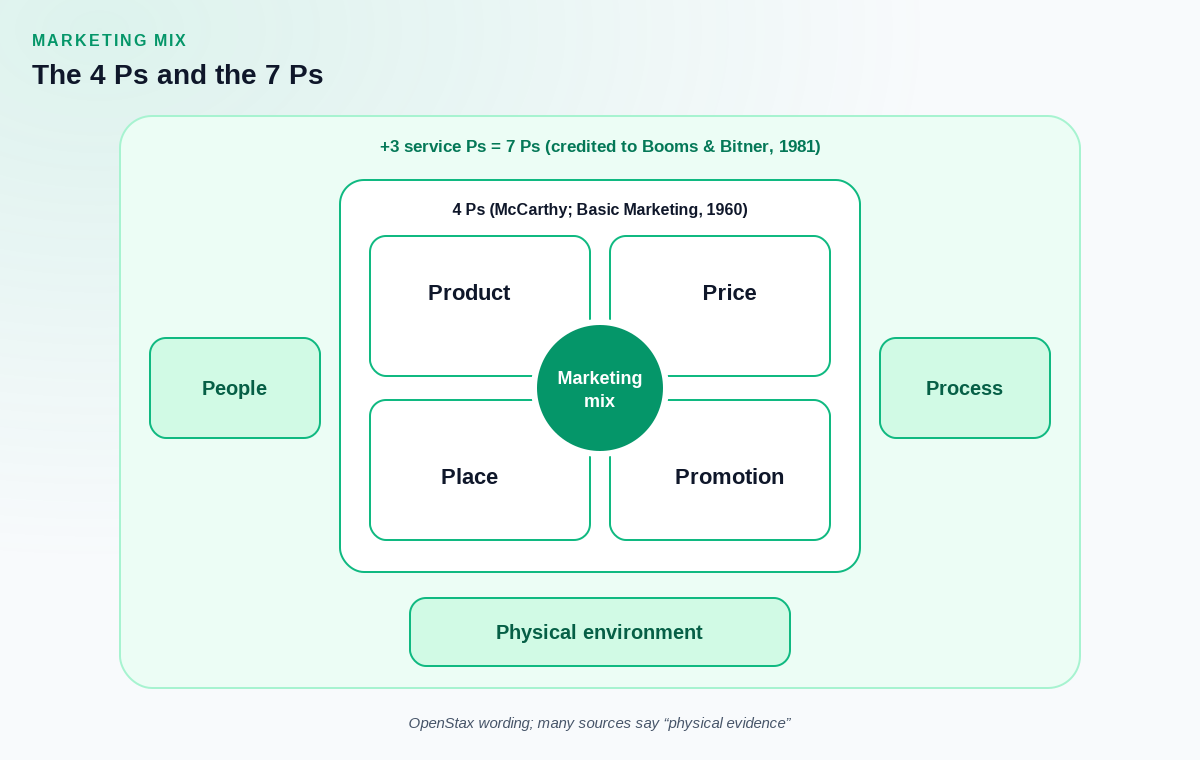
The 7 Ps keep the 4 Ps and add three that matter more for services; Rice University’s OpenStax textbook names them physical environment, process and people. OpenStax says the first four (product, pricing, promotion and place) relate more to products and the other three relate more to services. Checked against OpenStax (Rice University), Entrepreneurship, 8.1 Entrepreneurial Marketing and the Marketing Mix
- People: the staff who deliver the service and how they deal with customers.
- Process: the steps a customer goes through, from booking or ordering to paying.
- Physical environment (often called physical evidence): the place and the tangible cues around the service, such as the room, the signs and the receipts.
The 7 Ps mix for services is credited to Booms and Bitner (1981) in Rafiq and Ahmed’s 1995 survey paper. Checked against Rafiq, M. and Ahmed, P.K. (1995) 'Using the 7Ps as a generic marketing mix: an exploratory survey of UK and European marketing academics', Marketing Intelligence & Planning 13(9), 4–15 (Emerald abstract)Archived copy, 12 December 2024 Booms and Bitner followed it with “Marketing Services by Managing the Environment” in the Cornell Hotel and Restaurant Administration Quarterly in May 1982. Checked against Crossref metadata for doi 10.1177/001088048202300107 (SAGE)
Who created the 4 Ps?
The 4 Ps are associated with E. Jerome McCarthy, whose textbook Basic Marketing: A Managerial Approach was published in 1960. The Library of Congress record dates that edition to 1960, published by R.D. Irwin of Homewood, Illinois. Checked against Open Library edition record (from Library of Congress MARC data): Basic marketing, a managerial approach (1960) A 1995 peer-reviewed survey paper by Rafiq and Ahmed refers to the four-element mix as “McCarthy’s 4Ps”. Checked against Rafiq, M. and Ahmed, P.K. (1995) 'Using the 7Ps as a generic marketing mix: an exploratory survey of UK and European marketing academics', Marketing Intelligence & Planning 13(9), 4–15 (Emerald abstract)Archived copy, 12 December 2024
The marketing mix on social media
On social media all four Ps show up, but promotion is the one people see: your posts and your ads. How each P maps across:
| P | What it means on social | Example (illustrative) | Read more |
|---|---|---|---|
| Product | Comments, questions and messages show what people want added or changed | A bakery adds a gluten-free loaf after the same request keeps coming up in comments | Define your target audience |
| Price | Offers, launch prices and limited-time discounts announced in posts | A launch-week price shown in a carousel | |
| Place | Selling where your audience already spends time, including any shopping features a network offers | A post that links straight to the bakery’s online order page | Social commerce |
| Promotion | Organic posts on your own accounts, plus paid ads and boosted posts | A weekly how-to video plus a small ad to a local audience | Organic vs paid social |
If people buy from you in several places, such as the shop, the website and a social platform, omnichannel marketing is about making Place feel like one experience across them.
Do not confuse the marketing mix with social marketing, which borrows it for a different goal. The University of Kansas Community Tool Box says the 4 Ps can help organise a social marketing strategy, where the product is a behaviour or benefit, the price is what people believe they must give up to adopt it, place is where they can act, and promotion is how they learn about it. Checked against University of Kansas Community Tool Box, Chapter 45 Section 1: Understanding Social Marketing Our page on what social marketing means sets the two side by side.
Of the four Ps, promotion is the one a scheduling tool helps with:
Marketing mix example (illustrative)
Here is the full mix for a made-up neighbourhood coffee roaster; it is an illustrative example, not a real business or real results.
- Product: three house blends, sold as whole beans or ground, plus one seasonal coffee.
- Price: one standard bag price, and a lower price for a monthly subscription.
- Place: its own café counter, its website and two local grocers.
- Promotion: short videos from roasting days on Instagram, a monthly email, and tastings at the farmers’ market.
Because it also runs a café, the three service Ps apply:
- People: baristas who can explain each blend in a sentence.
- Process: order at the counter, name called when ready, beans ground to order on request.
- Physical environment: the roaster visible behind glass, and bags on open shelves where customers can read the labels.
Is the marketing mix still useful?
Yes, as a checklist, although academics have questioned the 4 Ps since at least the 1990s. Rafiq and Ahmed wrote in 1995 that McCarthy’s 4Ps had increasingly come under attack, with different mixes put forward for different marketing contexts. Checked against Rafiq, M. and Ahmed, P.K. (1995) 'Using the 7Ps as a generic marketing mix: an exploratory survey of UK and European marketing academics', Marketing Intelligence & Planning 13(9), 4–15 (Emerald abstract)Archived copy, 12 December 2024 They also reported a high degree of dissatisfaction with the 4Ps among the UK and European marketing academics they surveyed, and argued that the 7Ps had already gained wide acceptance as a generic mix. Checked against Rafiq, M. and Ahmed, P.K. (1995) 'Using the 7Ps as a generic marketing mix: an exploratory survey of UK and European marketing academics', Marketing Intelligence & Planning 13(9), 4–15 (Emerald abstract)Archived copy, 12 December 2024
For a small business the debate matters less than the questions. What exactly do we sell, what do we charge, where can people buy it, and how will they hear about it? If one of those has no clear answer, that is the gap to fix first; if you sell a service, add who delivers it, how it works and what the place feels like.
Marketing mix FAQ
What is the marketing mix in simple words?
The marketing mix is the combination of actions a company uses when it sells a product or service, often described as the four Ps: product, price, place and promotion. That is how Cambridge’s Business English dictionary puts it; MASB’s marketing dictionary calls them the controllable marketing variables a firm uses to pursue the level of sales it wants in its target market.
What are the 4 Ps of marketing?
Product, price, place and promotion. Cambridge describes the idea as having the right product, sold at the right price, in the right places, with the right advertising and support.
What are the 7 Ps of marketing?
The 7 Ps add three service elements to the 4 Ps. Rice University’s OpenStax textbook lists them as product, pricing, promotion and place, plus physical environment, process and people; many sources say “physical evidence” instead of “physical environment”. The 7 Ps mix for services is credited to Booms and Bitner (1981).
Who introduced the 4 Ps of marketing?
The four Ps are attributed to E. Jerome McCarthy: a 1995 peer-reviewed survey refers to them as “McCarthy’s 4Ps”, and his textbook Basic Marketing: A Managerial Approach was published in 1960.