
Brand Ambassador Programs: What They Are and How to Start
Brand ambassador programs are ongoing arrangements in which a company rewards people who already like it, with payment, free products, perks or access, for using its products and encouraging others to do the same. Ambassadors usually promote one brand over months rather than in a single post, which makes them one of the longer-running parts of social media marketing.
Every ambassador gets something of value, so every ambassador post that endorses the brand needs a clear disclosure. This guide defines the term, compares ambassadors with influencers, affiliates and employee advocates, and builds that disclosure duty into the six steps of starting a program.
Table of Contents
- What is a brand ambassador?
- Brand ambassador vs influencer vs affiliate: what’s the difference?
- How do brand ambassador programs work?
- How to create a brand ambassador program in 6 steps
- What are the disclosure rules for brand ambassadors?
- How to be a brand ambassador
- Brand ambassador FAQ
What is a brand ambassador?
A brand ambassador is a person who is paid or given free products by a company in exchange for using its products and encouraging others to do the same. That is the Cambridge Advanced Learner’s Dictionary’s definition, which also mentions wearing the products. Checked against Cambridge Advanced Learner's Dictionary: brand ambassador Cambridge is the dictionary that defines the phrase: Merriam-Webster has no entry, Collins sends it to its spellcheck page and MASB’s marketing dictionary has no page for it. Checked against Merriam-Webster: brand ambassador (no entry)
Notice what the definition includes: payment or free products. Under U.S. rules, a business relationship, payment or free or discounted products are all “material connections” that have to be disclosed clearly when the audience would not expect them. Checked against eCFR: 16 CFR § 255.5(a) Disclosure of material connections So by the dictionary’s own wording, every brand ambassador has something to disclose.
Brand ambassador vs influencer vs affiliate: what’s the difference?
An ambassador has an ongoing relationship with one brand; an influencer is anyone whose posts sway their audience; an affiliate earns commission on sales through a tracked link; an employee advocate is a staff member sharing company posts. One person can be several at once, and the disclosure duty follows each relationship.
| Role | Relationship | Typical reward | Disclosure (U.S., FTC staff guidance) |
|---|---|---|---|
| Brand ambassador | Ongoing, with one brand | Payment or free products, per the Cambridge definition | The financial connection exists whether or not a particular post was paid for, so every endorsing post discloses it. Checked against FTC: FTC's Endorsement Guides: What People Are Asking |
| Influencer | Cambridge: a person active on social media who can influence opinions or persuade people to buy a product. Checked against Cambridge Dictionary: influencerIndustry convention Can be one post, a campaign or ongoing | Fee, free product or both | Disclose any material connection the audience would not expect. |
| Affiliate | Earns commission on purchases made through their own links; Amazon Associates is one example. Checked against Amazon Associates Central: home page | Commission per sale | Disclose clearly and close to the link: “affiliate link” alone is not adequate, “paid link” next to the link should be. Checked against FTC: FTC's Endorsement Guides: What People Are Asking |
| Employee advocate | Works for the company and shares its posts | Salary (the job itself) | Say they work there when a share promotes the company. Checked against FTC: FTC's Endorsement Guides: What People Are Asking “I work for XYZ” or “#XYZ_Employee” is clearer than “#employee”. Checked against FTC: FTC's Endorsement Guides: What People Are Asking |
Many ambassadors are also influencers, and an ambassador chosen for expertise rather than reach is closer to a KOL (key opinion leader). For the categories brands usually sort creators into, see the types of influencers and the guide to micro-influencers.
How do brand ambassador programs work?
A brand ambassador program recruits people who already like the brand, gives them a reward (payment, free products, perks or access), asks them to share it in their own words, and trains and monitors them so every post discloses the relationship. Day to day, brand ambassador work can include using the product, posting about it, showing up at events or community moments, sharing codes or links, and telling the brand what customers say.
Brand ambassador program examples
Programs come in a few common shapes. Each example below is the brand’s own description, not measured results:
- Community and athlete ambassadors. lululemon says its ambassador program creates ongoing partnerships with values-driven role models in its communities, from local influencers to professional athletes. Checked against lululemon: Community Engagement (corporate site)Vendor's own description
- Creator programs. Sephora’s Squad site, in an archived copy from June 2026, described membership as a yearlong, paid partnership open to creators of all backgrounds and audience sizes, including Sephora Beauty Advisors, with gratis product boxes, chances to be featured, events, master classes and alumni perks. Checked against Sephora Squad (Sephora USA)Archived copy, 28 June 2026 View the archived copy Sephora Canada announced on 12 January 2026 that applications for the second year of Sephora Squad Canada would open for ten Canadian creators on Instagram, TikTok and YouTube. Checked against Sephora Canada press release via Cision/CNW (12 Jan 2026)Vendor's own description
- Student and campus programs. GitHub’s student programme, Campus Experts, is for student leaders who build technical communities on campus. GitHub Docs say they train for six weeks, applicants must be 18 or older and enrolled with more than a year left, and applications open every July for a month. Checked against GitHub Docs: Applying to be a GitHub Campus Expert; About GitHub Campus ExpertsVendor's own description
- Employee programs. FTC staff say a company can’t be expected to monitor every employee post, but should run a formal programme that periodically reminds staff of its disclosure policy, and must monitor reviews it actively encouraged employees to write. Checked against FTC: FTC's Endorsement Guides: What People Are Asking
- Product seeding networks. FTC staff say the FTC Act covers people who receive free products or perks with the expectation that they will promote them, including bloggers in networks that send free samples in exchange for posts. Checked against FTC: FTC's Endorsement Guides: What People Are Asking
Ambassador posts work best when they sit inside a wider plan. Pick the themes first with these content marketing strategies, then give ambassadors the parts of that plan that sound best in a customer’s voice.
How to create a brand ambassador program in 6 steps
Set a goal, define who you want, decide the reward, write a brief that includes the disclosure wording, recruit and onboard, then monitor posts and keep in touch. The steps below follow a common order; step 4 and step 6 carry the FTC’s expectations.
1. Decide what the program is for
Choose one thing the program should change and a date to check it. Count something the ambassadors control, such as posts, sign-ups or referral codes used, rather than a vague aim like awareness. An illustrative goal: “Get 40 customer-made product videos posted by the end of the quarter.”
2. Define who you want
Start with people who already buy and talk about the product, then check that their followers match the audience you want ambassadors to reach. Write down the audience you want ambassadors to reach before you look at anyone’s follower count. Your most devoted fans may already call themselves stans; read what stan means and how brands should use the word before you borrow it in a recruiting post. Existing customers, staff, local community figures and creators can all fit; the guide to finding influencers covers where to search.
3. Decide the reward
Decide what ambassadors get: payment, free products, discounts, perks, early access or a mix. Each of these counts as something of value. FTC staff say free products and perks given with the expectation of promotion bring the poster under the FTC Act, so a product-only program still needs disclosure. Checked against FTC: FTC's Endorsement Guides: What People Are Asking
4. Write a brief that includes the disclosure
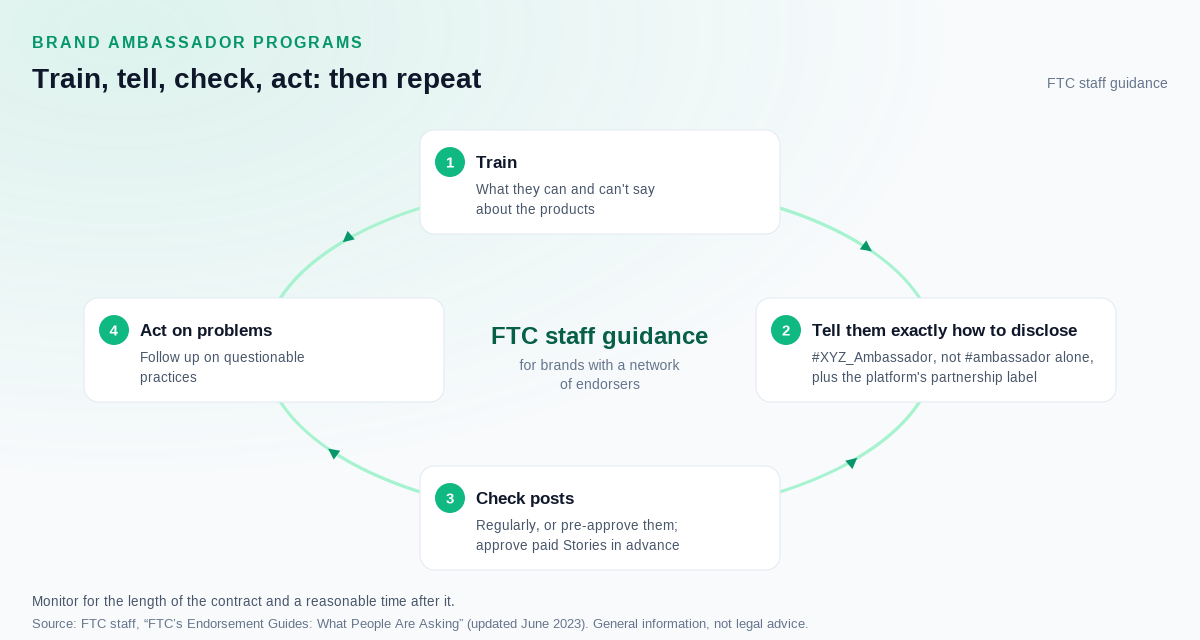
Put what ambassadors can and can’t say, and exactly how to disclose, in writing before anyone posts. FTC staff say advertisers who promote through a network of endorsers need a reasonable programme that explains what members can and can’t say about the products, tells them exactly how to disclose the connection, periodically checks what they post and acts on problems. Checked against FTC: FTC's Endorsement Guides: What People Are Asking The FTC’s influencer guide adds that an endorser can’t talk about experience with a product they haven’t tried, or call a product terrific if they were paid and thought it was terrible. Checked against FTC: Disclosures 101 for Social Media Influencers
A disclosure section for the brief could read like this (illustrative wording, adapt it to your brand):
- Start every post about us with “Ad” or “#BrandName_Ambassador”, in the same language as the post (U.S. wording; see Outside the U.S.).
- Turn on the platform’s paid-partnership or branded-content label as well.
- In videos, say it out loud too; in live streams, repeat it.
FTC staff say the FTC doesn’t mandate exact words, that starting a post with “Ad:”, “#ad” or “Advertisement” would likely be effective and that a disclosure at the end of a long post is easier to miss. Checked against FTC: FTC's Endorsement Guides: What People Are Asking
5. Recruit and onboard
Invite people one by one, agree terms in a written contract, and walk them through the brief before their first post. The guide on how to reach out to creators covers the first message, and the free social media contract template covers the agreement. If you send unsolicited products, FTC staff say training material alone is important but insufficient: ask recipients to disclose the gift, tell them how, ask them to tag the brand and monitor the tagged posts. Checked against FTC: FTC's Endorsement Guides: What People Are Asking
6. Monitor posts and keep in touch
Check what ambassadors post on a regular schedule, or pre-approve posts if you can’t. FTC staff set no standard frequency, but say a company that can’t monitor regularly should probably switch to pre-approval, and that paid ephemeral posts such as Stories shouldn’t go out without advance approval. Checked against FTC: FTC's Endorsement Guides: What People Are Asking Monitor for the length of each contract and a reasonable time after it, such as a few months. Checked against FTC: FTC's Endorsement Guides: What People Are Asking If a PR firm or agency runs the program, the brand is still ultimately responsible: ask for regular reports and check the network yourself now and then. Checked against FTC: FTC's Endorsement Guides: What People Are Asking
Log each ambassador’s posts against the goal from step 1; the guide to measure creator results covers which numbers to track.
What are the disclosure rules for brand ambassadors?
In the U.S., an ambassador must disclose the connection clearly in every post that endorses the brand, whether or not that post was paid for; FTC staff say “#XYZ_Ambassador” is likely clearer than “#ambassador” alone. This section is general information from FTC staff guidance, not legal advice.
The rules come from the FTC’s Endorsement Guides (16 CFR Part 255), last revised in 2023, which say tags in social media posts can be endorsements. Checked against eCFR: 16 CFR Part 255 — Guides Concerning Use of Endorsements and Testimonials in Advertising FTC staff answer common questions about them in an FAQ dated June 2023. Checked against FTC: FTC's Endorsement Guides: What People Are Asking The points that matter most for ambassadors:
- Name the brand in the tag. FTC staff call “#ambassador” or “partner” on its own ambiguous and confusing; “#XYZ_Ambassador” or “#XYZ_Partner” will likely be clearer. Checked against FTC: FTC's Endorsement Guides: What People Are Asking
- Put it where people will see it. The FTC’s 2019 influencer guide says the disclosure belongs with the endorsement (not only in a bio or a block of hashtags), in the video itself for video, and repeated during live streams. Checked against FTC: Disclosures 101 for Social Media Influencers
- Gifts count. For a free product with nothing else attached, “Gifted by XYZ” should be sufficient; a bare “Gifted” is ambiguous. Checked against FTC: FTC's Endorsement Guides: What People Are Asking
- Platform labels are not enough on their own. FTC staff say it is always best to add your own disclosure even when a platform offers a tool. Checked against FTC: FTC's Endorsement Guides: What People Are Asking
For the wider meaning of these labels, see what sponsored means on a post.
Platform labels for ambassador posts
Each network has its own built-in label; use it in addition to the words in your caption.
| Network | Built-in label | What the network says |
|---|---|---|
| Paid partnership label | Available on feed posts, stories, broadcast channels, Live, reels and videos in the mobile app; the brand gets a request and the label shows without its name until it approves. Checked against Instagram Help Center: How to use the paid partnership label to tag organic branded content on Instagram | |
| Facebook and Threads | ”Paid partnership with” label | Meta’s label names the brand partner’s account or Page. Checked against Meta Business Help Center: About labels on paid partnership posts On Threads: Options, then Mark as paid partnership, and @mention the brand. Checked against Instagram Help Center: Use the paid partnership tool to tag organic branded content on Threads |
| TikTok | Commercial content disclosure toggle | TikTok’s Branded Content Policy (published 4 August 2026, effective 31 August 2026) names brand-ambassador relationships as branded content and requires the toggle. Checked against TikTok: Branded Content Policy (published 4 August 2026, effective 31 August 2026) Set to a third party, the post shows a Paid partnership label. Checked against TikTok Help Center: Promoting a brand, product, or service |
| YouTube | Paid promotion box | Tick it in the video details when a video contains paid promotion; YouTube adds a disclosure label at the start. Checked against YouTube Help: YouTube Branded Content Policies |
| Brand partnership toggle | Required for content shared in exchange for value; works on public posts only and resets to off for each new post. Checked against LinkedIn Help: Label post as brand partnership |
Outside the U.S.
Other countries have their own guidance, and it does not always agree with the FTC’s. The UK’s CAP and CMA influencer guide advises against labels such as “brandambassador”, “Gifted” and “Sponsored”. Checked against CAP and CMA: Influencers' guide to making clear that ads are ads (3rd edition, 2023), p. 7 Canada’s Ad Standards lists #XYZAmbassador, #ad and #sponsored among clear, widely accepted disclosures. Checked against Ad Standards: Influencer Marketing Disclosure Guidelines (Update: Fall 2025), pp. 7, 26 If your ambassadors post for several countries, brief them on each country’s wording.
If your brand schedules its own posts about the program with Outfeed, here is what it does and doesn’t do with disclosures:
How to be a brand ambassador
Pick brands you already use, apply through the brand’s own program page, read the brief and contract, and disclose the relationship in every post using the platform’s label plus clear words in the caption.
- Start with what you use. The FTC says you can’t talk about your experience with a product you haven’t tried. Checked against FTC: Disclosures 101 for Social Media Influencers
- Apply on the brand’s own page. Sephora’s Squad site, for example, listed creating an account, an application of roughly 15 minutes and asking followers for testimonials. Checked against Sephora Squad (Sephora USA)Archived copy, 28 June 2026 View the archived copy
- Bring a media kit. A short influencer media kit and a rate card template show what you offer and what you charge.
- Disclose every time. The FTC’s 2019 influencer guide tells you to disclose any financial, employment, personal or family relationship with a brand, including free products you weren’t asked to mention, and says this is your responsibility. Checked against FTC: Disclosures 101 for Social Media Influencers Use a tag that names the brand, such as #BrandName_Ambassador, and turn on the platform’s label too.
Schedule your brand’s own posts with Outfeed AI
Brand ambassador FAQ
What does a brand ambassador do?
A brand ambassador uses a company’s products and encourages other people to use them, for example by posting about the brand on social media, appearing at events or sharing discount codes, in return for payment, free products or perks. Every endorsing post should disclose that relationship.
Do brand ambassadors get paid?
Often, but not always in money. Cambridge’s definition covers people who are paid or given free products. Checked against Cambridge Advanced Learner's Dictionary: brand ambassador Under the FTC’s Endorsement Guides, free or discounted products are a material connection too, so an ambassador rewarded only with products still has to disclose the relationship. Checked against eCFR: 16 CFR § 255.5(a) Disclosure of material connections
What is the difference between a brand ambassador and an influencer?
An ambassador usually has an ongoing relationship with one brand and promotes it over months, while an influencer is anyone whose posts sway their audience and often works with brands campaign by campaign. Many ambassadors are influencers. Both must disclose paid or gifted relationships; the comparison table above sets out the differences.
Is #ambassador enough as a disclosure?
Probably not on its own. FTC staff call a bare #ambassador or partner ambiguous and confusing and say a tag that names the brand, such as #XYZ_Ambassador, will likely be clearer. Checked against FTC: FTC's Endorsement Guides: What People Are Asking Platform labels like Instagram’s paid partnership tag help, but the FTC says to add your own disclosure as well. This is general information, not legal advice.