
Social Media Campaign Strategy: How to Plan One
A social media campaign is a planned run of posts, and sometimes ads, built around one idea and aimed at one measurable goal by a set date. Plan it in seven steps: a SMART goal, an audience, the platforms, one concept adapted per network, a dated post plan, a decision on paid support and tagged links. Below are the steps, a one-page brief you can fill in with a worked example, real campaign examples, campaign ideas by goal and how to measure the result.
This guide is part of our social media marketing for small business playbook. For a ready-made version, the free social media campaign template turns eight fields into a campaign brief, a dated post plan per platform, UTM links and a results sheet.
Table of Contents
- What is a social media campaign?
- Social media campaign strategy in 7 steps
- A one-page social media campaign brief you can fill in
- Real social media campaign examples
- Social media campaign ideas by goal
- How to measure a social media campaign
- Social media campaign FAQ
What is a social media campaign?
A social media campaign is a time-bound set of posts with one theme and one goal; your everyday posting is the strategy that surrounds it. We found no dictionary entry for the phrase itself, so start from the word: Cambridge defines a campaign as a planned group of activities intended to achieve a particular aim Checked against Cambridge Advanced Learner's Dictionary: campaign, and MASB’s marketing dictionary describes a marketing campaign as coordinated, specific activities based on a common theme and designed to promote a product or business through different media. Checked against MASB Universal Marketing Dictionary: Advertising Campaign Applied to social media, that means posts across your chosen networks, under one theme, working toward one result.
The difference from your regular content is the end date and the single goal. Daily posts keep an account alive; a campaign concentrates effort on one launch, offer or message, then stops and gets judged.
Social media campaign strategy in 7 steps
Work through the steps in order, because each answer narrows the next: the goal decides the audience, the audience decides the platforms, and the platforms decide how the copy is written.
Step 1: Set a SMART goal
Write the goal as one sentence with a number and a deadline. The CDC’s evaluation brief No. 3b (updated August 2018) spells SMART as Specific (who and what), Measurable (how much change), Achievable (within the time and resources you have), Realistic (it addresses the scope of the problem) and Time-phased (it says when it will be met or measured). Checked against CDC Healthy Youth: Evaluation Brief No. 3b — Writing SMART Objectives (PDF) Many guides print “Relevant” and “Time-bound” instead; the letters vary by source. A Penn State course credits George T. Doran with defining S.M.A.R.T. in 1981, in the journal Management Review. Checked against Penn State World Campus WFED 585: Defining KPIs and Objectives
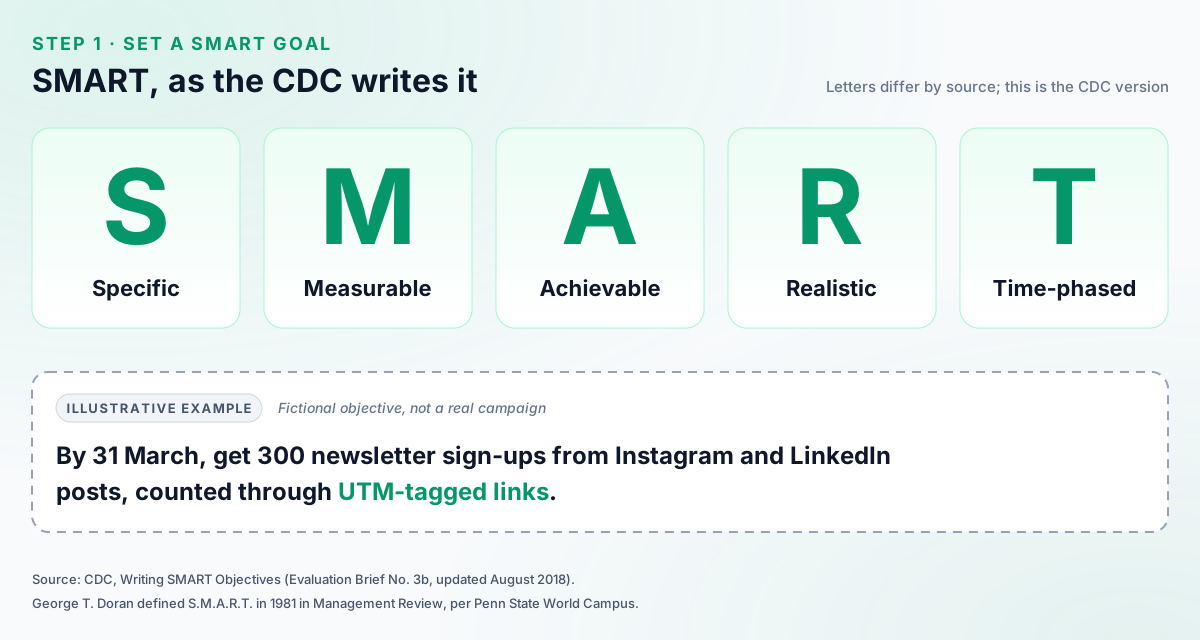
The US Small Business Administration names more email subscribers, a bigger market share and higher sales by a set percentage as common marketing goals. Checked against U.S. Small Business Administration: Manage your business — Marketing and sales The social version in the figure is illustrative: “By 31 March, get 300 newsletter sign-ups from Instagram and LinkedIn posts, counted through UTM-tagged links.”
Step 2: Pick the audience
Name who the campaign is for before you write a word. Cambridge defines a target audience as the particular group of people an advertisement, product or website is directed at Checked against Cambridge Business English Dictionary: target audience, and the SBA tells businesses to describe their market’s size, demographics, traits and trends in detail. Checked against U.S. Small Business Administration: Manage your business — Marketing and sales A buyer persona turns that description into one person you can write for.
Test the message on that audience too. For Tips From Former Smokers, the national tobacco education campaign it launched in March 2012, the CDC says audience testing found that fear of dying did not motivate people to quit, while seeing how hard it is to live with a smoking-related disease did; the CDC estimates that about 1 million people quit because of the campaign from 2012 to 2018. Checked against CDC: Tips From Former Smokers — About the Campaign It was a national paid-media campaign, not a social-only one, but the lesson carries over: research what moves your audience instead of guessing.
Step 3: Choose the platforms
Go where that audience already is, and pick two or three networks you can post to well rather than all of them. In the U.S., Pew Research Center’s 2026 survey of 5,511 U.S. adults found that 84% say they ever use YouTube, 70% Facebook, 51% Instagram, 37% TikTok, 31% LinkedIn and 18% X. Checked against Pew Research Center: Americans' Use of Social Media in 2026 (fact sheet, 19 Oct 2026)
Step 4: Write one concept, then adapt it per network
Keep one idea and one key message, and rewrite the copy for each network instead of pasting the same text everywhere. Each network caps post text differently:
| Network | Post text limit | Source |
|---|---|---|
| 3,000 characters | LinkedIn Help: Post and share updates | |
| X | 280 weighted characters (Premium: up to 25,000 characters) | X Developer Platform: Counting characters |
| Threads | 500 characters | Threads API: overview |
| Bluesky | 300 characters (graphemes) | AT Protocol lexicon: app.bsky.feed.post |
Limits last verified 27 September 2026.
Step 5: Put every post on a dated plan
Lay the posts out as phases with dates: a tease before launch, the launch itself, follow-up posts that keep it going, and a last call before the end date. Give each post a network, a time, an owner and its tagged link. The free content calendar template holds the plan next to your regular posts, so the campaign doesn’t crowd them out.
Step 6: Decide on paid support
Decide up front whether organic reach is enough or whether some posts need a budget. The lightest option is a boost: Meta defines a boosted post as an ad made from a post you already published, with fewer targeting options than an ad built in Ads Manager. Checked against Meta Business Help Center: The difference between boosted posts and Meta ads Social media advertising compares each platform’s minimum budgets, bidding and review times.
Step 7: Tag every link
Give every link in the campaign UTM parameters, so each visit traces back to the post that sent it. Google Analytics says to always use utm_source, utm_medium and utm_campaign Checked against Google Analytics Help: URL builders: Collect campaign data with custom URLs, treats values as case-sensitive, and recommends lowercase with one consistent utm_source per platform. Checked against Google Analytics Help: URL builders: Collect campaign data with custom URLs The free UTM generator builds the links.
A one-page social media campaign brief you can fill in
A campaign brief fits on one page: the goal, who it is for, where it runs, what it says, when each post goes out and how you will count the result. Copy the fields below. The right-hand column is an illustrative example for a fictional bakery launching a weekend sourdough subscription, not a real campaign or a benchmark.
| Field | What to write | Illustrative example |
|---|---|---|
| Goal (SMART) | One result, a number and a date | 120 subscription sign-ups from social links by 30 April |
| Audience | Who, where, what they care about | Local families who already buy bread at weekend markets |
| Platforms | Two or three networks that audience uses | Instagram and Facebook |
| Concept | The one idea every post serves | ”Saturday bread, sorted”: fresh loaves held for subscribers |
| Key message | The sentence people should remember | Subscribe once, collect every Saturday |
| Posts | Formats and how many per network | 6 Instagram posts, 4 Facebook posts, 2 Reels |
| Dates | Tease, launch, follow-up and last call | 1 April tease, 8 April launch, weekly follow-ups, 28 April last call |
| Paid support | Yes or no, budget and which posts | Boost the launch post for one week |
| Links | The landing page with UTM tags | utm_source=instagram, utm_medium=social, utm_campaign=sourdough-launch |
| Owner | Who writes, approves and posts | Owner writes; shop manager approves |
| Measure | Where the result is counted | Sign-ups by campaign in Google Analytics |
The social media campaign template builds the same brief, the dated post plan and the tagged links from eight fields.
Real social media campaign examples
Documented campaigns follow the same pattern as the steps above: one idea, a fixed window, several networks and an easy way for people to take part. Three examples, each described in the organiser’s own words:
Spotify Wrapped 2025: personal content people want to share
Spotify says its 2025 Wrapped campaign launched on 3 December 2025 alongside the in-app Wrapped experience, ran in more than 30 markets with around 50 installations and pop-ups beyond traditional billboards, and gave users share cards to send through Spotify Messages or post to their own social channels. Checked against Spotify Newsroom: How Our 2025 Wrapped Campaign Turns Your Year in Listening Into a Global CelebrationVendor's own description Spotify’s German press release lists the networks the digital campaign used in Germany: Instagram, TikTok, Snapchat, Meta (Facebook), Reddit, YouTube Shorts and Netflix, including Spotify’s own accounts, with artists, podcasters, influencers and creators. Checked against Spotify Deutschland press release: Spotify startet Marketingkampagne zum Jahresrückblick 2025 WrappedVendor's own description Spotify says Wrapped ended the campaign with more than 300 million engaged users and more than 630 million shares on social media in 56 languages; that is the company’s own figure about its own campaign. Checked against Spotify Newsroom: Spotify Reports Fourth Quarter 2025 EarningsVendor's own description
Wrapped is built from each user’s listening data inside Spotify’s app, so a small business can’t copy it as-is. The part that transfers is the concept: give people something about themselves that they want to post.
Apple Shot on iPhone Macro Challenge 2022: a hashtag contest
Apple’s Shot on iPhone Macro Challenge ran from 25 January to 16 February 2022. Apple asked iPhone 13 Pro and Pro Max users to share macro photos on Instagram and Twitter (now X) with #ShotoniPhone and #iPhonemacrochallenge; a panel of judges picked 10 winners to be featured on Apple’s newsroom, website and social accounts, and Apple said it would pay the winners a licensing fee. Checked against Apple Newsroom: Share your best iPhone macro photos for Apple's Shot on iPhone ChallengeVendor's own description The structure (clear dates, a hashtag, judging, a reward) works at any size, but check each network’s promotion rules before you run a contest, as the giveaway idea below explains.
FDA The Real Cost: a public-education campaign on the networks teens use
The FDA describes The Real Cost as its first tobacco prevention campaign, running since February 2014 to reach young people aged 12 to 17 who are at risk of smoking, and built on ongoing research with teens. Checked against FDA: The Real Cost Cigarette Prevention Campaign — Internet Archive captureArchived copy, 18 September 2026 Among its tactics, the FDA lists streaming video ads on platforms like Hulu and YouTube, streaming audio ads, social media on Snapchat and Instagram, gaming-focused ads and a variety of influencers. Checked against FDA: The Real Cost Cigarette Prevention Campaign — Internet Archive captureArchived copy, 18 September 2026 It is a paid, multichannel campaign rather than a social-only one: the audience decided the channels, as step 3 suggests.
Social media campaign ideas by goal
Pick the campaign type from the goal, not the other way round. Five common types, with what to check before you run each:
- Launch: a new product, service or location, run as tease, launch and last call. Your brand awareness strategy sets the longer-term job a launch feeds into.
- Giveaway or contest: entries in exchange for a prize. Check each platform’s promotion rules first. LinkedIn’s Professional Community Policies say: “You may not use LinkedIn to hold lotteries, contests, sweepstakes, or giveaways.” (LinkedIn — Professional Community Policies, read 27 September 2026). Social media giveaway ideas lists formats and the rules for the other networks.
- Creator collaboration: creators post about your offer for a fee or free product. In the U.S., the FTC says a material connection the audience wouldn’t expect, such as payment or free products, must be disclosed clearly and conspicuously (regulator guidance, not legal advice). Checked against eCFR: 16 CFR § 255.5(a) Disclosure of material connections Influencer marketing campaigns compares the formats.
- Content series: a fixed run of posts on one theme, such as weekly tips or behind-the-scenes posts, ending in an offer.
- Seasonal or event push: a short campaign tied to a holiday, anniversary or event date, so the end date is set for you.
How to measure a social media campaign
Judge the campaign against its SMART goal, and compare what it cost with what it brought in. The SBA advises comparing marketing costs with the revenue they generate and measuring consistently. Checked against U.S. Small Business Administration: Manage your business — Marketing and sales If the goal was sign-ups, count sign-ups from tagged links; reach and likes only explain why the number came out as it did.
Decide the metrics before launch and keep them the same until the end date. Social media KPIs has the formulas for reach, engagement rate and click-through rate, and the campaign template’s results sheet keeps the numbers next to the brief.
Social media campaign FAQ
What is a social media campaign?
A planned set of social posts, sometimes with ads, built around one theme and aimed at one measurable goal by a set date. Cambridge defines a campaign as a planned group of activities intended to achieve a particular aim, and MASB’s marketing dictionary describes a marketing campaign as coordinated activities based on a common theme. Applied to social media, that means posts across your chosen networks working toward one result.
How do you plan a social media campaign?
Set a SMART goal, define the audience, choose the platforms that audience uses, write one concept and adapt the copy to each network’s text limit, put every post on a dated plan, decide whether the campaign needs paid support, and tag every link with UTM parameters so you can trace the results.
What does SMART stand for in a campaign goal?
It depends on the source. The CDC’s evaluation brief No. 3b spells it Specific, Measurable, Achievable, Realistic and Time-phased, while many other sources use Relevant and Time-bound. A Penn State course credits George T. Doran with defining S.M.A.R.T. in 1981. Say which version you use.
What are some examples of social media campaigns?
Spotify’s 2025 Wrapped campaign gave users personal share cards to post on their own social channels, alongside ads and pop-ups in more than 30 markets. Apple’s 2022 Shot on iPhone Macro Challenge asked iPhone users to share macro photos with set hashtags for a chance to be featured. The FDA’s The Real Cost campaign reaches teens with video, audio and gaming ads, social media and influencers.
How do you measure a social media campaign’s results?
Compare the result with the goal you set, and compare what the campaign cost with the revenue it brought in, as the US Small Business Administration advises for any marketing. Tag every link with utm_source, utm_medium and utm_campaign, which Google Analytics says to always use, so each visit and sign-up traces back to the campaign.