
Social Media Algorithms: How Every Platform Ranks Posts
Social media algorithms are the ranking and recommender systems that decide which posts you see and in what order. They work in the same broad stages: gather candidate posts, read signals about each post and viewer, predict how you will react, then score, order and filter the feed. Everything below comes from the platforms’ own documents (Meta’s system cards, X’s open-source code, help centres, Bluesky’s blog) and the EU’s Digital Services Act, with a dated source stamp on every claim.
For what is rising now, see what’s trending across social media right now; for what to do with these signals, see how to go viral without tricks.
Table of Contents
- What is a social media algorithm?
- How do social media algorithms work?
- How does each platform’s algorithm differ?
- Which signals matter most now: watch time, shares or replies?
- Do algorithms penalise scheduled posts or third-party tools?
- How do you see, change or reset what your feed shows you?
- Social media algorithm news: what changed recently
- Algorithm myths: shadowbans, test pools and ‘1 report = 468 likes’
- Social media algorithms FAQ
What is a social media algorithm?
A social media algorithm is the system a platform uses to pick which posts to show you and in what order, based on what it knows about each post and about you. Merriam-Webster’s general definition of an algorithm is a step-by-step procedure for solving a problem or reaching a result. Checked against Merriam-Webster: algorithm
The algorithm meaning in social media is narrower. The EU’s Digital Services Act calls it a recommender system: a fully or partly automated system a platform uses to suggest or prioritise information, including by setting the order or prominence of what is shown. Checked against EUR-Lex: Regulation (EU) 2022/2065 (Digital Services Act), Article 3(s)
Two platform points reframe any algorithm in social media:
- A time-ordered feed is an algorithm too. Bluesky said in 2023 that a feed of people you follow, ordered only by time, is a very simple algorithm, and set out to replace one company-controlled “master algorithm” with a marketplace users choose from. Checked against Bluesky blog: Algorithmic choice
- One app runs many algorithms. Instagram says it has no single algorithm: it uses a variety of algorithms, classifiers and processes, and ranks Feed, Stories, Explore and Reels differently. Checked against About Instagram: Instagram Ranking Explained
How do social media algorithms work?
Social media algorithms work as a pipeline: gather candidate posts, read signals about each post and viewer, predict how the viewer will react, order posts by a score, then mix and filter the final feed. Meta documents Facebook Feed this way, and X’s code follows the same shape.
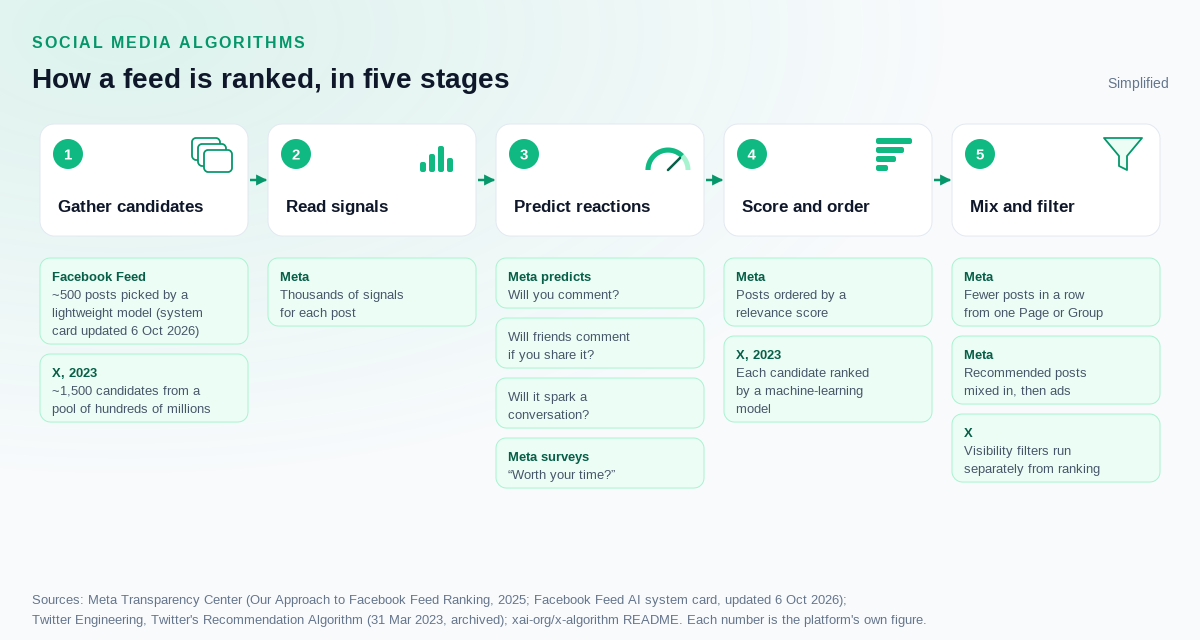
- Gather candidates. Facebook starts from new posts by the friends, Pages and Groups you are connected to, minus content flagged for breaking its rules. Checked against Meta Transparency Center: Our Approach to Facebook Feed Ranking A lightweight model then picks approximately 500 of the most relevant to score. Checked against Meta Transparency Center: Facebook Feed AI system card X mixes recent posts from accounts you follow with out-of-network posts found by its retrieval models. Checked against GitHub: xai-org/x-algorithm README (Overview) In 2023 Twitter said this step pulled roughly 1,500 candidates from hundreds of millions. Checked against Twitter Engineering blog: Twitter's Recommendation Algorithm (archived)Archived copy, 5 December 2023 View the archived copy
- Read signals. Facebook considers thousands of signals per post Checked against Meta Transparency Center: Our Approach to Facebook Feed Ranking: about the post, how others interacted with it and how you engaged with similar content. Checked against Meta Transparency Center: Our approach to explaining ranking (updated 31 December 2023)
- Predict reactions. Facebook predicts how likely you are to comment, how likely your friends are to comment if you share, and whether a post will start a conversation, and asks people in surveys whether posts were worth their time. Checked against Meta Transparency Center: Our Approach to Facebook Feed Ranking X predicts likes, replies, reposts, shares, clicks, dwell time and negative actions such as mute or report. Checked against GitHub: xai-org/x-algorithm README (Scoring and Ranking)
- Score and order. Facebook orders posts by a relevance score. Checked against Meta Transparency Center: Our Approach to Facebook Feed Ranking X combines its predictions into one score, weighting positive actions up and negative ones down. Checked against GitHub: xai-org/x-algorithm README (Scoring and Ranking)
- Mix and filter. Facebook tries to avoid several posts in a row from one Group or Page, mixes in recommended posts, then adds ads. Checked against Meta Transparency Center: Our Approach to Facebook Feed Ranking X keeps ranking (the order) apart from visibility filtering (whether a post can be shown at all, using your blocks, mutes and labels on posts). Checked against GitHub: xai-org/x-algorithm README (Overview; Key Design Decisions)
In the EU, Article 27 of the Digital Services Act requires platforms to set out in plain language the main parameters of their recommender systems and any options users have to change them. Checked against EUR-Lex: Digital Services Act, Article 27
How does each platform’s algorithm differ?
Each network predicts a different mix of actions: TikTok and YouTube lean on watching, Instagram names watch time, likes and sends, Facebook and X predict long lists of reactions, and Bluesky lets you pick the algorithm. For how many people each network reaches, see social media statistics by platform.
| Network | What it says it predicts or weighs most | Source |
|---|---|---|
| TikTok | Your interactions, with watch time generally weighted most; also video and account information | Checked against TikTok Help Center: How TikTok recommends content |
| Watch time, likes and sends (said in January 2025) | Checked against Adam Mosseri, Head of Instagram (own Instagram account) | |
| YouTube | Whether viewers choose to watch, how much they watch, then likes and survey answers | Checked against YouTube Help: Search & discovery tips (Video) |
| X | Probabilities of likes, replies, reposts, shares, clicks, dwell time and negative actions, combined into one score | Checked against GitHub: xai-org/x-algorithm README (Scoring and Ranking) |
| Comments, conversation and “worth your time” survey answers in Feed | Checked against Meta Transparency Center: Our Approach to Facebook Feed Ranking | |
| Identity, content and activity signals | Checked against LinkedIn Help: LinkedIn relevance - Optimizing the member experience | |
| Threads | Likes, scrolling past, replies, clicks and profile visits | Checked against Meta Transparency Center: Instagram Threads Feed AI system card |
| Who you follow, the boards you create, the Pins you engage with and your searches | Checked against Pinterest Help: Explore the home feed | |
| Bluesky | Whichever feed you choose from an open marketplace | Checked against Bluesky Help Center (Zendesk): Moderation and Custom Feeds |
TikTok
TikTok says For You is shaped by your interactions (likes, shares, comments, full watches, skips), video information (sounds, hashtags, views, country of posting) and your information (device, language, location, time zone), with watch time generally weighted most. Checked against TikTok Help Center: How TikTok recommends content
TikTok’s 2020 explainer adds detail:
- Finishing a longer video counts for more than sharing a country with the creator. Checked against TikTok Newsroom: How TikTok recommends videos #ForYou
- Language, country setting and device type get lower weight. Checked against TikTok Newsroom: How TikTok recommends videos #ForYou
- New users pick interests or start with popular videos. Checked against TikTok Newsroom: How TikTok recommends videos #ForYou
- Two videos in a row rarely share a sound or creator, and videos outside your interests are mixed in. Checked against TikTok Newsroom: How TikTok recommends videos #ForYou
- Follower count is not a direct factor, though bigger accounts likely get more views. Checked against TikTok Newsroom: How TikTok recommends videos #ForYou (18 June 2020)
New to the feed itself? Read what the For You page is.
Instagram ranks each surface separately, and Head of Instagram Adam Mosseri said in January 2025 that the three signals that matter most are watch time, likes and sends. He added that likes matter slightly more for reaching your followers and sends slightly more for reaching people who don’t follow you. Checked against Adam Mosseri, Head of Instagram (own Instagram account) A send is a post or reel shared by direct message; for reels shared inside a chat, see Instagram Blend, a shared reels feed in a DM chat.
For Reels, the 2023 explainer named its most important predictions: resharing, watching all the way through, liking and visiting the audio page. Checked against About Instagram: Instagram Ranking Explained (31 May 2023) It uses thousands of signals and about a dozen predictions, without publishing their weights. Checked against About Instagram: Instagram Ranking Explained The full table is in how the Instagram algorithm ranks each surface.
YouTube
YouTube says its recommendation system finds videos for each viewer rather than promoting videos to an audience, and reads three kinds of performance signal: appeal, engagement and satisfaction. Checked against How YouTube Works: Recommendations Checked against YouTube Help: Understand your content performance for YouTube's recommendation system
- Long-form: whether viewers choose to watch, then average view duration and percentage viewed, then likes and surveys; no format is favoured. Checked against YouTube Help: Search & discovery tips (Video)
- Shorts: the share of viewers who chose to view, then view duration and percentage viewed, then likes and surveys. Checked against YouTube Help: Search & discovery tips (Shorts)
- Channel quality: a channel’s reputation and quality also shape how, when and to whom content is surfaced. Checked against How YouTube works: Algorithm-based recommendations on YouTube
X (Twitter)
X publishes the code behind its For You feed: a model predicts how likely you are to take each of a list of actions, and the predictions are combined into one score. The code sits in the xai-org/x-algorithm repository, created on 19 January 2026, with dated update notes. Checked against GitHub: xai-org/x-algorithm (README and repository metadata)
After scoring, extra posts from the same author count for less, posts from accounts you don’t follow are discounted, and authors with low impressions get a boost. Checked against GitHub: xai-org/x-algorithm README (Scoring and Ranking) The Following timeline skips all of this and shows only accounts you follow. Checked against X Help Center: About your For you timeline on X (archived)Archived copy, 29 September 2026 View the archived copy
The often-quoted 2023 details are history: Twitter’s code released on 31 March 2023 Checked against Twitter Engineering blog: Twitter's Recommendation Algorithm (archived)Archived copy, 5 December 2023 View the archived copy ranked with a roughly 48-million-parameter network Checked against Twitter Engineering blog: Twitter's Recommendation Algorithm (archived)Archived copy, 5 December 2023 View the archived copy and averaged a 50/50 in-network split. Checked against Twitter Engineering blog: Twitter's Recommendation Algorithm (archived)Archived copy, 5 December 2023 View the archived copy Today’s code ranks posts from accounts you follow and from elsewhere together, with one transformer model. Checked against GitHub: xai-org/x-algorithm README (Overview)
Our guide to the Twitter (X) algorithm covers each signal and what it means for your posts.
Facebook Feed ranks on predicted comments and conversation and on what people say is worth their time; Facebook Reels ranks on whether you watch rather than skip. Checked against Meta Transparency Center: Our Approach to Facebook Feed Ranking
Post signals include the post type, how much of it is identical to other posts, likely rule-breaking and fact-checker ratings. Checked against Meta Transparency Center: Our Approach to Facebook Feed Ranking (Signals Used in Ranking Connected Content) For Reels, a lightweight model picks approximately 10 to 100 reels, and predictions include watching rather than skipping, finishing, liking and hiding. Checked against Meta Transparency Center: Facebook Reels AI system card In October 2026 Meta said large language models now let ranking take free-text requests into account within a session. Checked against Meta Newsroom: Your Algorithm, Your Words
LinkedIn says its Feed weighs three kinds of signal: identity (your profile), content (engagement, topic, recency, connection and how constructive the conversation is) and activity (what you react to, share and spend time viewing). Checked against LinkedIn Help: LinkedIn relevance - Optimizing the member experience It says its systems consider hundreds of signals and that age, race or gender are not visibility signals. Checked against LinkedIn Help: How the Feed ranks content
- Dwell time was described as a feed ranking signal by LinkedIn’s engineers in 2020, measured both on the feed and after a click. Checked against LinkedIn Engineering — Understanding dwell time to improve feed ranking (dated )
- The ranker predicts likes, comments, shares, votes, long dwell and clicks and combines them linearly; the coefficients are not published. Checked against LiRank: Industrial Large Scale Ranking Models at LinkedIn (Borisyuk et al.)
- March 2026: larger models with LLMs, and action against engagement pods, comment automation and engagement bait. Checked against LinkedIn Pressroom: How LinkedIn Is Improving the Feed to Show More Relevant, Authentic Professional Content
More detail is in how the LinkedIn feed algorithm works.
Threads algorithm
The Threads algorithm blends posts from accounts you follow with recommended posts and ranks them by predicted value, from signals such as how you have engaged with similar accounts and content. Checked against Meta Transparency Center: Instagram Threads Feed AI system card Its predictions include how likely you are to like a post, scroll past it, reply, click and visit the author’s profile. Checked against Meta Transparency Center: Instagram Threads Feed AI system card
Threads also has a Following feed, custom feeds and a Fediverse feed. Checked against Instagram Help Center (Threads): About your feeds on Threads New to the app? Start with what Threads is.
Pinterest says the “Pins picked for you” in your home feed come from the people you follow, the boards you create, the Pins you engage with and what you search for. You can hide individual Pins to signal what you want, and the Explore tab collects what is trending on Pinterest. Checked against Pinterest Help: Explore the home feed
Bluesky
Bluesky lets you choose the algorithm: custom feeds, built by Bluesky and third-party developers, sit in an open marketplace you browse under My Feeds. Checked against Bluesky Help Center (Zendesk): Moderation and Custom Feeds Background: how Bluesky works.
Which signals matter most now: watch time, shares or replies?
Watching is the signal platforms name most often, then sharing and sending, with replies named on conversation-led feeds; apart from X’s open-source code, no platform publishes how much each one counts. Before chasing any of them, know what going viral actually means.
- Watch time and completion. TikTok Checked against TikTok Newsroom: How TikTok recommends videos #ForYou, Instagram Reels Checked against About Instagram: Instagram Ranking Explained (31 May 2023), Facebook Reels Checked against Meta Transparency Center: Facebook Reels AI system card and YouTube Shorts Checked against YouTube Help: Search & discovery tips (Shorts) all name watching through. X followed in October 2026, ranking by how long you will spend on a post and retrieving posts people read to the end. Checked against GitHub: xai-org/x-algorithm README (Notable Updates)
- Shares and sends. Instagram’s Reels predictions start with resharing Checked against About Instagram: Instagram Ranking Explained (31 May 2023); X predicts shares, DM shares and copied links. Checked against GitHub: xai-org/x-algorithm README (Scoring and Ranking) Mosseri says sends matter slightly more for reaching non-followers. Checked against Adam Mosseri, Head of Instagram (own Instagram account)
- Replies and conversation. Facebook predicts comments and conversation Checked against Meta Transparency Center: Our Approach to Facebook Feed Ranking, Threads predicts replies Checked against Meta Transparency Center: Instagram Threads Feed AI system card, and LinkedIn looks at how constructive the conversation is. Checked against LinkedIn Help: LinkedIn relevance - Optimizing the member experience
Only X publishes weights. Of the ranking explanations we read, only X’s open-source code exposes weight parameters Checked against Absence finding across the platform sources in this ledgerNot verified, and X warns they scale predicted probabilities, not engagement counts. Checked against GitHub: xai-org/x-algorithm README (Notable Updates, 14 Aug 2026; Scoring and Ranking) A “share is worth five likes” rule is not from a platform.
Do algorithms penalise scheduled posts or third-party tools?
No platform’s own ranking explanation lists scheduling, publishing method or third-party tools as a ranking signal, and we found no platform document describing a penalty for posts published through its official API. Checked against Absence finding across the sources in this ledgerNot verified That is an absence of evidence, not proof that no penalty exists. Outfeed is a scheduling tool, so we have an interest here; check the linked sources yourself.
YouTube says publish time is not known to affect a video’s long-term performance, though it can help early viewership. Checked against YouTube Help: YouTube performance FAQ & Troubleshooting The signals the platforms do name (watching, sharing, replying) describe the post and the viewer, not how the post was sent. For the mechanics, see how to schedule social media posts; for where scheduling fits in a full plan, see social media marketing.
How do you see, change or reset what your feed shows you?
Every major network gives you at least one way to steer its algorithm: mark posts “Not interested”, switch to a Following feed, edit your interests or reset your recommendations.
| Network | Control | What it does | Source |
|---|---|---|---|
| Your Algorithm | Live across Feed, Reels and Explore, from the icon in the upper right of Reels or Explore | Checked against About Instagram: Introducing a new way to see and control your algorithm (10 December 2025, updated 10 June 2026) | |
| Reset suggested content | Under Content preferences; can’t be undone, doesn’t change who you follow | Checked against Instagram Help Center: Reset your suggested content | |
| Feed controls | Hide, Snooze, Unfollow, Favorites, Interested / Not interested; a reverse-chronological Following view | Checked against Meta Transparency Center: Facebook Feed AI system card | |
| Your algorithm | Manage the topics you want in Feed and Reels in your own words (rolling out) | Checked against Meta Newsroom: Your Algorithm, Your Words: New Ways to Shape What You See on Facebook | |
| Threads | Dear Algo | A public “Dear Algo” post adjusts your feed for three days (launched in four countries) | Checked against Meta Newsroom: Control Your Threads Feed With New Dear Algo Feature |
| Threads | Following feed | Only people you follow | Checked against Instagram Help Center (Threads): About your feeds on Threads |
| X | Following timeline | Only accounts you follow | Checked against X Help Center: About your For you timeline on X (archived)Archived copy, 29 September 2026 View the archived copy |
| TikTok | Not interested | Shows you fewer posts like the one you mark | Checked against TikTok Help Center: How to dislike a post on TikTok |
| TikTok | Refresh your For You feed | Restarts recommendations from popular content; can’t be undone | Checked against TikTok Help Center: How to refresh your For You feed |
| YouTube | Not interested / Don’t recommend channel | Feedback from a video’s More menu; clearable in My Activity | Checked against YouTube Help: Manage your recommendations & search results |
| Sort and Not interested | Most recent or Most relevant first; mute, hide or Not interested | Checked against LinkedIn Help: LinkedIn relevance - Optimizing the member experience | |
| Refine your recommendations | Fewer GenAI Pins by topic, or no recommendations from past engagement | Checked against Pinterest Help: Refine your recommendations | |
| Bluesky | Custom feeds | Pick the algorithm behind your timeline | Checked against Bluesky Help Center (Zendesk): Moderation and Custom Feeds |
In the EU, very large platforms (45 million or more average monthly active recipients) must offer at least one recommender option not based on profiling. Checked against EUR-Lex: Digital Services Act, Articles 33 and 38
Step by step: reset your YouTube, TikTok or Instagram recommendations, or tune the Instagram Explore page. Only Instagram? Here is how to reset your Instagram algorithm.
Social media algorithm news: what changed recently
Recent dated changes include X’s October 2026 updates on reading time and Facebook’s “Your algorithm”, announced on 13 October 2026. None of the platforms we checked publishes a change schedule. Checked against Absence finding across the platform sources in this ledgerNot verified Newest first:
- 8 and 13 October 2026, X: ranking estimates time spent per post; retrieval favours posts read to the end. Checked against GitHub: xai-org/x-algorithm README (Notable Updates)
- 13 October 2026, Facebook: Your algorithm announced. Checked against Meta Newsroom: Your Algorithm, Your Words: New Ways to Shape What You See on Facebook
- 6 October 2026, Facebook: Feed system card updated. Checked against Meta Transparency Center: Facebook Feed AI system card
- 14 August 2026, X: README warns weights are not engagement counts. Checked against GitHub: xai-org/x-algorithm README (Notable Updates, 14 Aug 2026; Scoring and Ranking)
- 19 June 2026, Facebook: Reels system card updated. Checked against Meta Transparency Center: Facebook Reels AI system card
- 10 June 2026, Instagram: Your Algorithm live across Feed, Reels and Explore. Checked against About Instagram: Introducing a new way to see and control your algorithm (10 December 2025, updated 10 June 2026)
- 30 April 2026, Instagram: originality rule extended from reels to photos and carousels. Checked against Instagram for Creators — Rewarding original creators on Instagram (dated )
- 12 March 2026, LinkedIn: new Feed models; action on pods and engagement bait. Checked against LinkedIn Pressroom: How LinkedIn Is Improving the Feed to Show More Relevant, Authentic Professional Content
- 11 February 2026, Threads: Dear Algo launched. Checked against Meta Newsroom: Control Your Threads Feed With New Dear Algo Feature
- 19 January 2026, X: code moved to xai-org/x-algorithm. Checked against GitHub: xai-org/x-algorithm (README and repository metadata)
Algorithm myths: shadowbans, test pools and ‘1 report = 468 likes’
The most repeated algorithm claims are either contradicted by the platforms or trace to no platform source.
| Myth | What the platforms actually say | Source |
|---|---|---|
| Every new post is tested on 200 to 1,000 non-followers first | No platform source we read states a test-audience size; Instagram’s trial reels are an opt-in feature. | Checked against Absence finding across the sources in this ledger (Meta system cards, TikTok 2020 explainer, YouTube Help, X README)Not verified Checked against Instagram — Instagram Ranking Explained (dated ) |
| On X, one report cancels out 468 likes | X says its weights scale predicted probabilities, not counts. | Checked against GitHub: xai-org/x-algorithm README (Notable Updates, 14 Aug 2026; Scoring and Ranking) |
| On Instagram, a send is worth 3 to 5 likes | Mosseri said “slightly” more important, with no multiplier. | Checked against Adam Mosseri, Head of Instagram (own Instagram account) |
| On LinkedIn, a comment is worth N likes | The coefficients are not published. | Checked against LiRank: Industrial Large Scale Ranking Models at LinkedIn (Borisyuk et al.) |
| Shadowbans are secret punishments | Instagram’s Account Status shows whether content can be recommended to non-followers; followers still see it. | Checked against Instagram Help Center: Recommendation eligibility on Instagram Checked against Instagram for Creators — Recommendations on Instagram |
| Scheduled posts get less reach | We found no platform document describing a penalty. | Checked against Absence finding across the sources in this ledgerNot verified |
| More hashtags mean more reach | Instagram lists hashtags among search surfaces, not as a reach lever. | Checked against Instagram for Creators — Tips for improving your reach (dated ) |
If reach drops, check the platform’s own status page first: see what an Instagram shadowban really is and whether hashtags still help reach.
Plan and schedule your posts with Outfeed AI
Social media algorithms FAQ
What is an algorithm in social media?
It is the ranking or recommender system a platform uses to pick which posts you see and in what order. The EU’s Digital Services Act defines a recommender system as an automated system that suggests or prioritises information, including by setting the order or prominence of what is displayed. Checked against EUR-Lex: Regulation (EU) 2022/2065 (Digital Services Act), Article 3(s)
How do social media algorithms work?
Most follow the same broad steps their owners describe: gather candidate posts, read signals about each post and viewer, predict how likely the viewer is to watch, share, reply or skip, then order posts by a score and mix in recommendations. Meta describes Facebook Feed this way Checked against Meta Transparency Center: Our Approach to Facebook Feed Ranking, and X publishes its For You code on GitHub. Checked against GitHub: xai-org/x-algorithm (README and repository metadata)
Do social media algorithms penalise scheduled posts?
None of the platforms’ own ranking explanations lists scheduling, publishing method or third-party tools as a ranking signal, and we found no platform document describing a penalty for posts published through its official API. Checked against Absence finding across the sources in this ledgerNot verified YouTube says publish time is not known to affect a video’s long-term performance. Checked against YouTube Help: YouTube performance FAQ & Troubleshooting
Can you turn off the algorithm and see a chronological feed?
Partly. Threads Checked against Instagram Help Center (Threads): About your feeds on Threads and X Checked against X Help Center: About your For you timeline on X (archived)Archived copy, 29 September 2026 View the archived copy offer a Following feed of accounts you follow, Facebook has a Following view in reverse chronological order Checked against Meta Transparency Center: Facebook Feed AI system card, and Bluesky lets you choose the feed algorithm you use. Checked against Bluesky Help Center (Zendesk): Moderation and Custom Feeds In the EU, very large platforms must offer at least one recommender option not based on profiling. Checked against EUR-Lex: Digital Services Act, Articles 33 and 38 Even a time-ordered feed is still an algorithm, as Bluesky points out. Checked against Bluesky blog: Algorithmic choice
How often do social media algorithms change?
Often, and on no published schedule. Instagram says it adds and removes signals and predictions over time Checked against About Instagram: Instagram Ranking Explained, X records dated updates in its public algorithm README, and Meta dates its system cards. Checked against Absence finding across the platform sources in this ledgerNot verified The news section lists the most recent dated changes with their sources.