
Social Media Marketing for Law Firms: Ethics-Safe Guide
Social media marketing for law firms works when every post passes two tests before it goes up: is it true and not misleading, and does it keep client information private? Lawyers can post explainers, firm news and their services on any network; they can’t mislead, reveal a client’s matter, pay for recommendations or solicit a specific person live. This guide puts the ABA Model Rule beside each kind of post, with Florida and New York as state examples. For goals, audiences and a posting rhythm that every business shares, start with the full social media marketing playbook.
This is general information, not legal advice. The ABA Model Rules are a model and your state adopted its own version, so check with your bar, counsel or compliance team before you act on it.
Table of Contents
- Does social media marketing for law firms actually work?
- Which social media platforms should lawyers use?
- What can lawyers post on social media?
- Bar advertising rules for social media: ABA Model Rules 7.1 to 7.3
- Client confidentiality, testimonials and past results
- How should lawyers handle comments and online reviews?
- State bar rules: Florida and New York as examples
- A weekly social media plan for a small law firm
- Scheduling posts without skipping the ethics check
- Frequently asked questions
Does social media marketing for law firms actually work?
It can, if every post clears the advertising and confidentiality rules first, and most lawyers already use it. In the ABA’s 2024 Legal Technology Survey, 80% of responding lawyers reported some use of social media as a marketing tool, down from 89% in 2022. LinkedIn was the main platform (76%, down from 89%), followed by Facebook (53%, down from 62%), and 10% reported a YouTube presence. Checked against American Bar Association: 2024 Practice Management TechReport (archived)Archived copy, 14 October 2025 View the archived copy
The report gives no sample size for these questions. The work mostly stays in-house: in the ABA’s 2023 Websites and Marketing TechReport, 58% of respondents said attorneys perform marketing activities in their firms and 18% used external consultants. Checked against American Bar Association: 2023 Websites and Marketing TechReport (archived)Archived copy, 11 September 2026 View the archived copy In 2024, 11% of solo respondents and 18% at firms of 2-9 lawyers reported outsourcing social media marketing. Checked against American Bar Association: 2024 Practice Management TechReport (archived)Archived copy, 14 October 2025 View the archived copy So the rules below are often the posting lawyer’s to apply.
Which social media platforms should lawyers use?
Start where lawyers already are: LinkedIn first, then a Facebook Page, then YouTube for explainers. LinkedIn and Facebook led in the ABA’s 2024 survey above; fewer lawyers reported a YouTube presence (10%), but it suits explainers. Checked against American Bar Association: 2024 Practice Management TechReport (archived)Archived copy, 14 October 2025 View the archived copy Your clients may be elsewhere: in Pew Research Center’s 2026 survey of 5,511 U.S. adults, 84% said they use YouTube, 70% Facebook, 51% Instagram, 37% TikTok and 31% LinkedIn. Checked against Pew Research Center: Americans' Use of Social Media in 2026 (fact sheet, 19 Oct 2026)
- LinkedIn: business and employment practices, referrals and recruiting, from lawyers’ own profiles and the firm’s LinkedIn company page.
- Facebook: local consumer practices such as family, estate and injury law.
- YouTube, Instagram and TikTok: short videos that answer common questions in general terms. The rules apply to a 30-second video as much as to a website.
If your lawyers post from their own LinkedIn profiles, this is what Outfeed does there (more on our LinkedIn post scheduler page):
What can lawyers post on social media?
Explainers of the law in general terms, firm news, events, community work, the services you offer and how fees are set. ABA Model Rule 7.2(a) lets lawyers communicate about their services through any media, and its comment [1] lists what may be published, including services offered, how fees are set and, with their consent, names of clients regularly represented. Checked against American Bar Association: Model Rule 7.2 Communications Concerning a Lawyer's Services: Specific Rules, and its comment (archived)Archived copy, 11 November 2026 View the archived copy The limit is Rule 7.1: nothing false or misleading.
Common lawyer social media posts and the rules they touch:
| Post idea | Rule it touches | What to do |
|---|---|---|
| Explainer of a new law or deadline | Rule 7.1; Formal Opinion 480 | Keep it general; don’t advise individual readers in the comments |
| Firm news, hires, events, community work | Rules 7.1 and 7.2(d) | Keep it true; name a responsible lawyer or firm and a contact route |
| Services and how fees are set | Rule 7.2(a); Rule 7.1, comment 3 | Allowed; no unsubstantiated fee comparisons |
| Bio that claims or implies “certified specialist” | Rule 7.2(c) | Only if an approved body certified you; “focuses on” or “specializes in” based on experience is generally allowed under the Model Rule, but some states are stricter |
| Case result or verdict | Rule 1.6; Formal Opinion 480; Rule 7.1, comment 3 | Client’s informed consent first; don’t imply the same result for others |
| A “hypothetical” from a real matter | Formal Opinion 480 | Change the facts so no one could identify the client |
| Client testimonial | Rules 1.6, 7.1 and 7.2(b) | Consent; not misleading; nothing of value given for it |
Three of those rules catch bios and handles most often:
- Specialist claims. Rule 7.2(c) bars implying certification as a specialist unless the certifying organization is state-approved or ABA-accredited; comment [9] says lawyers may generally say they “concentrate in” or “specialize in” a field based on experience, subject to Rule 7.1. Checked against American Bar Association: Model Rule 7.2 and comment (archived)Archived copy, 11 November 2026 View the archived copy
- Name and contact. Rule 7.2(d) requires the name and contact information of at least one responsible lawyer or firm, such as a website, phone number, email or office location. Checked against American Bar Association: Model Rule 7.2 and comment (archived)Archived copy, 11 November 2026 View the archived copy Put them in the profile and on promotional posts.
- Handles. Comment [5] to Rule 7.1 allows a distinctive social media username that is not misleading, and says a name is misleading if it implies a connection with, for example, a government agency or a lawyer not with the firm. Checked against American Bar Association: Comment on Rule 7.1 (archived)Archived copy, 7 April 2026 View the archived copy
Illustrative explainer post: “Signing a commercial lease this year? Three questions to ask first: [one], [two], [three]. General information, not advice on your situation. Questions? [Lawyer name], [Firm], [website or phone].”
For more formats, see our LinkedIn post ideas, and map your themes in the free social media strategy template.
Bar advertising rules for social media: ABA Model Rules 7.1 to 7.3
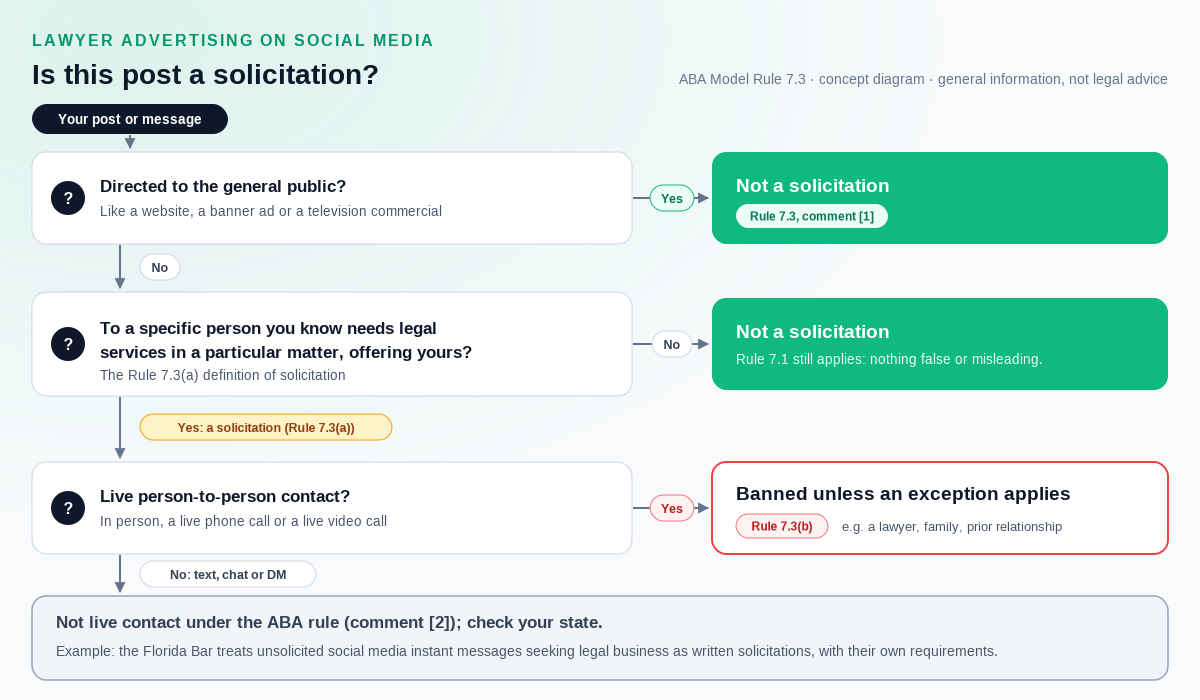
Rule 7.1 bans false or misleading statements, Rule 7.2 governs paid advertising, recommendations, “specialist” claims and contact details, and Rule 7.3 bans live person-to-person solicitation. A communication directed to the general public is not a solicitation under the Model Rule; a message aimed at a specific person who needs help with a particular matter can be.
Rule 7.1: nothing false or misleading
A lawyer shall not make a false or misleading communication about the lawyer or the lawyer’s services, including one that leaves out a fact needed to keep the whole statement from being materially misleading. Checked against American Bar Association: Model Rules of Professional Conduct, Rule 7.1 Communications Concerning a Lawyer's Services (archived)Archived copy, 1 November 2026 View the archived copy True statements can still fail: comment [2] covers one that is substantially likely to lead a reasonable person to a specific conclusion about the lawyer with no reasonable factual foundation. Checked against American Bar Association: Comment on Rule 7.1 (archived)Archived copy, 7 April 2026 View the archived copy
Rule 7.2: ads, recommendations and lead generators
You may pay for advertising; you may not pay a person to recommend you. Rule 7.2(b) bars giving anything of value for a recommendation, with exceptions including paying for ads and nominal thank-you gifts not given as compensation. Checked against American Bar Association: Model Rule 7.2 and comment (archived)Archived copy, 11 November 2026 View the archived copy Comment [3] allows paying for directory listings, sponsorships and Internet ads, and paying marketing staff and vendors. Checked against American Bar Association: Comment on Rule 7.2 (archived)Archived copy, 3 November 2026 View the archived copy Comment [5] allows paying for leads only if the lead generator doesn’t recommend the lawyer or imply it has analysed the person’s legal problem. Checked against American Bar Association: Comment on Rule 7.2 (archived)Archived copy, 3 November 2026 View the archived copy
Rule 7.3: what counts as solicitation
Solicitation is a communication directed to a specific person the lawyer knows or reasonably should know needs legal services in a particular matter, offering to provide them. Checked against American Bar Association: Model Rule 7.3 Solicitation of Clients (archived)Archived copy, 26 March 2026 View the archived copy A communication to the general public, such as a billboard, an Internet banner ad or a website, is not a solicitation. Checked against American Bar Association: Comment on Rule 7.3 (archived)Archived copy, 1 November 2026 View the archived copy
Rule 7.3(b) bars soliciting by live person-to-person contact for pecuniary gain, except with lawyers, family, close personal or prior professional contacts and routine business users of that service; Rule 7.3(c) bars soliciting anyone who has said no, or by coercion, duress or harassment. Checked against American Bar Association: Model Rule 7.3 Solicitation of Clients (archived)Archived copy, 26 March 2026 View the archived copy Comment [2] counts in-person, live phone and other real-time visual or audio contact as live, but not chat rooms, text messages or other written messages. Checked against American Bar Association: Comment on Rule 7.3 (archived)Archived copy, 1 November 2026 View the archived copy A direct message is written, but a state can still regulate it: see Florida below.
Client confidentiality, testimonials and past results
Never post information about a client’s matter without the client’s informed consent. Model Rule 1.6(a) bars revealing information relating to a representation unless the client gives informed consent, the disclosure is impliedly authorized, or a listed exception applies. Checked against American Bar Association: Model Rule 1.6 Confidentiality of Information (archived)Archived copy, 23 October 2026 View the archived copy ABA Formal Opinion 480 adds two points that surprise many lawyers:
- Public records aren’t a free pass. Lawyers who blog, podcast or comment publicly may not reveal information relating to a representation, even if it is in a public record, unless a Model Rule allows it. Checked against ABA Standing Committee on Ethics and Professional Responsibility: Formal Opinion 480, Confidentiality Obligations for Lawyer Blogging and Other Public Commentary (archived PDF)Archived copy, 16 July 2023 View the archived copy
- A “hypothetical” doesn’t fix it if a reader could identify the client from the facts. Checked against ABA Formal Opinion 480 (6 March 2018, archived PDF)Archived copy, 16 July 2023 View the archived copy
Past results. Comment [3] to Rule 7.1 says a truthful report of results may mislead if readers would expect the same result regardless of their own facts; qualifying language may prevent that finding, but isn’t a guarantee. Checked against American Bar Association: Comment on Rule 7.1 (archived)Archived copy, 7 April 2026 View the archived copy
Testimonials. A testimonial reveals that someone was your client, so get consent and give nothing for it. Fake ones are also unlawful: 16 CFR 465.2 makes it unlawful for a business to create reviews or testimonials that misrepresent the reviewer or their experience, or to buy or spread ones it knew or should have known were false. Checked against eCFR: 16 CFR Part 465 — Rule on the Use of Consumer Reviews and Testimonials, § 465.2 The rule took effect on 21 October 2024 and lets the FTC seek civil penalties against knowing violators. Checked against FTC press release: Federal Trade Commission Announces Final Rule Banning Fake Reviews and Testimonials (14 August 2024)
How should lawyers handle comments and online reviews?
Carefully, and often by not replying at all. ABA Formal Opinion 496 says a negative online review alone does not permit disclosure in self-defense under Rule 1.6(b)(5), and that a reply revealing client information would go further than the rule allows anyway. Checked against ABA Standing Committee on Ethics and Professional Responsibility: Formal Opinion 496, Responding to Online Criticism (13 January 2021; copy hosted by the Colorado Bar Association) As a best practice, it says, consider not responding; if you do, disclose nothing, but you may invite the reviewer to get in touch privately or say professional considerations prevent a response. Checked against ABA Formal Opinion 496, Responding to Online Criticism (13 January 2021; Colorado Bar Association copy)
Illustrative reply: “Professional obligations prevent us from discussing any matter here. If you’d like to talk, please contact [lawyer name] at [phone or email].”
On Google, an approved reply appears publicly under the review in the business’s name. Checked against Google Business Profile Help: Manage customer reviews Ask for reviews honestly:
- No incentives or gating: Google Maps’ policy bars rewards for reviews and asking only happy clients. Checked against Google Maps User Generated Content Policy Help: Prohibited & restricted content
- No suppression: 16 CFR 465.7 bars unfounded legal threats or intimidation to stop or remove a review. Checked against eCFR: 16 CFR Part 465 — Rule on the Use of Consumer Reviews and Testimonials, § 465.7
- No gag clauses: the Consumer Review Fairness Act bars standard contract terms that restrict or penalize reviews. Checked against FTC Business Guidance: Consumer Review Fairness Act: What Businesses Need to Know
Comments that ask for advice. Formal Opinion 480 warns lawyers who interact on social media to avoid accidentally forming attorney-client relationships with readers. Checked against ABA Formal Opinion 480 (6 March 2018, archived PDF), footnote 4Archived copy, 16 July 2023 View the archived copy Answer in general terms only. Comments, messages and reviews are handled in each network’s own app:
State bar rules: Florida and New York as examples
Your state’s rules are what bind you, and they can be stricter than the ABA model, as Florida’s are on instant messages.
In Florida, for example, pages used only to keep in touch with family and close friends are outside the advertising rules, while pages that promote the practice are subject to them. Checked against The Florida Bar Standing Committee on Advertising: Guidelines for Networking Sites (revised 19 August 2020, PDF)
- Promotional pages may not refer to past results that aren’t objectively verifiable or make predictions or guarantees. Checked against The Florida Bar Standing Committee on Advertising: Guidelines for Networking Sites (revised 19 August 2020, PDF)
- Paid “boosted” posts must meet the advertising rules and be filed for review under Rule 4-7.19, unless they are “tombstone” ads. Checked against The Florida Bar Standing Committee on Advertising: Guidelines for Networking Sites (revised 19 August 2020, PDF)
- Posts targeted at people who have self-identified a specific legal need must meet Rule 4-7.18(b) and be filed. Checked against The Florida Bar Standing Committee on Advertising: Guidelines for Networking Sites (revised 19 August 2020, PDF)
- Unsolicited instant-message invitations to view your page, sent to get legal business, must meet the written-solicitation rules of Rule 4-7.18(b), unless sent to a current or former client, a relative, a prior professional contact or another lawyer. Checked against The Florida Bar Standing Committee on Advertising: Guidelines for Networking Sites (revised 19 August 2020, PDF)
- Lawyers aren’t responsible for what third parties post on their pages, unless they prompted it or used the third party to get around the advertising rules. Checked against The Florida Bar Standing Committee on Advertising: Guidelines for Networking Sites (revised 19 August 2020, PDF)
In New York, for example, many guides are out of date. New York used to require an “Attorney Advertising” label, the disclaimer “Prior results do not guarantee a similar outcome” on results claims and testimonials, and copies kept for set periods. Checked against New York State Supreme Court, Appellate Division: Joint Order amending 22 NYCRR Part 1200 (effective 1 June 2026), read against the pre-2026 unofficial compilation of Part 1200 on nycourts.gov (both archived)Archived copy, 31 October 2026 View the archived copy Since 1 June 2026 its new Rule 7.1 bans false or misleading communications and requires the name and contact information of a responsible lawyer or firm. Checked against New York State Supreme Court, Appellate Division: Joint Order amending 22 NYCRR Part 1200, Rules 1.0, 7.1, 7.3 and 7.4 (dated May 2026, effective 1 June 2026, PDF, archived)Archived copy, 31 October 2026 View the archived copy Its new Rule 7.3 bans live person-to-person solicitation for pecuniary gain, with listed exceptions. Checked against New York State Supreme Court, Appellate Division: Joint Order amending 22 NYCRR Part 1200, Rule 7.3 (effective 1 June 2026, PDF, archived)Archived copy, 31 October 2026 View the archived copy
Other states differ: check your state bar’s advertising rules before your first promotional post. Realtors face a similar layer of license-law ad rules: see real estate social media marketing.
A weekly social media plan for a small law firm
Three to four posts a week is a workable start: an explainer, a firm update, a lawyer’s own LinkedIn post and a short video. No source we read sets the right number for law firms, so treat this as a starting plan.
| Day | Post | Network | Rule check |
|---|---|---|---|
| Monday | Plain-language explainer | LinkedIn and Facebook | General terms; name and contact |
| Tuesday | Firm or community update | Facebook, LinkedIn company page | Client names only with consent |
| Wednesday | A lawyer’s own LinkedIn post | Never imply certification as a specialist unless an approved body certified you | |
| Thursday | Short video or Q&A | YouTube, Instagram or TikTok | No individual advice or client facts |
If you also post on X, our X marketing strategy covers its formats. Each network can get its own version of a post:
Pre-publish checklist (a starting list, not legal wording):
- Is it true, and could it still mislead (Rule 7.1)?
- Does it reveal anything about a client’s matter, even as a “hypothetical” (Rule 1.6)?
- Could readers expect the same result?
- Does it state or imply you are a certified specialist without an approved certification (Rule 7.2(c))? “Specializes in” based on experience is generally allowed under the Model Rule; check whether your state is stricter.
- Is a responsible lawyer or firm named, with contact details (Rule 7.2(d))?
- Is it aimed at a specific person who needs help with a matter (Rule 7.3)?
- Does your state require filing for this kind of post?
Write these checks into a social media policy for your firm.
Scheduling firm posts without skipping the ethics check
A scheduler publishes the posts; the ethics check stays with your lawyers. If your firm needs a review step or a record of what was posted, set those up separately. Here is where Outfeed stands on both:
Plan and schedule your firm’s posts with Outfeed AI
Other regulated industries face similar rules: see healthcare social media marketing and social media for financial services.
Frequently asked questions
Should law firms use social media?
Many lawyers already do. In the ABA’s 2024 Legal Technology Survey, 80% of responding lawyers reported some use of social media as a marketing tool, with LinkedIn the main platform. Every post still has to follow the lawyer advertising and confidentiality rules.
What ABA rules apply to lawyer social media?
Mainly Model Rules 7.1 (no false or misleading communications), 7.2 (advertising, paying for recommendations, specialist claims and contact details), 7.3 (solicitation) and 1.6 (confidentiality). States adopt their own versions, so check your bar’s rules.
Can lawyers reply to negative online reviews?
They may, but must not reveal client information. ABA Formal Opinion 496 says a negative review alone does not permit disclosure in self-defense and that, as a best practice, lawyers should consider not responding.
Is messaging a potential client on social media solicitation?
Under the ABA Model Rule, live person-to-person contact excludes text messages and chat, but a message aimed at a specific person who needs legal help can still be a solicitation, and some states, such as Florida, treat unsolicited instant messages as written solicitations with their own requirements.
Can lawyers post client testimonials on social media?
Only with the client’s informed consent, and only if the testimonial is not misleading, for example by implying the same result for others. Nothing of value may be given for it, and creating or buying fake reviews or testimonials is unlawful under the FTC’s rule on consumer reviews and testimonials.