
Healthcare Social Media Marketing: A HIPAA-Aware Guide
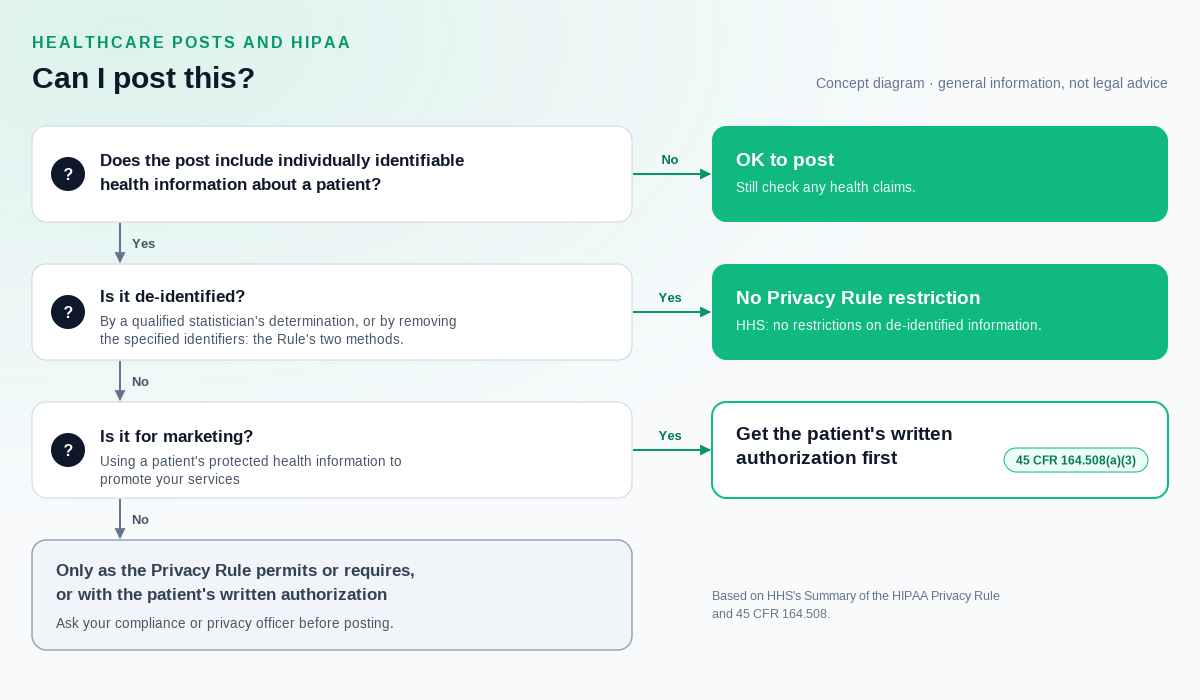
Healthcare social media marketing starts with one test for every post: does it reveal anything about a patient? If it doesn’t, hospitals and practices can post education, service news, events and recruitment freely. If it does, HIPAA usually requires the patient’s written authorization before the post goes up. This guide turns HHS’s own rules, the settlements its Office for Civil Rights has reached over social media and review replies, and the AMA’s ethics guidance into a “can I post this?” check for each kind of post.
This is general information, not legal or medical advice; check with your compliance team or a lawyer before you act on it.
Table of Contents
- What is healthcare social media marketing?
- Social media and HIPAA: what does it mean for posts?
- What can hospitals and medical practices post?
- Patient stories, testimonials and review replies: what OCR has settled
- Tracking pixels and health ads: what HHS and Meta say
- Staff and physician accounts: what goes in a social media policy
- Which social media platforms work for healthcare organizations?
- Where a scheduling tool fits in a healthcare team
- Frequently asked questions
What is healthcare social media marketing?
Healthcare social media marketing (social media marketing for healthcare) is social media marketing done by hospitals, medical practices, clinics and health brands: education, service news, events, recruitment and community updates. The Cambridge Business English Dictionary defines social media marketing as advertising products, services or brands online by attracting the interest of groups of people who discuss them and make suggestions about them. Checked against Cambridge Business English Dictionary: social media marketing What makes healthcare different is who is posting.
HHS says the HIPAA Privacy Rule applies to health plans, health care clearinghouses and any health care provider that transmits health information electronically for standard transactions such as claims and eligibility inquiries; using email alone doesn’t make a provider a covered entity. Checked against HHS Office for Civil Rights: Summary of the HIPAA Privacy Rule If your organization is covered, the rules below apply to its social accounts like any other channel.
The basics every industry shares, from goals to a posting rhythm, are in the full social media marketing playbook. This page covers what changes when patients are involved. It makes no medical claims, and neither should your posts without evidence.
Social media and HIPAA: what does it mean for posts?
HIPAA protects patient information, not posting itself: a covered entity may not use or disclose protected health information except as the Privacy Rule permits or the patient authorizes in writing. Checked against HHS Office for Civil Rights: Summary of the HIPAA Privacy Rule
Four definitions decide most social media questions:
- Protected health information (PHI) is all individually identifiable health information a covered entity or its business associate holds or sends, in any form, including identifiers such as name, address and birth date. Checked against HHS Office for Civil Rights: Summary of the HIPAA Privacy Rule A name in a caption can be enough, and two of the settlements below involved patient photos.
- De-identified information carries no Privacy Rule restrictions, but only when it is produced one of two ways: a qualified statistician’s determination, or removal of specified identifiers of the person and of relatives, household members and employers. Checked against HHS Office for Civil Rights: Summary of the HIPAA Privacy Rule Cropping a photo or dropping a surname doesn’t by itself meet either method.
- Marketing means a communication about a product or service that encourages people to buy or use it, with exceptions such as treatment communications and certain communications about the covered entity’s own health-related services. Checked against eCFR: 45 CFR 164.501 — Definitions (up to date as of 19 Nov 2026)
- Authorization for marketing. A covered entity needs the individual’s authorization for any use or disclosure of PHI for marketing, except face-to-face communication or a promotional gift of nominal value; if a third party pays for it, the authorization must say so. Checked against eCFR: 45 CFR 164.508 — Uses and disclosures for which an authorization is required
What can hospitals and medical practices post?
Anything that holds no patient information is open: health education, service and equipment news, events and hiring. Patient stories need written authorization, and replies to reviews need the most care.
| Post type | Can you post it? | What to check |
|---|---|---|
| General health education | Yes | Health claims need evidence (below) |
| New service, specialty or equipment | Yes | No patient details in the post |
| Events, screenings, community news | Yes | Photos of attendees only with their OK |
| Staff spotlights and hiring | Yes, with the staff member’s agreement | Keep patients out of the frame |
| Patient stories, photos, testimonials | Only with the patient’s written authorization | Authorization in hand before drafting |
| Replies to reviews | With care | Never confirm the reviewer is a patient |
Service news is the clearest case in HHS’s own guidance: it gives, as an example of a communication that is not marketing, a hospital using its patient list to announce a new specialty group or new equipment, such as an MRI machine, through a general mailing or publication, because that describes its own health-related services. Checked against HHS Office for Civil Rights: Marketing (HIPAA Privacy Rule guidance)
Claims are a separate test. FTC staff’s Health Products Compliance Guidance (December 2022) counts social media and influencer marketing as advertising, held to the same truth-in-advertising principles Checked against FTC: Health Products Compliance Guidance (published 20 Dec 2022), and says claims about the health benefits or safety of health-related products need “competent and reliable scientific evidence”, which generally means randomized, controlled human clinical testing. Checked against FTC: Health Products Compliance Guidance
To review what your accounts already show, work through our free social media audit template.
Patient stories, testimonials and review replies: what OCR has settled
HHS’s Office for Civil Rights has settled at least five cases over patient information posted online: on websites, on social media and in replies to online reviews. Each provider also agreed to a corrective action plan.
| Year | Provider | What was posted | Settlement | Source |
|---|---|---|---|---|
| 2016 | Complete P.T., Pool & Land Physical Therapy (Los Angeles area) | Patient testimonials with full names and full-face photos on its website, without valid authorizations | $25,000 | Checked against HHS Office for Civil Rights: Physical therapy provider settles violations that it impermissibly disclosed patient information (12 February 2016) |
| 2019 | Elite Dental Associates (Dallas, Texas) | Patients’ PHI disclosed on social media | $10,000 | Checked against HHS OCR resolution agreement page: Dental Practice Pays $10,000 to Settle Social Media Disclosures of Patients' Protected Health Information (2 Oct 2019) |
| 2022 | New Vision Dental (California) | Patients’ names, treatment and insurance details in replies to online reviews | $23,000 | Checked against HHS OCR resolution agreement page: New Vision Dental (14 Dec 2022) and the HHS press release of the same date (archived) |
| 2023 | Manasa Health Center (New Jersey) | A patient’s PHI in a response to that patient’s negative online review | $30,000 | Checked against HHS OCR resolution agreement page: Manasa Health Center (5 June 2023) |
| 2025 | Cadia Healthcare Facilities (Delaware) | A patient’s name, photo, conditions, treatment and recovery as a website “success story”, without a valid written authorization | $182,000, with a plan monitored for two years | Checked against HHS Office for Civil Rights press release: OCR Settles HIPAA Investigation of Cadia Healthcare Facilities (30 September 2025) |
Patient stories. Get the written authorization first, then draft. Even with it, a testimonial isn’t proof: the FTC’s health guidance says testimonials are not substantiation, and the advertiser still needs scientific evidence that the product works as it did for the endorser. Checked against FTC: Health Products Compliance Guidance (endorsements and testimonials section) The FTC’s rule on consumer reviews and testimonials, effective 21 October 2024, lets the FTC seek civil penalties against knowing violators, and it covers fake reviews and review suppression. Checked against FTC press release: Federal Trade Commission Announces Final Rule Banning Fake Reviews and Testimonials (14 August 2024)
Review replies. On Google, an approved reply is public under the review, in the business’s name. Checked against Google Business Profile Help: Manage customer reviews A pattern that keeps patient details out (illustrative, not an HHS template):
- Thank the person for the feedback.
- Don’t confirm or deny that they are a patient, and mention no visit, treatment or detail.
- Give a phone number or email for the practice manager and invite them to get in touch.
Illustrative reply: “Thank you for taking the time to write this. We take every concern seriously and would like to talk. Please call our practice manager at [number].”
Tracking pixels and health ads: what HHS and Meta say
HHS says HIPAA applies when information collected through tracking technologies includes protected health information. Its bulletin adds that disclosing PHI to a tracking-technology vendor without patients’ authorizations needs a signed business associate agreement and a Privacy Rule permission. Checked against HHS Office for Civil Rights: Use of Online Tracking Technologies by HIPAA Covered Entities and Business Associates
Part of that bulletin no longer stands. On 20 June 2024 a federal court in Texas (American Hospital Association v. Becerra) vacated only the part saying HIPAA is triggered when a tracker links an IP address to a visit to an unauthenticated public page about specific health conditions or providers; HHS says it is evaluating next steps. Checked against HHS Office for Civil Rights: Use of Online Tracking Technologies (vacatur notice at the top of the page) The rest still applies.
Meta has its own rules, separate from HIPAA:
- No health data through its tools. Advertisers must not use the Meta Business Tools, such as the Meta Pixel, to share prohibited information, which includes health information, and event, conversion and Custom Audience names must not reflect it. Checked against Meta Business Help Center: About Prohibited Information
- Restricted data sources. Meta may place a website or app in a data source category that blocks some mid- and lower-funnel events or all event sharing; under full restrictions it suggests objectives such as Awareness, Engagement and Traffic. Checked against Meta Business Help Center: Understand data sharing restrictions based on data source categories
- Adults only for some health ads. Ads for dietary, health, weight-loss or weight-gain products and services, and for cosmetic products and procedures, must target people 18 or older and avoid clickbait health claims. Checked against Meta Transparency Center: Advertising Standards, Health and Wellness
If you work for a drug or device maker rather than a provider, note that the FDA’s 2014 guidance on character-limited platforms is still a draft, not for implementation, and covers those firms, not clinics. Checked against U.S. Food and Drug Administration: guidance document page, docket FDA-2014-D-0397 (archived)Archived copy, 20 September 2026 View the archived copy
Staff and physician accounts: what goes in a social media policy
A short written policy prevents most problems, because staff post from personal accounts too. The AMA’s Opinion 2.3.2 says physicians and medical students should not publish patient information online without appropriate consent, should keep patient-physician boundaries, should disclose financial interests such as paid partnerships, and should share only useful, accurate health information. Checked against AMA Code of Medical Ethics: Opinion 2.3.2 Professionalism in the Use of Social Media It also says they can’t realistically separate personal and professional personas online, and that even personal posts can damage a professional reputation. Checked against AMA Code of Medical Ethics: Opinion 2.3.2 Professionalism in the Use of Social Media Physicians paid by drug or device companies as advisers or speakers are often called KOLs in pharmaceutical marketing; see what a KOL is in healthcare marketing.
A workable policy answers these questions (a checklist, not legal wording):
- Who may post for the organization, and who signs off posts that mention patients.
- Patient information: never on personal or official accounts without written authorization, including photos taken in clinical areas.
- Reviews and comments: who replies, using the pattern above.
- Personal accounts: staff speak for themselves, keep patient-physician boundaries and disclose paid partnerships.
- Mistakes: who to tell, and how fast a post comes down.
Our free social media strategy template has room for these rules beside your goals and posting plan.
Which social media platforms work for healthcare organizations?
Start with the networks your patients and future staff already use, and only as many as you can keep current. In Pew Research Center’s 2026 survey of 5,511 U.S. adults, 84% said they use YouTube, 70% Facebook, 51% Instagram, 37% TikTok and 31% LinkedIn. Checked against Pew Research Center: Americans' Use of Social Media in 2026 (fact sheet, 19 Oct 2026)
- Facebook and Instagram suit community updates, events and service news.
- YouTube suits explainer videos. If several people manage the channel, set it up as a YouTube Brand Account so it belongs to the organization, not one person.
- LinkedIn suits recruitment and news for referring physicians and partners.
Whichever you pick, keep the same name, look and tone across all of them; our guide to social media branding shows how.
Where a scheduling tool fits in a healthcare team
A scheduler handles the publishing; the rules above stay with your team. For what a scheduler does on each network, see how Outfeed’s social media scheduler publishes to each network. Whether a post contains patient information is a judgment your team makes before the post reaches any tool, and patient information stays out of any tool your compliance team hasn’t approved. Here is what Outfeed does and doesn’t do:
Schedule your organization’s posts with Outfeed AI
Financial firms face a similar set of rules; see social media marketing for financial services.
Frequently asked questions
Is it a HIPAA violation to post on social media?
Posting is not a violation in itself. It becomes one when a covered entity shares a patient’s protected health information, such as a name, photo or treatment detail, without the patient’s written authorization or another permission in the Privacy Rule.
Can healthcare providers respond to patient reviews online?
Yes, but carefully. HHS’s Office for Civil Rights has settled cases with providers that disclosed patient information in replies to online reviews, so a reply that keeps patient information out does not confirm the person is a patient and moves the conversation offline.
Can a doctor post patient photos with consent?
Only with the patient’s written authorization. A covered entity may disclose protected health information only as the Privacy Rule permits or the patient authorizes in writing, marketing uses need that authorization, and the AMA’s ethics guidance says physicians should not publish patient information online without appropriate consent.
Which social media platform is best for healthcare organizations?
It depends on the audience. Facebook and Instagram suit community updates, YouTube suits explainer videos and LinkedIn suits recruitment. Post only where you can keep up regularly.
Do HIPAA rules apply to tracking pixels on a clinic website?
HHS says HIPAA applies when information collected through tracking technologies includes protected health information. A 2024 court ruling vacated one part of that guidance, about unauthenticated public pages, so check the current bulletin with your compliance team.