
Social Media Marketing for Financial Services: The Rules

Social media marketing for financial services runs on the same rules as a firm’s ads, letters and website: FINRA for broker-dealers, the SEC Marketing Rule for investment advisers, and existing consumer-protection law for banks and credit unions. The practical questions are which posts need approval first, what you must archive, and when a like or a share turns someone else’s words into your advertisement.
This guide is general information, not legal or financial advice. Involve your compliance team before you change how your firm posts.
Table of Contents
- What is social media marketing for financial services?
- Which rules apply? FINRA, the SEC Marketing Rule and bank guidance
- Static vs interactive posts: what needs approval first?
- Social media archiving for financial advisors: what firms must keep
- What can financial advisors, banks and insurers post?
- Testimonials, likes and shares: when you adopt someone else’s words
- A compliant posting workflow: draft, review, approve, publish, archive
- Which social media tools do financial firms use?
- Financial services social media FAQ
What is social media marketing for financial services?
It is marketing on social networks by banks, credit unions, broker-dealers, investment advisers and insurers, under the same communications rules that apply to their ads, letters and websites. For banks, no new rulebook was written: the FFIEC’s 2013 guidance for banks, savings associations, credit unions and CFPB-supervised nonbanks says existing consumer protection and compliance laws apply to social media just as to other channels, and that it imposes no new requirements. Checked against FDIC Financial Institution Letter: Social Media: Consumer Compliance Risk Management Guidance (FFIEC, 2013)
So the marketing side looks like any other industry’s, and the general planning steps are in our small business social media marketing playbook. What changes is the review around each post.
Which rules apply? FINRA, the SEC Marketing Rule and bank guidance
Which rules apply depends on what the firm is: FINRA rules cover member broker-dealers and their registered reps, the SEC Marketing Rule covers registered investment advisers, and banks and credit unions apply existing consumer-protection law under the FFIEC’s 2013 guidance.
| Rule or guidance | Who it covers | What it means for a post | Source |
|---|---|---|---|
| FINRA Rule 2210 (communication types) | FINRA member broker-dealers and their associated persons | Correspondence goes to 25 or fewer retail investors within 30 days, retail communications to more than 25, institutional communications only to institutional investors | Checked against FINRA Rule 2210: Communications with the Public |
| FINRA content standards | Same | Posts must be fair, balanced and complete, with no false, promissory or exaggerated claims and, generally, no performance predictions | Checked against FINRA Key Topics: Social Media (Fair and Balanced Communications) |
| FINRA Regulatory Notices 10-06, 11-39, 17-18 | Same | FINRA’s social media guidance, published 25 January 2010, 18 August 2011 and 25 April 2017 | Checked against FINRA.org notice pages for Regulatory Notices 10-06, 11-39 and 17-18 ('Published Date' field) |
| FINRA Rule 2210 interactive-post amendments | Same | FINRA codified its guidance on supervising interactive posts in Rule 2210, effective 4 February 2013 | Checked against FINRA Regulatory Notice 17-18 (Background) and Regulatory Notice 11-39 |
| SEA Rule 17a-4 and FINRA Rule 4511 | Same | Business communications, including posts, are records to keep for at least three years | Checked against FINRA Key Topics: Social Media (Books and Records) |
| SEC Marketing Rule, 206(4)-1 | SEC-registered investment advisers | Amended December 2020, effective 4 May 2021, compliance required from 4 November 2022; governs testimonials and endorsements | Checked against SEC Division of Investment Management: Marketing Compliance Frequently Asked Questions |
| FFIEC social media guidance (2013) | Banks, savings associations, credit unions, CFPB-supervised nonbanks | Existing consumer protection and compliance laws apply on social media as in other channels | Checked against FDIC Financial Institution Letter: Social Media: Consumer Compliance Risk Management Guidance (FFIEC, 2013) |
| Meta Special Ad Category “Financial products and services” | Advertisers based in or reaching the United States | Paid campaigns for financial products and services must select it from 21 January 2025, or ads may be rejected; organic posts are not affected | Checked against Meta Business Help Center: Special Ad Categories have expanded and now include financial products and services |
| NAIC Model 570 | Life insurance and annuities, in states that adopt it | Internet material counts as advertising, and the insurer’s name must be clearly identified | Checked against National Association of Insurance Commissioners: Model 570, Advertisements of Life Insurance and Annuities Model Regulation (NAIC Model Laws, 2nd Quarter 2015) |
For anyone running paid campaigns or tracking, Meta also says advertisers must not use its Business Tools, such as the Meta Pixel, to share prohibited information, which includes financial information. Checked against Meta Business Help Center: About Prohibited Information
For insurers, Model 570 is a model regulation: it binds only in states that adopt it, sometimes with changes, and it covers life insurance and annuities only. Insurers should check their state insurance department for the rules that apply to them.
Static vs interactive posts: what needs approval first?
FINRA treats a post that stays up (static content) as a communication that usually needs a registered principal’s approval before use, while real-time interactive posts need no prior approval if the firm supervises them like correspondence. FINRA says static content usually must be approved by a registered principal before use and is sometimes filed with FINRA; interactive communications need no prior approval if supervised like correspondence, with written procedures covering training, surveillance, follow-up on problems and documentation. Checked against FINRA Key Topics: Social Media
The rule text behind this: Rule 2210(b)(1)(A) requires an appropriately qualified registered principal to approve each retail communication before the earlier of its use or its filing with FINRA. Checked against FINRA Rule 2210(b)(1)(A) Retail communications posted on an online interactive forum are excepted from prior approval if supervised like correspondence, and are excluded from filing; those provisions took effect on 4 February 2013. Checked against FINRA Rule 2210 (b)(1)(D), (c)(7)(M), with Regulatory Notice 17-18 footnote 1
A post drafted in advance and scheduled is not a real-time reply, so ask your compliance team whether your procedures treat it as static content that needs approval first. The sites themselves need sign-off too. A registered principal must review, before use, any social media site an associated person intends to use for business, and may approve it only after deciding the person can and will follow the rules. Checked against FINRA Key Topics: Social Media (Supervision)
Social media archiving for financial advisors: what firms must keep
Firms must keep records of business communications, including social media posts, for at least three years, and what must be kept depends on the content, not the app or device used. FINRA says this “business as such” test is about what the message says, and the underlying rule is SEA Rule 17a-4(b)(4), which requires the first two years to be kept in an easily accessible place. Checked against FINRA Key Topics: Social Media (Books and Records)
Four points trip firms up:
- Six years is the fallback, not the social media rule. FINRA Rule 4511 sets six years only for FINRA records with no other retention period. Checked against FINRA Rule 4511: General Requirements
- Third-party posts count. Posts by others on a firm’s interactive page are generally outside the advertising rules unless the firm adopts them or becomes entangled with them, but recordkeeping still applies. Checked against FINRA Key Topics: Social Media (Third-Party Posts)
- Messaging apps need retention first. A firm that lets staff discuss its business by text or chat must first make sure it can keep those records as SEA Rules 17a-3 and 17a-4 and FINRA Rule 4511 require. Checked against FINRA Regulatory Notice 17-18, Q1 Direct messages on social networks raise the same question.
- Personal accounts used for business. FINRA’s advertising rules don’t apply to personal use, but firms must teach staff the difference, because business use of a personal account can leave the firm unable to keep required records. Checked against FINRA Key Topics: Social Media (Books and Records)
In practice, firms capture posts with an archiving system the compliance team approves. Two vendors that describe such services are listed in the tools section.
What can financial advisors, banks and insurers post?
Education, firm and community news and people stories usually need the least review, as long as anything about products or performance is fair, balanced and approved where the rules require it. Product posts are where the review burden sits. The rules don’t pick a best platform for financial services either: what must be kept depends on the content, not the app or device used Checked against FINRA Key Topics: Social Media (Books and Records), so choose networks your firm can supervise and archive.
Financial advisor social media marketing: advisers and registered reps
Posts that don’t concern the firm’s products or services sit outside Rule 2210. FINRA says a rep’s personal post sharing firm content about a charity sponsorship, a human-interest article or a job opening is not subject to it. Checked against FINRA Regulatory Notice 17-18, Q2 Anything about products still has to be fair, balanced and complete. Checked against FINRA Key Topics: Social Media (Fair and Balanced Communications)
Watch links: a firm may not link to a third-party site it knows or has reason to know contains false or misleading content. Checked against FINRA Regulatory Notice 11-39: Social Media Websites and the Use of Personal Devices for Business Communications One rule you can relax: the BrokerCheck link required on firm websites is not required on social media, email or text. Checked against FINRA Regulatory Notice 17-18, Q12 (citing Regulatory Notice 15-50)
Lower-risk formats include market-education explainers (approved as static content), office and team news, and community work. Our LinkedIn post ideas give more formats, and the LinkedIn Company Page guide covers setting up the firm’s page.
Social media for banks and credit unions
Banks and credit unions post under the consumer-protection laws that already govern their ads. Checked against FDIC Financial Institution Letter: Social Media: Consumer Compliance Risk Management Guidance (FFIEC, 2013) Education, branch and community news and service updates are the usual mix. One specific warning in the FFIEC guidance: creditors may not, with limited exceptions, ask for information such as an applicant’s race, color, religion, national origin or sex, and should make sure they don’t request, collect or use it through social media in breach of fair lending laws. Checked against FDIC Financial Institution Letter: Social Media: Consumer Compliance Risk Management Guidance (Fair Lending section) Keep application questions off comment threads and social forms.
Insurers
Insurers follow their state insurance regulator’s advertising rules. For life insurance and annuities, the NAIC’s model regulation says testimonials must be genuine, current and accurately reproduced, that the insurer or producer makes their statements its own, and that a testimonial giver’s financial interest must be prominently disclosed. Checked against National Association of Insurance Commissioners: Model 570, Advertisements of Life Insurance and Annuities Model Regulation (NAIC Model Laws, 2nd Quarter 2015) Check with your state insurance department which version applies to you.
Testimonials, likes and shares: when you adopt someone else’s words
Sharing or linking third-party content adopts it, and on a business account even liking a client’s compliment adopts it, which brings in the testimonial rules. FINRA says that by sharing or linking to specific third-party content, such as an article or video, a firm adopts it and must hold it to the same standards as its own communications. Checked against FINRA Regulatory Notice 17-18, Q3 Unsolicited favourable comments are not the rep’s communications, but if the rep likes or shares them on a business account, the rep has adopted them, testimonial requirements included. Checked against FINRA Regulatory Notice 17-18, Q8 and Q9
Moderation is not adoption: routinely blocking or deleting content such as offensive material does not mean the firm has adopted the posts left on its page. Checked against FINRA Regulatory Notice 17-18, footnote 10 (quoting Regulatory Notice 11-39)
Influencer posts are the firm’s problem too. FINRA regards a firm as entangled with any post it arranges an influencer to make, and says such posts should be clearly identified as advertisements with the broker-dealer’s name. Checked against FINRA Regulatory Notice 17-18, Q7 In the US, the FTC adds that a material connection the audience wouldn’t expect, such as payment or free products, must be disclosed clearly and conspicuously. Checked against eCFR: 16 CFR § 255.5(a) Disclosure of material connections
Broker-dealers and advisers follow different testimonial rules:
| Broker-dealers: FINRA Rule 2210(d)(6) | Investment advisers: SEC Rule 206(4)-1 | |
|---|---|---|
| What counts | A testimonial about a member’s investment advice or performance | A testimonial comes from a current client or private-fund investor; an endorsement from anyone else Checked against eCFR: 17 CFR 275.206(4)-1 — Investment adviser marketing (definitions (e)(5) and (e)(17)) |
| Required disclosures | It may not be representative of other customers’ experience; it is no guarantee of future performance or success; it is a paid testimonial if more than $100 in value was paid Checked against FINRA Rule 2210(d)(6): Testimonials | Whether the person is a current client; whether cash or non-cash compensation was provided; a brief statement of material conflicts of interest; the material terms of any compensation Checked against eCFR: 17 CFR 275.206(4)-1(b)(1) — Required disclosures |
| Other conditions | Disclosures can sit in an interactive post near the testimonial or behind a clearly marked link such as “important testimonial information” Checked against FINRA Regulatory Notice 17-18, Q10 | A reasonable basis to believe each testimonial complies, a written agreement with anyone giving one, and no pay to disqualified persons Checked against eCFR: 17 CFR 275.206(4)-1(b)(2)–(3) |
| Small payments | Paid disclosure applies above $100 | $1,000 or less over 12 months is de minimis: exempt from the written-agreement and disqualification conditions, but the disclosures still apply Checked against eCFR: 17 CFR 275.206(4)-1(b)(4)(i) and (e)(2) |
One trap: Notice 17-18’s answer on testimonial disclosures (Q10) also quotes the old Advisers Act ban on “any testimonial of any kind”. Checked against FINRA Regulatory Notice 17-18, Q10 The amended SEC Marketing Rule, with compliance required from 4 November 2022, replaced it. Checked against SEC Division of Investment Management: Marketing Compliance Frequently Asked Questions Don’t quote that paragraph as current law.
A compliant posting workflow: draft, review, approve, publish, archive
A workable workflow has five steps: draft, compliance review, principal approval where required, publish, and archive, with interactive replies supervised like correspondence.
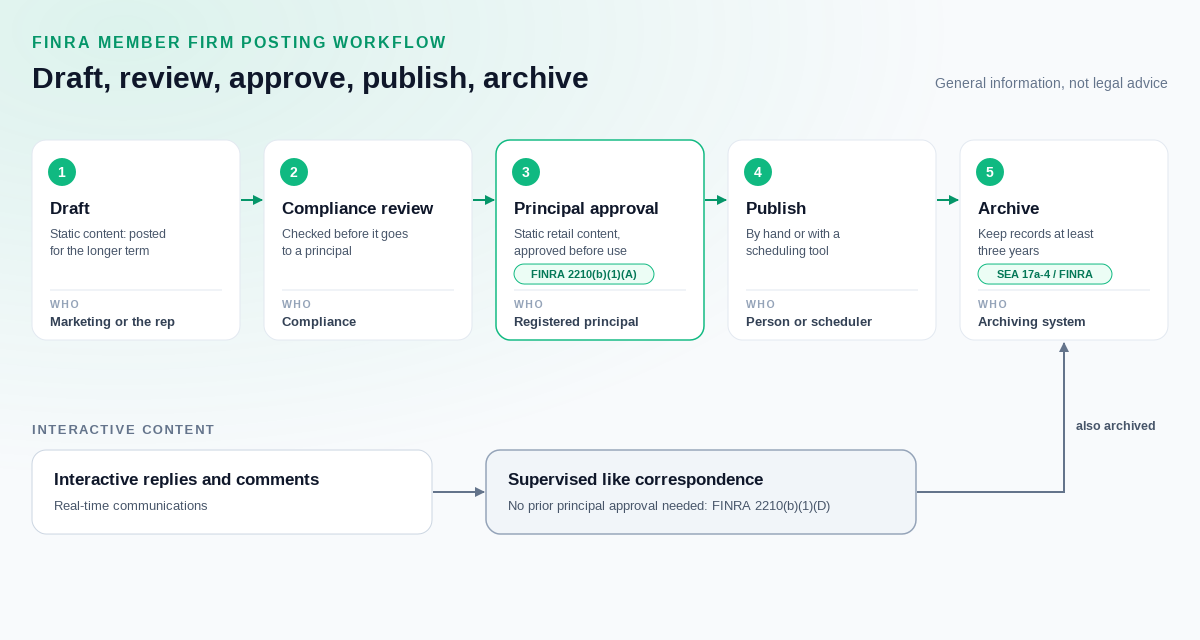
- Draft (marketing or the rep). Write the post and attach any third-party content you plan to share, since sharing adopts it.
- Compliance review. Check fair and balanced content, links and any testimonial disclosures.
- Principal approval (registered principal). Rule 2210 requires it for each retail communication before use Checked against FINRA Rule 2210(b)(1)(A), with an exception for interactive posts supervised like correspondence Checked against FINRA Rule 2210 (b)(1)(D), (c)(7)(M), with Regulatory Notice 17-18 footnote 1; FINRA says static posts usually need it. Checked against FINRA Key Topics: Social Media
- Publish (by hand or with a scheduling tool). Post exactly the approved version at the approved time.
- Archive (the archiving system). Keep the record for at least three years. Checked against FINRA Key Topics: Social Media (Books and Records)
Replies and comments take the side branch: supervised like correspondence, without prior approval, and archived. Checked against FINRA Key Topics: Social Media Track what went out each month with the social media report template.
Which social media tools do financial firms use?
Financial firms usually combine three kinds of tool: a publishing tool, an approval step (built into some suites or run by compliance), and an archiving system that captures posts from the networks. There is no single best social media tool for financial services; check each against your written procedures.
| Tool | What the vendor says it does | Fits if |
|---|---|---|
| Hootsuite | Post approval workflows, internal comments and suspending scheduled posts on Advanced and Enterprise only Checked against Hootsuite: Plans, Prices, and FeaturesVendor's own description | You want approvals inside the scheduler and are on a higher tier |
| Buffer | Content approval workflows and access levels on its Team plan Checked against Buffer: PricingVendor's own description | A small team needs a simple approval step |
| Agorapulse | Simple approval workflows, with multi-step approvals on its Custom plan Checked against Agorapulse: Pricing PlansVendor's own description | Several reviewers must sign off in sequence |
| Planable | An approval flow per workspace and post version history kept for a period set by plan Checked against Planable: PricingVendor's own description | You need a visible history of what changed |
| Smarsh | Captures and archives posts, comments, direct messages and media on LinkedIn, Instagram, TikTok, Facebook and X, and says it is built for SEC Rule 17a-4 and FINRA Rules 3110 and 4511; prices not published Checked against Smarsh: Social Media Archiving for SEC & FINRA ComplianceVendor's own description | You need an archive for business communications |
| Global Relay | Collects data from LinkedIn, X, Facebook, Instagram and YouTube through connectors, for individual or corporate profiles; prices not published Checked against Global Relay: Social ArchiveVendor's own description | You need individual reps’ profiles captured |
Fit with your obligations is each vendor’s own claim, not a regulator’s finding. For a wider comparison, see social media management tools; if you’d rather hand the posting to someone else, social media management services covers the options. Health providers face a similar mix of rules: see healthcare social media marketing and HIPAA.
Where Outfeed fits, and where it doesn’t (for what it publishes on each network, see how Outfeed’s social media scheduler works):
Use Outfeed AI for the scheduling step
Financial services social media FAQ
What are FINRA’s rules for social media?
FINRA Rule 2210 applies to member firms’ social media like any other communication: posts must be fair and balanced Checked against FINRA Key Topics: Social Media (Fair and Balanced Communications), static content usually needs a registered principal’s approval before use, interactive posts must be supervised like correspondence Checked against FINRA Key Topics: Social Media, and records must be kept. Regulatory Notices 10-06, 11-39 and 17-18 explain how. This is general information, not legal advice.
Do financial firms have to archive social media posts?
Yes. FINRA says firms and their registered representatives must keep records of business communications for at least three years, and what must be kept depends on the content, not the device or app. Checked against FINRA Key Topics: Social Media (Books and Records) Firms usually use an archiving system their compliance team approves.
Can financial advisors post client testimonials on social media?
Registered investment advisers can, under the amended SEC Marketing Rule they had to comply with from 4 November 2022 Checked against SEC Division of Investment Management: Marketing Compliance Frequently Asked Questions, if they make the required disclosures and meet its oversight conditions. Broker-dealers follow FINRA Rule 2210, which also requires testimonial disclosures. Check the testimonials table in this guide and ask your compliance team.
Does liking a client’s comment count as a testimonial?
It can. FINRA’s Regulatory Notice 17-18 says that if a representative likes or shares a third party’s favourable comment on a business account, the representative has adopted it and the communications rules, including the testimonial requirements, apply. Checked against FINRA Regulatory Notice 17-18, Q8 and Q9
What should banks post on social media?
Financial education, community and branch news, service updates and people stories are the usual mix. The FFIEC’s guidance says existing consumer-protection and compliance laws apply on social media just as in other channels Checked against FDIC Financial Institution Letter: Social Media: Consumer Compliance Risk Management Guidance (FFIEC, 2013), so product posts need the same review as any other ad.