
Best Time to Post on Instagram (2026 Data Guide)
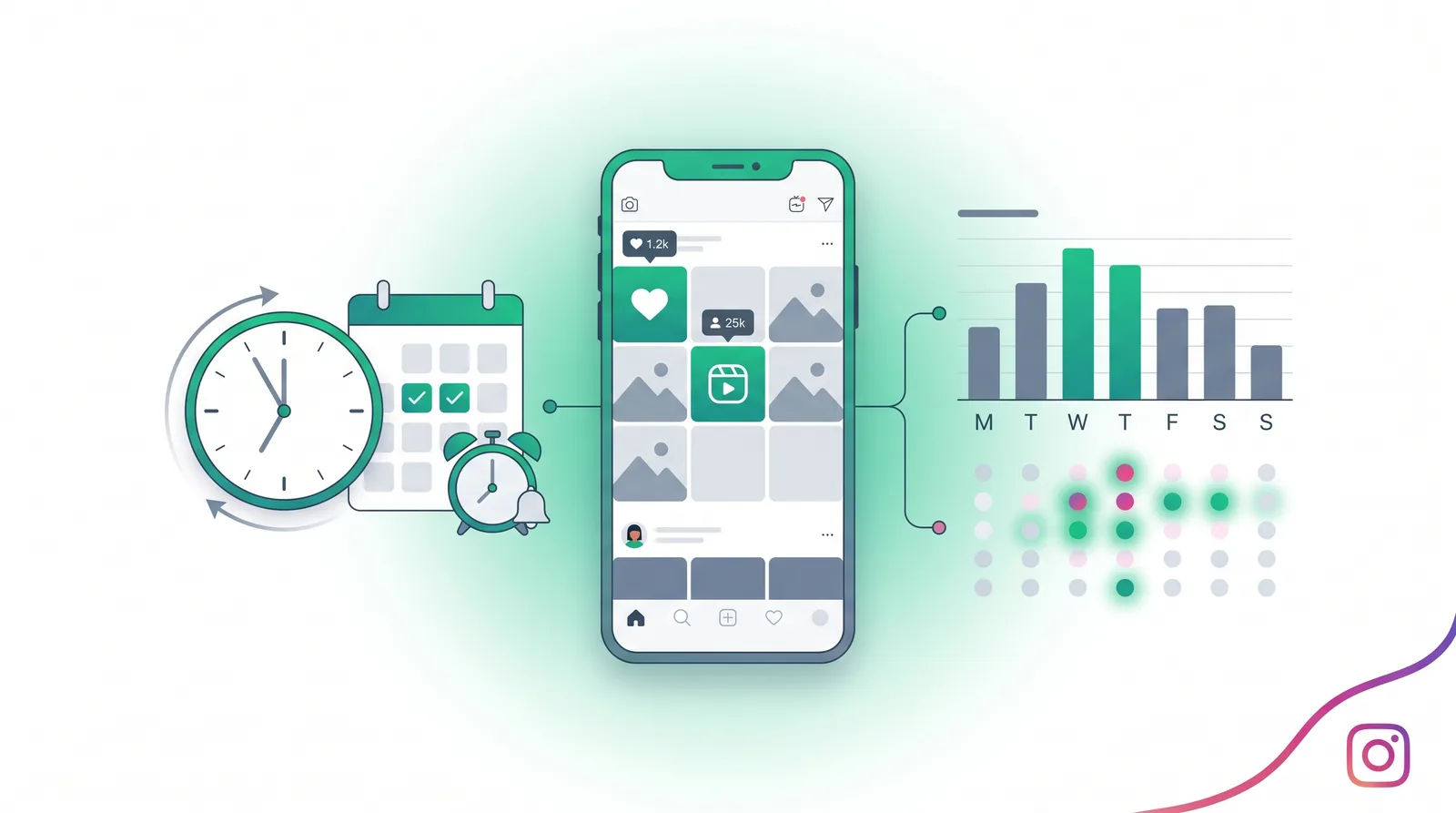
The best time to post on Instagram is one of the most-searched questions in social media — and the honest answer is more nuanced than any single chart suggests. If you’ve ever published a post that quietly flopped, timing was likely part of it. The catch: the major studies from Buffer, Sprout Social, and Later genuinely disagree with each other.
In this guide, you’ll get a clear day-by-day posting table, the reconciled answer behind conflicting data, dedicated Reels timing, the best windows for engagement and business accounts, and the exact steps to find your peak time in Instagram Insights. Everything is sourced and updated for 2026.
The Best Time to Post on Instagram (Quick Answer)
The best time to post on Instagram in 2026 is Tuesday through Thursday — peaking around Wednesday 12 PM, Thursday 9 AM, and weekday evenings 6-9 PM in your audience’s local time. Midweek afternoons and early evenings consistently show the highest engagement across the largest studies. But the single most reliable “best time” is when your specific audience is online — published windows are a starting point to test, not a rule.
Table of Contents
- Why the Studies Disagree
- Best Time to Post on Instagram in 2026
- Best Times to Post on Instagram by Day of the Week
- Best Day to Post on Instagram (and the Worst)
- Best Time to Post Instagram Reels
- Best Time to Post on Instagram for Engagement, Followers, and Business
- How Often Should You Post on Instagram?
- Why Timing Matters: Engagement Velocity and the 2026 Algorithm
- How to Find Your Own Best Time to Post
- How to Schedule Instagram Posts at the Right Time
- Frequently Asked Questions
Why the Studies Disagree
There is no single universal “best time” to post on Instagram because the major studies measure different datasets, time zones, and metrics — then reach conflicting conclusions. This is the part most guides skip, and it’s the most important thing to understand before you trust any chart.
The biggest divergence is time-zone basis. Sprout Social, Hootsuite, and Buffer report the viewer’s local clock and land on afternoon and evening peaks. Later normalizes to the audience’s local zone, which mechanically pulls “best time” toward early morning (around 5 AM) — when there’s less competition and you catch the first morning scroll.
Here’s how the major sources compare:
| Study | Dataset | Best overall window | Best day |
|---|---|---|---|
| Buffer | 9.6M posts, 200K+ accounts | Wed 12 PM, Thu 9 AM, evenings | Wednesday |
| Sprout Social | ~2B engagements, 307K profiles | Tue-Thu, midday-evening | Tue / Wed |
| Later | 6M+ posts (audience-local) | ~5 AM most days | Monday |
| Hootsuite | 1M+ posts, 118 countries | Weekday afternoons (3-7 PM) | Mon / Tue / Thu |
They also use different metrics and date ranges — Buffer measures median engagement across 2024-2025, while Sprout uses total engagements from late 2025 into 2026. The takeaway: treat published times as a hypothesis to test against your own Instagram Insights, not gospel. Every one of these publishers states the same disclaimer — your own analytics override their charts.
Best Time to Post on Instagram in 2026
The freshest 2026 data points to a midweek, viewer-local consensus: Wednesday around noon, Thursday morning, and weekday evenings 6-9 PM. Buffer’s 9.6-million-post analysis (the largest viewer-local dataset) and Later’s 6-million-post study agree on the shape of the week even when they disagree on the exact hour.
For the camp most readers can act on — viewer local time — the recurring high-engagement windows are:
- Wednesday 12 PM — the most consistently cited single best slot.
- Thursday 9 AM — Buffer’s standout morning window.
- Tuesday afternoon into evening — reliable across all three big studies.
- Weekday evenings, 6-9 PM — strong for feed posts and especially Reels.
If you only remember one thing: aim for midweek (Tuesday-Thursday), midday or early evening, then refine with your own numbers. The contrarian alternative — Later’s 5 AM audience-local window — is a real finding driven by low competition, and it’s worth testing for one to two weeks if your evenings feel crowded.
Best Times to Post on Instagram by Day of the Week
The best times to post on Instagram by day cluster around weekday afternoons and early evenings, peaking Tuesday through Thursday. Below is a consolidated table synthesizing Sprout Social, Hootsuite, and Buffer — the three large-sample studies that report windows in the reader’s own time zone.
| Day | Best window (your audience’s local time) | Notes |
|---|---|---|
| Monday | 2 PM - 4 PM, then 6 PM - 9 PM | Strong start to the week; Later names it the top day overall. |
| Tuesday | 1 PM - 7 PM (peak ~7 PM) | Top-three day across every source. |
| Wednesday | 12 PM - 6 PM (peaks ~12 PM and ~5-6 PM) | Most consistently cited single best day. |
| Thursday | 9 AM - 2 PM, then 4 PM - 5 PM | Buffer flags a 7-9 AM morning exception. |
| Friday | ~4 PM (weak; Buffer notes ~10 PM) | Engagement starts dropping. |
| Saturday | 11 AM and ~5 PM (low overall) | Weakest weekday in Sprout and Later. |
| Sunday | 12 PM - 3 PM | Modest; better than Saturday in some datasets. |
All windows are in your audience’s local time and are a starting point only. The universal “avoid” zone is 1 AM - 5 AM and very late nights after 10-11 PM, where engagement bottoms out in every viewer-local dataset. If your followers live in another region, convert these windows to their clock — covered in the Insights section below.
Best Day to Post on Instagram (and the Worst)
The best day to post on Instagram is Wednesday, followed by Thursday and Tuesday — the midweek block delivers the most consistent engagement across studies. Wednesday offers the widest high-performing window, from midday into early evening.
The single-best-day debate splits along dataset lines. Buffer and Sprout Social both crown Wednesday. Hootsuite leans toward Monday, Tuesday, and Thursday. Later’s normalized 6-million-post dataset is the outlier, naming Monday its top day because early-morning posts face the least competition.
The worst days are clearer: Friday and the weekend. Friday engagement starts sliding as attention drifts toward the weekend, and Saturday is the weakest day in both Sprout and Later. Sunday recovers slightly in the early afternoon. Our recommendation: anchor your most important content to a Tuesday-Thursday midday or evening slot, then run a controlled test on a weak day for two to three weeks — you may uncover an under-used window most accounts ignore.
Best Time to Post Instagram Reels
The best time to post Instagram Reels is weekday afternoons and evenings — roughly 12-2 PM and 6-9 PM, Monday through Thursday. Reels are the most-distributed format on Instagram, and timing them with your audience’s active hours maximizes the early plays that feed the algorithm.
Here’s the honest nuance the major studies reveal:
- Sprout Social says Reels timing mirrors your overall best windows — the algorithm prioritizes when your audience is active over what format you publish. Format doesn’t change the optimal time.
- Buffer found Reels peak in the evenings (6-11 PM) on Wednesday and Thursday, with carousels following the same midweek pattern.
- Later (analyzing 975K Reels) is the contrarian, naming 12 AM on Monday the top Reels slot — a low-competition artifact worth testing, not treating as gospel.
- Influencer Marketing Hub (100K+ short-form videos) flags Wednesday and Thursday as best days, with strong mid-morning (9-11 AM) and early-evening (7-8 PM) slots.
For most accounts, the safe play is to post Reels at the same midweek afternoon-to-evening windows as your feed, then experiment with one early-morning Reel per week to see if the low-competition theory holds for your audience. A strong hook in the first three seconds matters more than the exact minute — pair your timing with a tight caption from our free Instagram caption generator. Captions are capped at five hashtags since December 2025, so it is worth reading how to pick five hashtags for Instagram Reels before you spend the slots on #reels and #viral.
Best Time to Post on Instagram for Engagement, Followers, and Business
The best time to post on Instagram for engagement is right before your audience’s peak active hours, because early engagement velocity signals the algorithm to push your post wider. Strong likes, comments, and especially DM shares in the first hour are what turn a post into a candidate for Explore and the Reels feed.
Here’s how the ideal timing shifts by goal:
- For engagement: Post 30-60 minutes ahead of your peak window — midweek midday or early evening — so the post collects reactions during the algorithm’s critical first hour.
- For follower growth: Consistency beats any single perfect slot. Posting on a steady weekly rhythm trains both the algorithm and your audience to expect you.
- For business and small business: B2B and professional services often perform best 11 AM - 1 PM on weekdays, before the afternoon gets busy. B2C, retail, and lifestyle brands skew later — 6-9 PM when people relax and scroll.
Niche matters too. Fitness content often spikes in the early morning (5-7 AM), e-commerce around lunch (11 AM - 1 PM), fashion and beauty in the evening (6-9 PM), and food right before mealtimes. Whatever your niche, pair timing with discoverability — our free Instagram hashtag generator helps your posts reach beyond your existing followers. Keep the set short, though: Instagram’s hashtag limit is now five per post rather than 30, and the caption and first comment share those same five slots.
How Often Should You Post on Instagram?
The 2026 posting sweet spot is 3-5 feed posts per week, 2-4 Reels per week, and 1-3 Stories per day. Consistency and quality matter far more than hitting a volume target — the algorithm rewards a predictable rhythm over occasional bursts.
Here’s a simple frequency guide by format:
| Format | Recommended frequency | Why |
|---|---|---|
| Feed posts | 3-5 per week | Enough to stay visible without diluting quality. |
| Reels | 2-4 per week | Highest-reach format; prioritize if growth is the goal. |
| Stories | 1-3 per day | They expire in 24 hours, so frequency and consistency win. |
| Carousels | 1-2 per week | High saves and dwell time; follows the same midweek timing. |
The trap is sacrificing quality for quantity. One Reel with a strong hook and high completion rate will outperform three rushed posts. Stories are the exception to “best time” thinking — because they vanish in a day, regular posting matters more than the clock. If you can only sustain one excellent post a day, do that, then scale as your workflow allows.
Why Timing Matters: Engagement Velocity and the 2026 Algorithm
Yes, posting time matters — because it fuels early engagement velocity, and the first 30-60 minutes after posting heavily influence how far Instagram distributes your content. When you post when your audience is online, your likes, comments, and shares arrive fast, signaling the algorithm to expand your reach.
Here’s the mechanism: Instagram shows new content to a sample of your followers first. If they engage quickly — and especially if they send it to friends via DM — the algorithm pushes it wider. In 2026, Instagram head Adam Mosseri has repeatedly cited “sends per reach” (how often people share your post in DMs) as a top-tier ranking signal. Posting at peak times stacks the odds of those sends happening fast.
But timing can’t save weak content. If your hook is flat or your value is thin, no posting time will rescue it. Think of timing as an amplifier — it boosts good content and does little for bad. Optimize the post first, then the slot. This is the same principle behind the best time to post on TikTok: early velocity during the test window drives distribution on both platforms.
How to Find Your Own Best Time to Post
The most reliable way to find your best time to post on Instagram is to check your follower activity in Instagram Insights — your specific audience has its own rhythm that overrides any published chart. Best of all, this data is free; you don’t need a paid analytics tool. Here’s the exact click path:
- Switch to a Professional account — Open Instagram, go to Settings → Account type and tools → Switch to professional account (free, takes seconds).
- Open Insights — Tap the menu on your profile, then Insights.
- Go to Total Followers — Scroll to your audience breakdown.
- Find “Most active times” — Toggle between Hours and Days to see exactly when your followers are online.
- Cross-reference your top posts — Check which past posts performed best and what time they went live.
Once you have your active hours, run a structured test for three to four weeks: post at your data-suggested peak, log the reach and engagement, and watch comment and send velocity in the first hour. After a month you’ll have a personalized schedule that beats any generic chart. In our experience at Outfeed AI, timing varies far more by individual audience than the global averages suggest — two accounts in the same niche routinely peak hours apart.
How to Schedule Instagram Posts at the Right Time
The easiest way to post at your optimal time consistently is to schedule posts in advance instead of relying on being free at 6 PM every weekday. Manually publishing at peak hours is the first thing busy creators drop — and inconsistency quietly kills reach.
This is where Outfeed AI helps. Instead of memorizing a posting grid, you tell the AI what you need in plain language: “Schedule my Instagram posts for Tuesday through Thursday at 6 PM in my audience’s time zone.” It queues your posts across all 9 platforms — Instagram, TikTok, YouTube, LinkedIn, and more — from one conversation. No dashboard, no juggling tabs. If you share the same content to Meta’s text app, note that the best time to post on Threads skews earlier than Instagram, and repurposed carousels do best in Pinterest’s evening window.
Because Outfeed AI is chat-first, the same conversation can write the caption, suggest hashtags, and set the schedule in one step. Plans start at $29/month, with Pro at $59/month including 3 team members — see the full Outfeed AI pricing breakdown for what each tier includes.
Want to plan content beyond scheduling? Try the social media post creator free, or explore all our free social media tools.
Ready to stop guessing about timing? Start with Outfeed AI and let the AI schedule your posts to the optimal slot across every platform.
Frequently Asked Questions
What is the best time to post on Instagram in 2026?
The best time to post on Instagram in 2026 is Tuesday through Thursday, with peak windows around Wednesday 12 PM, Thursday 9 AM, and weekday evenings 6-9 PM (per Buffer’s 9.6-million-post study). Midweek consistently beats weekends. These are global averages, so confirm your own peak in Instagram Insights before committing to a schedule.
What is the best day to post on Instagram?
Wednesday is the single best day to post on Instagram, followed by Thursday and Tuesday. Friday and the weekend are the weakest across nearly every study. Later’s contrarian dataset names Monday its top day, but the midweek block is the safest bet for most accounts.
What is the best time to post Instagram Reels?
Reels perform best on weekday afternoons and evenings, roughly 12-2 PM and 6-9 PM, Monday through Thursday. Sprout Social found Reels timing mirrors your overall best windows because the algorithm prioritizes when your audience is active over the format you post. Later’s data favors early-morning Reels, which is worth A/B testing.
How often should you post on Instagram?
The 2026 sweet spot is 3-5 feed posts per week, 2-4 Reels per week, and 1-3 Stories per day. Consistency beats volume — the algorithm rewards a predictable rhythm over occasional bursts. Post only as often as you can sustain quality.
Does posting time still matter with the Instagram algorithm?
Yes. Timing drives early engagement velocity, and the first 30-60 minutes after posting heavily influence how far Instagram distributes your content. In 2026, sends per reach (DM shares) is Instagram’s top ranking signal per Adam Mosseri, so posting when your audience is active helps those early signals fire fast.
Conclusion
The best time to post on Instagram is Tuesday through Thursday — peaking around Wednesday noon, Thursday morning, and weekday evenings 6-9 PM in your audience’s local time — but the studies genuinely disagree, so treat every chart as a starting point. The reliable path is to check your own follower activity in Instagram Insights, post just before your peak, and stay consistent.
Once you know your window, the hard part is showing up at the right time every day. Let Outfeed AI handle the scheduling across all 9 platforms from a single conversation.
Next steps: Explore Outfeed AI’s free social media tools, or read our companion guide on the best time to post on TikTok to time your short-form video across both platforms.