
What Is Omnichannel? Omnichannel vs Multichannel Marketing
What is omnichannel? It describes a way of selling that is the same and equally good for the customer whether they buy on a computer, in a mobile phone app or in a physical shop. That is the Cambridge Dictionary’s definition. Checked against Cambridge Advanced Learner's Dictionary: omnichannel The idea is not more channels, but channels that feel like one.
This page sets omnichannel against multichannel, explains what omnichannel marketing adds and reports what one large study of shoppers found, and where it stops. It then turns the idea into an omnichannel strategy a small brand can run on social media, alongside the rest of our social media marketing playbook for small business.
Table of Contents
- What is omnichannel?
- Omnichannel vs multichannel: what’s the difference?
- What is omnichannel marketing?
- What research says about omnichannel shoppers
- How to build an omnichannel strategy
- Omnichannel on social media
- Omnichannel examples
- Omnichannel FAQ
What is omnichannel?
Omnichannel (also written omni-channel) means the customer gets the same, equally good experience on every channel a business sells through. Cambridge’s entry names a computer, a mobile phone app and a physical shop as examples, and points to “multichannel” to compare. Checked against Cambridge Advanced Learner's Dictionary: omnichannel
Not every dictionary lists it: Merriam-Webster had no entry for “omnichannel” when checked and suggested “multichannel” instead. Checked against Merriam-Webster: search for 'omnichannel' Note what Cambridge’s definition is about: the experience across channels, not how many there are.
Omnichannel vs multichannel: what’s the difference?
Multichannel is about having several ways to reach the customer; omnichannel is about those ways working as one.
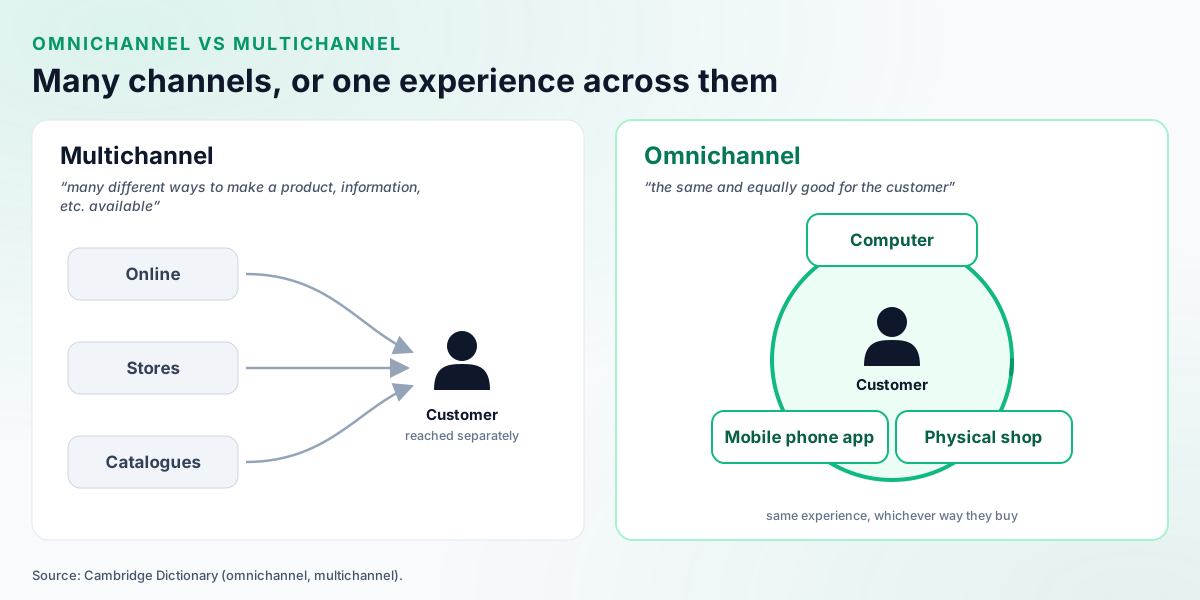
Cambridge defines multichannel, in its business sense, as involving or using many different ways to make a product or information available; its example is selling online, in stores and through catalogues. Checked against Cambridge Advanced Learner's Dictionary: multichannel
| Multichannel | Omnichannel | |
|---|---|---|
| Cambridge definition | Many different ways to make a product or information available | A way of selling that is the same and equally good for the customer on each channel |
| Examples in the entry | Online, stores, catalogues | A computer, a mobile phone app, a physical shop |
| The question it answers | How many ways can people reach us? | Does each way give the same experience? |
| What a customer notices | Each channel can feel like a different company | They can switch channels without starting again |
The last two rows are our reading of the two definitions, not dictionary text. Every omnichannel business is also multichannel; the reverse is not true.
What is omnichannel marketing?
Omnichannel marketing applies the same idea to every place a customer meets your brand, not just where they pay. MASB’s Universal Marketing Dictionary defines it as the strategic integration of all possible points of contact between customers or prospects and the marketer, covering media (including social media), sales, distribution and customer support, to create consistent, seamless interactions. It says this extends integrated marketing communication beyond media messaging. Checked against MASB Universal Marketing Dictionary: Omnichannel Marketing
For a small brand, many of those touchpoints are channels it controls. In a 2009 Forrester post, owned media meant a channel you control: fully owned, such as your website, or partially owned, such as a Facebook fan page or Twitter account. Checked against Forrester blog: 'Defining Earned, Owned And Paid Media' (Sean Corcoran, 16 Dec 2009) — Internet Archive captureArchived copy, 4 October 2021 An omnichannel brand keeps its name, offer, prices and tone the same across all of them, which is where social media branding comes in.
Not to be confused with social marketing, which Cambridge defines as using marketing methods to change people’s behaviour in areas such as health and education. Checked against Cambridge Business English Dictionary: social marketing
What research says about omnichannel shoppers
A study published in Harvard Business Review found that most of one retailer’s customers used several channels, and that they spent more, but it covers one company in one country. In Harvard Business Review in January 2017, Emma Sopadjieva, Utpal Dholakia and Beth Benjamin reported on just over 46,000 customers of one major US retailer who bought between June 2015 and August 2016. Checked against Harvard Business Review: 'A Study of 46,000 Shoppers Shows That Omnichannel Retailing Works' (Jan 2017) — Internet Archive captureArchived copy, 11 February 2017
| Customer group | Share of customers studied |
|---|---|
| Shopped online only | 7% |
| Shopped in stores only | 20% |
| Used multiple channels | 73% |
After controlling for shopping experience, these omnichannel customers spent on average 4% more per store visit and 10% more online than single-channel customers. Checked against Harvard Business Review: 'A Study of 46,000 Shoppers Shows That Omnichannel Retailing Works' (Jan 2017) — Internet Archive captureArchived copy, 11 February 2017 Treat that as one retailer’s result from 2015–2016, not a market-wide figure.
Stores still matter because most retail sales still happen outside e-commerce. The US Census Bureau estimated that e-commerce made up 17.1% of total US retail sales in the second quarter of 2026 (seasonally adjusted, released 18 August 2026). Checked against U.S. Census Bureau: Quarterly Retail E-Commerce Sales (2nd quarter 2026) Those figures cover retail only, not services or business-to-business sales.
How to build an omnichannel strategy
An omnichannel strategy starts from the customer’s route, not from your list of channels. These five steps are our own editorial checklist; they apply whether you run a shop, a service or an online-only brand:
- Map the channels your customers actually use. Start from your buyer persona: where they discover you, where they ask questions and where they buy.
- Keep one message. Product names, prices, offers and policies should match on your website, in email, in store and on every social profile.
- Carry context between channels. A customer who asked a question by message shouldn’t have to explain it again by email or at the counter. Write down where each conversation lives and who picks it up.
- Make handoffs work. Every social post that sells should link to the exact page it mentions, and connected accounts make the next step shorter; for example, see how to link Facebook to Instagram.
- Review the whole route regularly. Pick a few numbers that show customers moving between channels, then check them on a schedule using our social media KPIs guide.
Selling to businesses? The same steps apply to longer buying journeys; see B2B social media marketing.
Omnichannel on social media
On social media, omnichannel means one message adapted to each network and published as one plan, so a customer who sees you in three places sees the same brand. The offer, dates and links stay identical; the format changes, from a short video on one network to a text post or a carousel on another.
Practical habits for a small team:
- Launch together. Schedule the website change, the email and the social posts for the same day, so no channel announces something another doesn’t know about.
- One source of truth. Keep the approved wording, prices and links in one document and copy from it.
- Same look. Use the same profile name, image and bio wording everywhere; see social media branding.
- One calendar. A social media scheduler for small business keeps every network’s posts in one plan.
Consistency is the foundation; reaching more people is the next job, covered in social media growth.
Omnichannel examples
Illustrative examples: the scenarios below are generic descriptions of how omnichannel works, not case studies of real companies.
| Example | Channels involved | What makes it omnichannel |
|---|---|---|
| Buy online, collect in store | Website or app, physical shop | The order, price and stock match in both, and staff can see the order |
| Start on chat, finish in store | Website chat, phone, shop counter | The customer’s question and history follow them, so they don’t repeat it |
| A small brand’s product launch | Website, email, Instagram, LinkedIn, TikTok | Same product name, price, date and link everywhere; each network gets its own format |
| A local service booking | Social profile, booking page, reminder message | The booking link in every bio leads to the same calendar and the same prices |
Omnichannel FAQ
What does omnichannel mean?
Omnichannel describes a way of selling that is the same and equally good for the customer whether they buy on a computer, in a mobile phone app or in a physical shop, in the Cambridge Dictionary’s definition. Checked against Cambridge Advanced Learner's Dictionary: omnichannel Merriam-Webster had no entry for the word when checked. Checked against Merriam-Webster: search for 'omnichannel'
What is the difference between omnichannel and multichannel?
Multichannel means using many different ways to make a product or information available, such as selling online, in stores and through catalogues. Checked against Cambridge Advanced Learner's Dictionary: multichannel Omnichannel adds that the experience is the same and equally good across those channels. That is a reading of Cambridge’s two definitions: the first is about having several channels, the second about how well they work together for the customer.
What is an example of omnichannel?
Illustrative examples: ordering online and collecting in a store, starting a question in a chat and finishing it at the counter without repeating yourself, or a small brand launching a product with the same offer and wording on its website, email and each social network. In a 2017 Harvard Business Review study of one US retailer’s customers, 73% used more than one channel. Checked against Harvard Business Review: 'A Study of 46,000 Shoppers Shows That Omnichannel Retailing Works' (Jan 2017) — Internet Archive captureArchived copy, 11 February 2017
Is omnichannel only for retailers?
No. Cambridge’s definition is about selling products, but MASB’s Universal Marketing Dictionary defines omnichannel marketing as integrating every point of contact between customers and the marketer, including media and social media, sales, distribution and customer support. Checked against MASB Universal Marketing Dictionary: Omnichannel Marketing Service businesses, B2B sellers and small brands with a website and social accounts can apply the same idea.