
Social Media Team Structure: Roles for Every Team Size
A social media team is the group of people who plan, create, publish, answer and report on an organization’s social accounts, and its structure decides who owns each of those jobs. At a small business that can be one person; at a large company it can be several teams that share standards.
This guide gives the roles, a blueprint of who owns what at 1, 3, 5 and 10 people, when to add each hire, what a team costs, the five structure models most guides borrow from, and how to manage and equip the team. For the work itself, see what social media management involves; for the lead job, see the social media manager role.
Table of Contents
- What does a social media team do?
- Social media team roles and who owns what
- Social media team structure by company size
- When to add the next hire
- How much does a social media team cost?
- Centralized, hub-and-spoke or honeycomb: which model fits?
- How to manage a social media team
- What tools does a social media team need?
- Social media team FAQ
What does a social media team do?
A social media team runs an organization’s presence on social networks: it plans posts, makes them, publishes them, answers the people who respond and reports what worked. Official occupation data describe the same work. O*NET lists “Manage clients’ social media accounts, including creating content, responding to stakeholder comments and messages, and monitoring public perception” as a task of Public Relations Managers. Source: O*NET OnLine, Summary Report for 11-2032.00 Public Relations Managers, checked
O*NET has no “social media” occupation of its own, so it files the work under nearby ones. Its definition of Public Relations Specialists says they “May specialize in using social media”, and one of their listed tasks is posting and updating content on the company’s website and social media outlets. Source: O*NET OnLine, Summary Report for 27-3031.00 Public Relations Specialists, checked
Split into jobs, that work is six things: plan, create, publish, look after the community, run paid social and report. Every team, of any size, needs a named owner for each.
Social media team roles and who owns what
A social media team draws on up to seven roles: a manager or lead, a strategist, content creators, a coordinator, a community manager, a paid social specialist and an analyst, with design often a creator’s job. In small teams one person holds several of them. The scope column below is our summary of how employers commonly use the titles, not an official definition.
| Role | Owns (our summary) | Official anchor |
|---|---|---|
| Social media manager or lead | Strategy, the calendar, results, often people and budget | O*NET sample titles nearby: Communications Manager, Communications Director (11-2032) |
| Strategist | Goals, audiences, which networks and why | O*NET sample title: Content Strategist (13-1161) |
| Content creator | Posts, captions, photos, video and graphics for each network | No official title; see the social media specialist role |
| Coordinator | Scheduling, posting, first replies, weekly numbers | O*NET sample title: Public Relations Coordinator (27-3031); see the social media coordinator role |
| Community manager | Replies, comments and relationships with followers | Cambridge: someone whose job is to make sure a brand has a positive image and good relationships with its customers or followers on social media Checked against Cambridge Advanced Learner's Dictionary & Thesaurus |
| Paid social specialist | Ad budgets, targeting and boosted posts | No official title |
| Analyst | Reporting, tests and what to change next | O*NET sample title: Market Analyst (13-1161) |
Source: O*NET OnLine, Summary Reports (13-1161.00, 27-3031.00, 11-2032.00), checked .
None of O*NET’s sample job titles for these occupations is “social media manager”; the anchors show the nearest ones it reports. For what each person should be able to do as they move up, see the skills each role needs.
Social media team structure by company size
The right social media team structure gives every job one accountable owner, whatever the headcount; more people means narrower jobs, not more owners per job. We found no primary, dated benchmark for team size, so the table below is an illustrative blueprint, not a benchmark.
| Job | Team of 1 | Team of 3 | Team of 5 | Team of 10 |
|---|---|---|---|---|
| Plan and strategy | You | Manager | Manager | Head of social, with a strategist |
| Create | You, in a weekly batch | Content creator, with the manager | Two creators: one writing, one design and video | Writer, designer and video creator |
| Publish and schedule | You | Coordinator | Community manager | Coordinator |
| Community and replies | You, at set times each day | Coordinator | Community manager | Two community managers |
| Paid social | You, or an agency | Manager, or an agency | Paid social specialist | Paid social specialist |
| Report | You, monthly | Manager | Manager, with the paid specialist for ads | Analyst |
| Sign-off before posting | Your own check | Manager | Manager; legal for sensitive posts | Head of social or channel leads; legal for sensitive posts |
Illustrative blueprint (our editorial example). Team of 3: manager, content creator, coordinator. Team of 5: manager, two creators, community manager, paid social specialist. Team of 10: head of social, strategist, three creators, coordinator, two community managers, paid social specialist, analyst.
Read each column as one name per row. Other people help, but one person answers for the job. If a row has nobody’s name, that’s the job that slips.
Growing past one person raises the first big choice: an employee, a freelancer or an agency. Our guide on how to hire your first social media manager compares the routes.
When to add the next hire
Add a person when one job in the blueprint keeps slipping, not when the follower count passes a number. We found no dated benchmark that ties headcount to audience size, so these triggers are our editorial checklist, matched to the columns above.
| Move | Add | Signs it’s time (illustrative) |
|---|---|---|
| 1 → 3 | A content creator and a coordinator | Posts go out late or skip a week; comments wait until the evening; the owner has no time left to plan the next month |
| 3 → 5 | A second creator, a community manager and a paid social specialist | Video and design queue behind writing; replies now need someone on shift every day; ads run without anyone checking them weekly |
| 5 → 10 | A strategist, an analyst, a third creator and a second community manager | Regions or product lines want their own accounts; reports take the manager a full day; one person’s leave stops publishing |
Two checks before any hire:
- Is the job really full-time? If a row in the blueprint needs a few hours a week, a freelancer or a part-time contract can cover it. If it needs a strategy you don’t have yet, hiring a social media consultant for a one-off strategy can come first.
- Can the current owner hand it over? Write the job’s “done when” before the new person starts, so the handover has a finish line. The workflow guide shows how.
How much does a social media team cost?
A social media team costs the salaries of its people plus the tools they share, and U.S. government data have no social media occupation to price it from. No occupation in the BLS May 2025 wage data has “social media” in its title. Source: BLS OEWS May 2025 occupation profiles index and national data file, checked ; page date: May 2025 estimates, released 2026-05-15 The nearest official occupations give a proxy for each kind of role in the blueprint:
| Team role | Nearest BLS occupation (proxy) | Median annual wage, May 2025 |
|---|---|---|
| Content creator, coordinator, community manager | Public relations specialists | $74,750 a year |
| Strategist, analyst, paid social specialist | Market research analysts and marketing specialists | $78,760 a year |
| Head of social (ceiling proxy) | Public relations managers | $146,910 a year |
Source: U.S. Bureau of Labor Statistics, Occupational Employment and Wage Statistics (OEWS), May 2025 national estimates, checked ; page date: May 2025 estimates, released 2026-05-15.
Source: U.S. Bureau of Labor Statistics, Occupational Employment and Wage Statistics (OEWS), May 2025 national estimates, checked ; page date: May 2025 estimates, released 2026-05-15.
Source: U.S. Bureau of Labor Statistics, Occupational Employment and Wage Statistics (OEWS), May 2025 national estimates, checked ; page date: May 2025 estimates, released 2026-05-15.
These are proxies, not social media pay: the role-to-occupation match is our editorial judgment, and the managers’ figure is a ceiling for a head of social, not what a typical manager earns. BLS wage data also leave out the self-employed, so they say nothing about freelancers. Source: BLS news release: Occupational Employment and Wages — May 2025 (USDL-26-0725), checked ; page date: 2026-05-15 For salary-site figures by title and level, see our social media manager salary data by source.
To budget, write one line per person in your blueprint column, price it from local job ads or the proxies above, and add the tool. A tool billed per seat adds a cost with every hire, which the tools section below covers.
Centralized, hub-and-spoke or honeycomb: which model fits?
Pick the model by how many units post for themselves: one central team if only headquarters posts, a coordinated (hub-and-spoke) model if regions or products post, and something looser only if the culture is ready. The names come from one source. In a post dated 15 April 2010, Altimeter analyst Jeremiah Owyang described five ways companies organize for social business: Organic, Centralized, Coordinated, Multiple hub & spoke (“Dandelion”) and Holistic (“Honeycomb”). Checked against Jeremiah Owyang, Web Strategy: Framework and Matrix: The Five Ways Companies Organize for Social Business (15 Apr 2010)Vendor's own description
What most guides now call “hub and spoke” is the model Owyang called Coordinated.
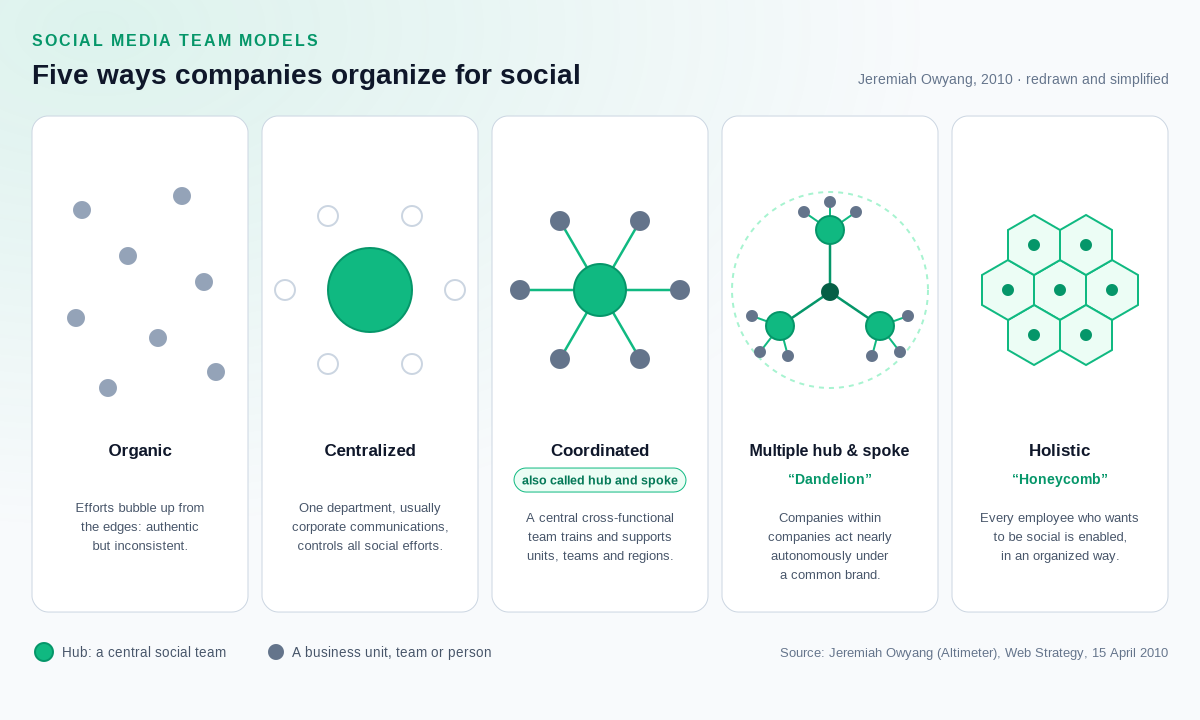
| Model (Owyang, 2010) | How it works | Good for | Watch out for |
|---|---|---|---|
| Organic | Social efforts bubble up from the edges of the company | Authenticity | Inconsistency Checked against Jeremiah Owyang, Web Strategy (15 Apr 2010)Vendor's own description |
| Centralized | One department, usually corporate communications, controls all social efforts | A consistent customer experience, coordinated resources and rapid response | May appear inauthentic Checked against Jeremiah Owyang, Web Strategy (15 Apr 2010)Vendor's own description |
| Coordinated (hub and spoke) | A cross-functional central team helps business units, product teams or regions through training, education and support | Knowing what each unit is doing | Cost Checked against Jeremiah Owyang, Web Strategy (15 Apr 2010)Vendor's own description |
| Multiple hub & spoke (“Dandelion”) | “Companies within companies” act nearly autonomously under a common brand, typical of large multinationals | Units that need near-autonomy under one brand | Needs constant communication between teams Checked against Jeremiah Owyang, Web Strategy (15 Apr 2010)Vendor's own description |
| Holistic (“Honeycomb”) | Every employee who wants to be social is enabled in an organized way | Organizations whose culture already supports it | Owyang says very few companies will achieve it Checked against Jeremiah Owyang, Web Strategy (15 Apr 2010)Vendor's own description |
In our reading, a business where one person or one team posts for everyone is Centralized by default. The Coordinated model starts to make sense when regions, stores or product lines want their own accounts and the central team becomes the place for training, the policy and the shared calendar.
Owyang’s own advice was to identify which model you’re in now, discuss the one you want, and recognize that the choice is a cultural change rather than an org chart. Checked against Jeremiah Owyang, Web Strategy (15 Apr 2010)Vendor's own description
How to manage a social media team
Social media team management comes down to four written things: a workflow, a policy, rules for staff who post about work, and a short list of who holds admin access on each platform. Write them once and the team stops relying on whoever remembers.
Write the workflow down
Map how a post moves from idea to published, with an owner and a “done when” for each stage. Our guide to a written social media workflow has a copyable stage table and examples for solo, in-house and agency teams.
Set a policy
A policy tells staff what they can post on the company’s accounts and their own, and who answers a crisis. Start from a social media policy for the team.
Decide how employees share
If staff will share company posts from their own profiles, run it as an employee advocacy program with clear disclosure rules rather than ad hoc requests.
Give access through platform roles, not shared passwords
Give full admin rights to as few people as possible and use each platform’s narrower roles for everyone else. The platforms build this in:
- LinkedIn Pages: a Page has three admin roles. Super admins hold every permission, including managing admins and editing the Page; content admins can post, boost posts and create events; analysts see analytics only. The Page’s creator becomes its super admin automatically. Checked against LinkedIn Help: LinkedIn Page admin roles Most people who post need content admin, not super admin.
- Meta (Facebook and Instagram): a business portfolio gives people either full control (formerly the business admin role) or partial access, where basic access was formerly the employee role, plus optional finance access and temporary access of 3 to 75 days. Checked against Meta Business Help Center: About business portfolio and business asset permissions in Meta Business Suite
Review the list when someone joins or leaves. Removing one person’s role is much easier than changing a shared password on every account.
What tools does a social media team need?
A team needs one shared calendar, one place to publish from with a seat or login for each person, and a clear rule for who signs off. How tools handle teams differs by vendor and plan, so check these points in each vendor’s own documentation:
- Buffer: the Team plan adds unlimited team members, access levels and content approval workflows; Free and Essentials include one user. Checked against Buffer: PricingVendor's own description
- Later: Access Groups, each with its own media library and calendar, are limited to 1 on Starter and unlimited on Growth and Scale. Checked against Later: PricingVendor's own description
- Hootsuite: the plans page lists 10 social accounts on Standard and unlimited on Professional, Advanced and Enterprise, with user seats bought one at a time on every self-serve plan. Checked against Hootsuite: Plans, Prices, and FeaturesVendor's own description
- Sprout Social: Message Approval Workflows, on the Professional and Advanced plans, let teams build multi-step, multi-user approval workflows with “Any” or “All” sign-off per step. Checked against Sprout Social Help Center: Message Approval WorkflowsVendor's own description
Seats matter for the budget as much as for access: a tool billed per person costs more with every hire. Our explainer on per-seat vs per-account tool pricing shows how the two models compare as a team grows.
Where Outfeed fits for a small team
Here is what Outfeed AI, which publishes this guide, covers for a team that publishes together.
If your team needs a formal sign-off, run it before a post reaches the scheduler, as the workflow guide shows. Seats are billed differently by plan:
Try Outfeed AI for scheduling your team’s posts
Social media team FAQ
What roles are on a social media team?
Usually a manager or strategist, one or more content creators and a community manager. As the team grows it adds a paid social specialist, an analyst and a designer or video creator. See the roles table above.
How big should a social media team be?
There’s no standard size. It follows the number of networks you run, how much content you make and whether replies and ads are handled in-house. The blueprint shows illustrative teams of 1, 3, 5 and 10.
What is a hub-and-spoke social media team?
A central team sets standards and supports business units, product teams or regions that post for themselves. Jeremiah Owyang’s 2010 framework calls this the Coordinated model, and his Dandelion model has several such hubs under one brand. Checked against Jeremiah Owyang, Web Strategy (15 Apr 2010)Vendor's own description
Should a small business have an in-house social media team or an agency?
In-house fits daily posting and fast replies, because the people closest to the business do the work. An agency or freelancer fits when nobody has the time or skills yet, and a consultant fits a one-off strategy. Our guide on how to hire your first social media manager compares the routes.
How much does a social media team cost?
Mostly salaries, plus tool seats. U.S. government wage data have no social media occupation, Source: BLS OEWS May 2025 occupation profiles index and national data file, checked ; page date: May 2025 estimates, released 2026-05-15 so the cost section prices each role from the nearest official occupations. Add one line per person in your blueprint, then the tool, which may bill per seat.