
Social Commerce: How It Works and Where Checkout Happens
Social commerce is buying and selling that runs through social platforms: people find a product in a post, video or live stream and buy it, either inside the app or on the seller’s own website, depending on the platform. Checkout rules have changed several times since 2022, so this guide maps where the sale completes on each platform today.
Shops are where our social media marketing playbook for small businesses turns into sales. This page covers shop features and checkout; for the relationship side of selling on social, see our guide to social selling.
Table of Contents
- What is social commerce?
- Social commerce vs ecommerce: what’s different?
- Social commerce platforms: where checkout happens
- Social commerce in the United States: the numbers you can trust
- Social commerce examples: the formats that sell
- How to build a social commerce strategy
- Creators, affiliates and disclosure
- Where Outfeed fits in social commerce
- Social commerce FAQ
What is social commerce?
Social commerce is shopping that happens through social media: discovery, recommendations and often the purchase itself run through social apps rather than a standalone online store. Neither Merriam-Webster nor Cambridge has an entry for it, and MASB’s Universal Marketing Dictionary lists none either. Checked against Merriam-Webster: search for 'social commerce'
The working social commerce definition comes from research. In a 2011 special issue of the International Journal of Electronic Commerce, Ting-Peng Liang and Efraim Turban described social commerce as using Web 2.0 social media technologies to support online interactions and user contributions that help people acquire products and services. Checked against International Journal of Electronic Commerce: Liang & Turban, Introduction to the Special Issue: Social Commerce (abstract)
That definition predates shops and in-app checkout, so social shopping today is best understood platform by platform.
Social commerce vs ecommerce: what’s different?
In ecommerce the online store is where shopping starts; in social commerce discovery happens in a social feed, and on some platforms the sale completes there too. The difference is mostly about place, in the sense of the ‘place’ in the marketing mix: where the buyer meets the product and where they pay.
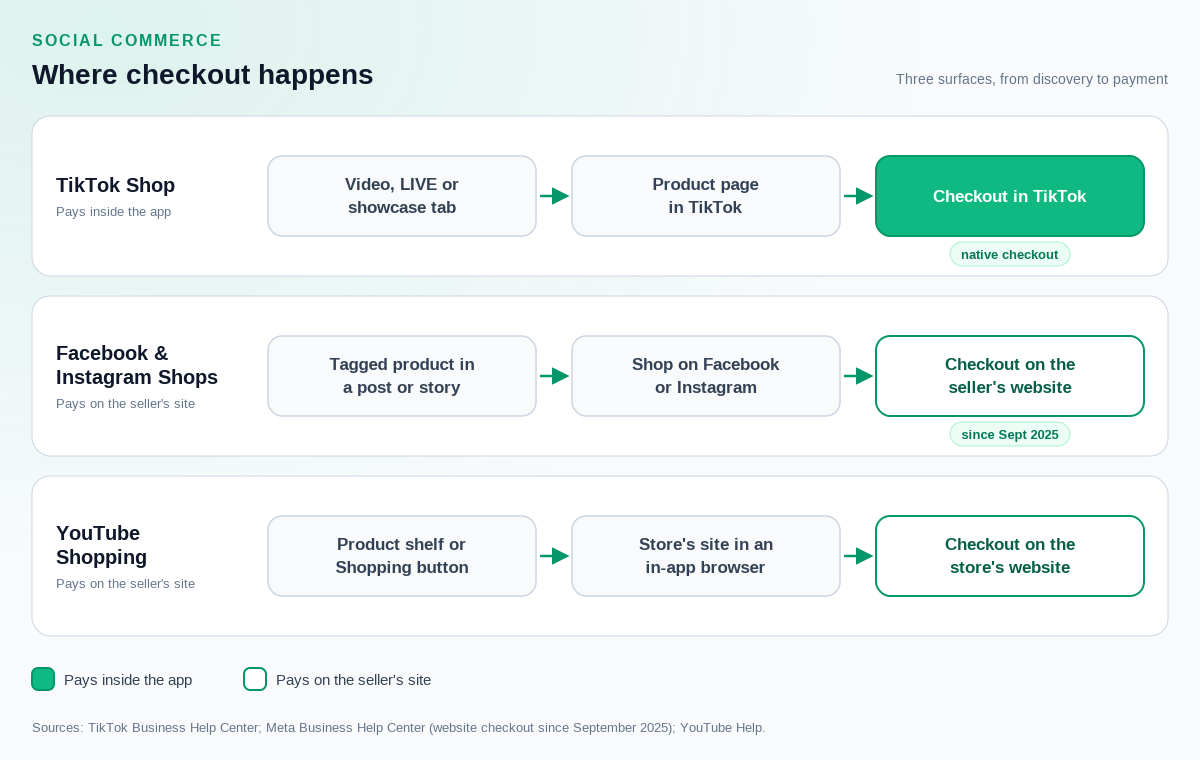
- Fully in the app: TikTok describes TikTok Shop as a fully native experience in which product discovery, product pages, shipping, billing, purchases and returns all happen on TikTok. Checked against TikTok Business Help Center: About TikTok Commerce
- Browse in the app, pay on your site: Meta says that as of September 2025 every Shop on Facebook and Instagram uses website checkout. Shoppers browse in the shop and buy on the seller’s own website. Checked against Meta Business Help Center: About changes to Shops and checkout on Facebook and Instagram
For scale, the U.S. Census Bureau estimated seasonally adjusted U.S. retail e-commerce at $347.3 billion in the third quarter of 2026: 17.9% of all retail sales and 10.4% more than a year earlier, in its release of 19 November 2026. That covers all online retail, not social commerce; no official U.S. series measures social commerce on its own. Checked against U.S. Census Bureau: Quarterly Retail E-Commerce Sales (19 Nov 2026 release)
Social commerce platforms: where checkout happens
Of the major social commerce platforms, only TikTok Shop keeps the whole purchase inside the app; Facebook, Instagram and YouTube send the buyer to the seller’s website to pay, and Pinterest’s current help pages don’t describe in-app checkout.
| Platform | Where people shop | Where checkout happens | What a seller needs |
|---|---|---|---|
| TikTok Shop | Shoppable videos, LIVE streams and a profile’s product showcase tab Checked against TikTok Business Help Center: About TikTok Commerce | Inside TikTok (native checkout) Checked against TikTok Business Help Center: About TikTok Commerce | A TikTok Shop seller account in a supported market (see the eligibility step below) |
| Facebook and Instagram Shops | The shop, plus product tags in posts and a product sticker in stories Checked against Instagram Help Center: Add shopping tags to Instagram posts | On the seller’s website, since September 2025 Checked against Meta Business Help Center: About changes to Shops and checkout on Facebook and Instagram | Meta’s commerce eligibility; the full Shops experience is in the United States, with open betas in other countries Checked against Meta Business Help Center: Supported countries for Shops on Facebook and Instagram |
| YouTube Shopping | The channel’s store, video descriptions, a product shelf below content and a Shopping button Checked against YouTube Help: Get started with Shopping on YouTube | The store’s own website, opened in an in-app browser Checked against YouTube Help: Connect, manage, & disconnect your store on YouTube | A channel in the YouTube Partner Program, not set as made for kids Checked against YouTube Help: Get started with Shopping on YouTube |
| Product Pins built from a retail catalog, which can be promoted as shopping ads Checked against Pinterest Help Center (Business): Get started with retail catalogs | Not documented on Pinterest’s current help pages Checked against Pinterest Help Center (Business): Checkout on Pinterest (redirects to Get started with retail catalogs)Not verified | A business account, a claimed website and the Pinterest tag | |
| Facebook Marketplace | Item listings; Facebook Help names Marketplace, buy and sell groups and Pages as ways to sell | Arranged with the seller: buyers message the seller to set up the sale Checked against Facebook Help Center: Ways to sell on Facebook | Not a Shop: no catalog or checkout setup described |
TikTok Shop. TikTok announced the full U.S. launch on 12 September 2023, bringing shoppable videos and LIVE streams to For You feeds across the country. Checked against TikTok Newsroom: Introducing TikTok Shop (12 Sep 2023) Its About TikTok Commerce help article lists eight markets: Indonesia, Malaysia, the Philippines, Singapore, Thailand, the United Kingdom, the United States and Vietnam. Checked against TikTok Business Help Center: About TikTok Commerce (first published 14 Feb 2023) More on how TikTok Shop works.
Facebook and Instagram. NBC News reported in January 2023 that Instagram would remove the Shop tab from its navigation bar in February 2023, with Adam Mosseri saying people could still shop in Feed, Stories, Reels and ads. Checked against NBC News: Instagram will remove the Shop tab from navigation in February (10 Jan 2023)Press report Meta also wound down live shopping: TechCrunch reported in August 2022 that Facebook would end live shopping events on 1 October 2022 Checked against TechCrunch: Facebook is shutting down its live shopping feature on October 1 (3 Aug 2022)Press report, and in February 2023 that Instagram would stop product tagging in live streams from 16 March 2023. Checked against TechCrunch: Instagram is killing live shopping in March, will focus on ads instead (14 Feb 2023)Press report One trap: Instagram’s own Shopping help article still says checkout is supported only in the United States. Checked against Instagram Help Center: Shopping on Instagram Meta’s Commerce Manager article is the newer statement. Setup: Instagram Shop and website checkout and Facebook Commerce Manager.
YouTube. Long videos and live streams keep playing in the mini-player while the store’s site is open; Shorts don’t. The retailer, not Google, handles payment, fulfilment and refunds. Checked against YouTube Help: Connect, manage, & disconnect your store on YouTube
Pinterest. A 2023 PYMNTS report, citing an Axios interview with Pinterest’s chief revenue officer, said Pinterest had dropped plans for direct checkout and was deep-linking shoppers to checkout in merchants’ apps instead. Checked against PYMNTS: Pinterest Invests in Shopping Tech to Retain Platform's Merchants (13 Apr 2023)Press report Treat that as a 2023 report, not current policy.
Social commerce in the United States: the numbers you can trust
The reliable U.S. numbers measure pieces of social commerce, not the whole: how many people buy after a creator’s post, how much brands spend on social ads, and how big ecommerce is overall.
- Buying after a creator’s post: in Pew Research Center’s July 2022 survey of 6,034 U.S. adults, three in ten adult social media users said they had bought something after seeing an influencer or content creator post about it, rising to 53% among users who follow influencers. Checked against Pew Research Center: For shopping, phones are common and influencers have become a factor (21 Nov 2022)
- Social ad spending: the IAB’s Internet Advertising Revenue Report, conducted by PwC, put U.S. social media ad revenue at $117.7 billion (calendar year 2025), up 32.6% year over year and 40% of all U.S. internet ad revenue. Checked against IAB: Internet Advertising Revenue Report, Full Year 2025, conducted by PwC (news release, 16 Apr 2026) That is all social advertising, shopping ads included, not sales.
Add the Census e-commerce figure above, and that is the reliable picture of the social commerce industry. We don’t quote market-size forecasts: those in circulation come from vendors or paywalled analysts, not primary measurement.
Social commerce examples: the formats that sell
The formats that sell are the shoppable ones each platform builds in.
- A product-tagged Instagram post: up to 20 products and shops in a photo post, or 20 tags across a carousel, from an eligible catalog in Commerce Manager. Checked against Instagram Help Center: Add shopping tags to Instagram posts
- A product sticker in an Instagram story: one sticker per story, tagging up to 5 products. Checked against Instagram Help Center: Shopping on Instagram (How to add product stickers to Instagram stories)
- A shoppable TikTok video or LIVE stream, plus the product showcase tab on your profile. Checked against TikTok Business Help Center: About TikTok Commerce
- A YouTube product shelf below a video, or products listed in the channel’s store. Checked against YouTube Help: Get started with Shopping on YouTube
- A Pinterest product Pin: title, description, price and availability pulled from your catalog, marked as shoppable. Checked against Pinterest Help Center (Business): Get started with retail catalogs
- A Meta collection ad: a larger cover image or video above a grid of products; a tap opens a full-screen Instant Experience, and it runs only in mobile placements. Checked against Meta Business Help Center: Supported objectives and placement options for collection ads
Illustrative example: a candle shop posts a carousel of three scents, each tagged, then a story with a product sticker for the bestseller. The buyer pays on the shop’s website.
How to build a social commerce strategy
Pick one platform, confirm eligibility, connect a catalog, know the fees, then post shoppable content steadily. The order is our advice; the rules are the platforms’.
- Pick the platform where your buyers already are and whose checkout fits your store: your own website (Meta, YouTube) or TikTok’s native checkout.
- Check eligibility before you plan content.
- Meta: follow its policies, sell products available for direct purchase on your own single domain, be in a supported country, show an authentic, established presence, and show accurate prices plus visible refund and return policies. Checked against Meta Business Help Center: Commerce eligibility requirements
- TikTok Shop (U.S. individual sellers): at least 18, living in the U.S., with a valid U.S. ID, the last 4 digits of your SSN (or an ITIN), bank details and a W-9. Checked against TikTok Shop Seller University (US): How to register as an Individual In every market TikTok covers in its requirements article, you must live in the country you choose for your shop. Checked against TikTok Business Help Center: Requirements to register as a seller on TikTok Shop
- YouTube (your own store): a channel in the YouTube Partner Program that meets its subscriber threshold or is an Official Artist Channel, and isn’t set as made for kids. Checked against YouTube Help: Get started with Shopping on YouTube
- Pinterest: a business account, a claimed website, the Pinterest tag, and a site with findable contact details plus shipping and refund policies. Checked against Pinterest Help Center (Business): Get started with retail catalogs
- Connect a catalog. In Meta’s Commerce Manager anyone can build a catalog, and you don’t need a shop to use it. Checked against Meta Business Help Center: About Commerce Manager Pinterest processes up to 20 million products per catalog and re-reads a hosted data source daily. Checked against Pinterest Help Center (Business): Get started with retail catalogs On YouTube you connect a store from YouTube Studio, under Earn and then Shopping, and the review typically takes a few business days. Checked against YouTube Help: Connect, manage, & disconnect your store on YouTube
- Know the fees. In an article last updated in May 2025, TikTok Shop’s U.S. Seller University says sellers pay a referral fee on completed orders that covers all TikTok Shop fees except shipping and tax: 6% per order from 1 April 2024, or 5% to 6% depending on category. On a refund, TikTok Shop returns the referral fee minus an administration fee of 20% of it, capped per item. Checked against TikTok Shop Seller University (US): TikTok Shop Referral Fee Updates - 2024 (updated 05/08/2025) Fees change, so check TikTok Shop Seller Center for the rate that applies to you today.
- Tag products in your regular posts and keep a steady posting cadence. Measure sales in your own store’s analytics: Meta’s “Meta purchases” metrics now show 0 after the move to website checkout. Checked against Meta Business Help Center: About changes to Shops and checkout on Facebook and Instagram Our guide to social media KPIs covers what else to track.
Creators, affiliates and disclosure
If a creator is paid, gifted or earns commission for a post selling your product, the post needs a clear disclosure, and the platform’s label may not be enough.
- What must be disclosed: the FTC says a material connection the audience would not expect must be disclosed clearly and conspicuously. That includes payment, free or discounted products, early access, a chance to win a prize, and business, family or personal relationships. Checked against eCFR: 16 CFR § 255.5(a) Disclosure of material connections
- Platform labels: asked whether a platform’s built-in tool is enough, FTC staff answer “Not necessarily” and advise adding your own disclosure as well. Checked against FTC: FTC's Endorsement Guides: What People Are Asking Instagram’s paid partnership label works on posts, stories, reels and Live, and shows without the brand’s name until the brand approves. Checked against Instagram Help Center: How to use the paid partnership label to tag organic branded content on Instagram
- YouTube affiliates: the YouTube Shopping affiliate program is open by invitation to channels in the YouTube Partner Program in a list of countries that includes the United States, excluding music channels and made-for-kids channels. Checked against YouTube Help: YouTube Shopping affiliate program overview & eligibility YouTube says routing traffic from outside YouTube to merchants through your YouTube affiliate links breaks its terms and can suspend your affiliate features, so keep those links on YouTube. Checked against YouTube Help: YouTube Shopping affiliate program overview & eligibility
This is guidance, not legal advice; see what sponsored posts must disclose.
Where Outfeed fits in social commerce
Here is the honest split: the shop features stay with each platform, and the posts around them can be planned in one place.
Social commerce FAQ
What is an example of social commerce?
Buying a product from a TikTok video or LIVE stream without leaving TikTok is one: TikTok Shop handles the product page, checkout, shipping and returns inside the app. Tapping a tagged product in an Instagram post and paying on the seller’s website is another, because every Shop on Facebook and Instagram has used website checkout since September 2025.
Which social platforms still let you check out inside the app?
Of the major ones, only TikTok Shop keeps the whole purchase inside the app. Meta says that as of September 2025 every Shop on Facebook and Instagram uses website checkout, YouTube Shopping opens the store’s own website in an in-app browser, and Pinterest’s current help pages don’t describe in-app checkout.
Is TikTok Shop social commerce?
Yes, and it is the most complete example. TikTok describes TikTok Shop as a fully native experience in which product discovery, product pages, shipping, billing, purchases and returns all happen on TikTok. TikTok’s About TikTok Commerce help article lists eight markets for it, including the United States, where it fully launched in September 2023.
What is the difference between social commerce and ecommerce?
Social commerce is the part of online shopping that runs through social platforms. In Liang and Turban’s 2011 journal definition, it uses social media technologies to support online interactions and user contributions that help people acquire products and services. Where the sale completes varies: inside the app on TikTok Shop, or on the seller’s own website for Facebook, Instagram and YouTube.
How big is social commerce in the United States?
No official series measures it on its own. The best official figure is broader: the U.S. Census Bureau estimated that e-commerce was 17.9% of all U.S. retail sales in the third quarter of 2026. In a July 2022 Pew Research Center survey, three in ten U.S. adult social media users said they had bought something after seeing an influencer or creator post about it.