
Government Social Media: Rules, Records and a Playbook
Government social media is how agencies, cities and public officials publish services, news and emergency updates, and it carries rules a company’s posts don’t: public records, free speech and accessibility. A post can be a record you must keep. Blocking a critic can be state action. A new post may have to meet a web accessibility standard. This guide puts the U.S. rules in one place from the primary sources, then gives a content plan, a crisis template and a checklist for choosing tools. The planning basics every organization shares are in our social media marketing playbook.
This is general information, not legal advice; check with your counsel, records officer or compliance team before you act on it.
Table of Contents
- How do government agencies use social media?
- Are government social media posts public records?
- Can government officials block people on social media?
- What accessibility rules apply to government posts?
- Crisis and emergency communication on social media
- Social media management and archiving software for government: what to look for
- A social media content plan for a city or agency
- Government social media examples from official sources
- What a scheduler can and can’t do for an agency
- Frequently asked questions
How do government agencies use social media?
To publish services and news, answer the public and reach people fast in an emergency. Digital.gov, run by the U.S. General Services Administration, says social media helps agencies strengthen their connection with the public, promote transparency and respond to their audience’s needs, and calls it an essential tool for communications during emergencies. Checked against Digital.gov (U.S. General Services Administration): Social media topic page The CDC’s crisis communication manual adds a reason to post early: for the public, the first source of information often becomes the preferred one. Checked against U.S. Centers for Disease Control and Prevention: CERC Introduction chapter (2018 update, PDF)
The audience is broad. In Pew Research Center’s 2026 survey of 5,511 U.S. adults, 84% said they use YouTube, 70% Facebook, 51% Instagram, 37% TikTok, 31% LinkedIn and 18% X. Checked against Pew Research Center: Americans' Use of Social Media in 2026 (fact sheet, 19 Oct 2026)
The subject isn’t new to policy makers: the OECD published a policy primer, “Social Media Use by Governments”, as a working paper in December 2014. Checked against OECD Publications: Social Media Use by Governments (working paper page) Much of the legal frame below came later.
Are government social media posts public records?
Often, yes. NARA Bulletin 2014-02, dated 25 October 2013 and addressed to the heads of federal agencies, says agency use of social media may create Federal records that must be captured and managed under federal records law. Checked against National Archives (NARA) Bulletin 2014-02: Guidance on managing social media records
NARA gives four questions. A yes to any of them means the content is likely a Federal record: Checked against National Archives (NARA) Bulletin 2014-02: Guidance on managing social media records
- Does it contain evidence of the agency’s policies, business or mission?
- Is the information only available on the social media site?
- Does the agency use the tool to convey official information?
- Is there a business need for the information?
Two more points from the bulletin change how agencies plan. Where no records schedule applies, social media records must be treated as permanent until they are scheduled, and agencies should form a working group of records, web, social media, IT, privacy, counsel and public affairs staff. Checked against National Archives (NARA) Bulletin 2014-02: Guidance on managing social media records And a provider that shuts down or deletes content, or an agency that leaves a platform, doesn’t end the agency’s records obligations. Checked against National Archives (NARA) Bulletin 2014-02: Guidance on managing social media records
State and local governments follow state law, and it differs by state. In New York, for example, the State Archives says no single retention schedule covers social media, because retention depends on a record’s content, not its format: a school district’s post announcing a new superintendent may count as a press release with a potentially permanent retention, while posted board-meeting recordings need only be kept four months after the minutes are made. Checked against New York State Archives: Understanding the Importance of Managing Social Media Records (advisory, January 2021, PDF) That is why social media archiving for government is a records question first and a software question second.
Can government officials block people on social media?
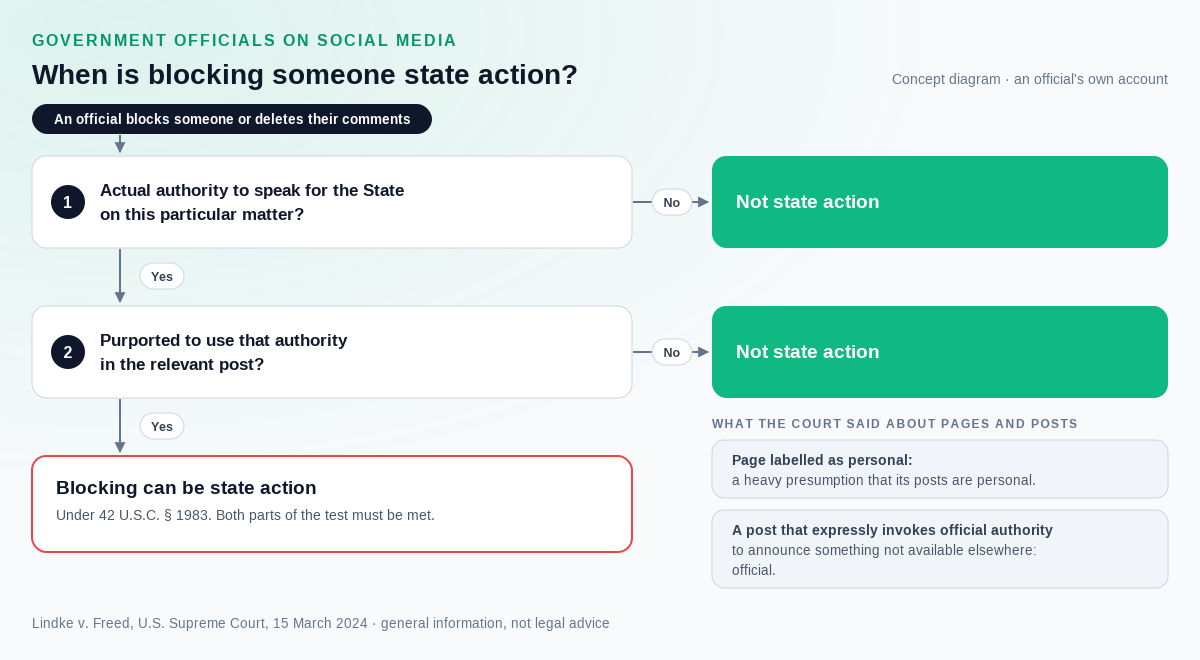
Sometimes blocking is state action, and then the First Amendment applies. In Lindke v. Freed, decided unanimously on 15 March 2024, the Supreme Court looked at Port Huron, Michigan’s city manager, who deleted Kevin Lindke’s comments on his public Facebook page and then blocked him; it vacated the lower court’s judgment and sent the case back. Checked against Supreme Court of the United States: Lindke v. Freed, No. 22-611 (decided 15 March 2024), slip opinion The Court held that an official who stops someone commenting engages in state action only if the official both had actual authority to speak for the State on a particular matter and purported to use that authority in the relevant posts. Checked against Supreme Court of the United States: Lindke v. Freed, No. 22-611 (decided 15 March 2024), slip opinion
Two details matter for officials who run their own accounts:
- Label personal accounts. A label such as “this is the personal page of” an official earns a heavy presumption that all posts are personal, and an official who mixes personal posts into an unlabelled account takes on more risk. Checked against Supreme Court of the United States: Lindke v. Freed, No. 22-611 (decided 15 March 2024), slip opinion
- What a post says counts. On an ambiguous account, a post that expressly invokes official authority to announce something not available elsewhere is official; one that merely repeats information available elsewhere is more likely personal. Because Facebook’s blocking works page-wide, a court must consider every post the blocked person wanted to comment on. Checked against Supreme Court of the United States: Lindke v. Freed, No. 22-611 (decided 15 March 2024), slip opinion
The case is about an official’s own account; it doesn’t set rules for an agency’s official account. For those, NARA says some content removed for breaking posting policies, such as spam, may be non-record while other removed content is a record, and that agencies should consult counsel on moderation consistent with their First Amendment obligations. Checked against National Archives (NARA) Bulletin 2014-02: Guidance on managing social media records The New York State Archives advises posting an appropriate-use policy for comments and a disclaimer, consulting counsel on keeping conversations civil without violating free speech, and notes that the government owns comment content and must manage it. Checked against New York State Archives: Understanding the Importance of Managing Social Media Records (advisory, January 2021, PDF)
What accessibility rules apply to government posts?
State and local governments must meet WCAG 2.1 Level AA for web content under the ADA Title II rule, and federal agencies follow Section 508. The Justice Department’s rule, published on 24 April 2024, covers web content and mobile apps that state and local governments provide, including public schools, community colleges and public universities, and content contractors make for them. Checked against U.S. Department of Justice (ada.gov): Fact Sheet: New Rule on the Accessibility of Web Content and Mobile Apps Provided by State and Local Governments A DOJ interim final rule of 20 April 2026 moved compliance to 26 April 2027 for governments of 50,000 people or more and 26 April 2028 for smaller ones and special district governments. Checked against U.S. Department of Justice (ada.gov): Fact Sheet: New Rule on the Accessibility of Web Content and Mobile Apps Provided by State and Local Governments Many guides still give the earlier dates.
What the rule means for posts:
- Old posts are exempt. Posts made before your compliance date need not meet WCAG 2.1 AA; DOJ’s example is a city sanitation department’s 2017 post about a trash-collection delay. Checked against U.S. Department of Justice (ada.gov): Fact Sheet: New Rule on the Accessibility of Web Content and Mobile Apps Provided by State and Local Governments New posts after the date are covered, so start the habit now.
- Third-party content. Content third parties post on a government’s website or app without acting for it, such as a member of the public’s message-board post, is exempt, but third-party content the government itself posts is not. Checked against U.S. Department of Justice (ada.gov): Fact Sheet: New Rule on the Accessibility of Web Content and Mobile Apps Provided by State and Local Governments
- Exempt still means accessible on request. If a blind person asks about a picture a city posted on social media in 2023, the city could provide an alt text description. Checked against U.S. Department of Justice (ada.gov): Fact Sheet: New Rule on the Accessibility of Web Content and Mobile Apps Provided by State and Local Governments
Alt text matters because screen-reader users may have no way of knowing what an image shows without it. Checked against U.S. Department of Justice (ada.gov): Fact Sheet: New Rule on the Accessibility of Web Content and Mobile Apps Provided by State and Local Governments For federal agencies, Section 508 covers content they post to social media. Checked against Section508.gov (U.S. General Services Administration): Social media (reviewed/updated October 2026) Section508.gov’s advice works for any government account:
- Alt text: concise, conveying what matters in the image, not repeating the post text; on Facebook, replace the automatically generated alt text with your own. Checked against Section508.gov (U.S. General Services Administration): Social media (reviewed/updated October 2026)
- Hashtags: capitalize each word, as in #FourthOfJuly, so screen readers don’t read it as one word. Checked against Section508.gov (U.S. General Services Administration): Social media (reviewed/updated October 2026)
- Video: closed or open captions, often as .srt files, and audio description for visuals the narration doesn’t cover. Checked against Section508.gov (U.S. General Services Administration): Social media (reviewed/updated October 2026)
- Emoji, GIFs and symbols: limit emoji and avoid several in a row, avoid animated GIFs (they can’t be paused and may flash), and avoid special characters screen readers may misread. Checked against Section508.gov (U.S. General Services Administration): Social media (reviewed/updated October 2026)
- Contrast: at least 4.5:1 for text in graphics and 3:1 for large text, the WCAG minimum. Checked against W3C: Understanding WCAG 2.2 Success Criterion 1.4.3 Contrast (Minimum)
Where networks take alt text and captions:
| Network | Feature | Source |
|---|---|---|
| An alt text field for image posts in the publishing API (not Reels or Stories) | Checked against Meta for Developers: Instagram Platform, Content Publishing | |
| TikTok | Alt text of up to 300 characters per photo in a photo post | Checked against TikTok Help Center: Accessibility for your videos |
| TikTok | Automatic captions you can edit or remove | Checked against TikTok Help Center: Accessibility for your videos |
| Pin alt text up to 500 characters | Pinterest API v5 OpenAPI description | |
| Bluesky | Image alt text up to 2,000 characters in the official app | Checked against Bluesky social-app source on GitHub: constants.ts (MAX_ALT_TEXT) |
If you schedule Instagram posts with Outfeed, this is what it sends:
Crisis and emergency communication on social media
Be first, be right, be credible, express empathy, promote action and show respect: the six principles of the CDC’s Crisis and Emergency Risk Communication (CERC) manual. Checked against U.S. Centers for Disease Control and Prevention: CERC Introduction chapter (2018 update, PDF) CERC was written for public health emergencies, but the principles work as a frame for any urgent post: publish confirmed facts quickly, say what people should do, and update on a set rhythm.
A four-line template (illustrative):
- What happened: “[Confirmed fact], as of [time].”
- What to do: “[Action], for example avoid [area] or boil water before drinking.”
- Where to get updates: “[Official page or account].”
- Next update: “We will post again at [time].”
In a crisis, publish now rather than on a schedule, and cancel or move scheduled posts that would read badly next to the news. In Outfeed:
Social media management and archiving software for government: what to look for
These are two separate jobs: a scheduler plans and publishes, and an archive captures posts and comments into your recordkeeping system. NARA says temporary records with short retention may stay on the platform, while long-term and permanent records should be exported into an agency recordkeeping system, using methods such as platform APIs, RSS feeds, manual capture or the platforms’ own export tools. Checked against National Archives (NARA) Bulletin 2014-02: Guidance on managing social media records A platform can also delete content or shut down, which doesn’t end an agency’s obligations. Checked against National Archives (NARA) Bulletin 2014-02: Guidance on managing social media records
A buyer’s checklist for social media management software for government (a starting list; your records officer sets the requirements):
| Need | Ask the scheduler | Ask the archive |
|---|---|---|
| Publishing | Which networks and post types does it publish to? | Not its job |
| Records capture | Does it keep anything for records? | Does it capture posts, comments, edits and deletions with metadata? |
| Export | Can you export your posts? | What formats, and does it fit your records system? |
| Retention | Not its job | Can it apply your retention schedule, including permanent records? |
| Access | Who can post, and what roles exist? | Who can search and export records? |
| Accessibility | Can you add alt text and per-network text? | Does it keep alt text and captions with the record? |
The best social media tools for government agencies are the ones that pass both columns between them. If one tool claims to do both, check each claim in the vendor’s own documentation. Here is where Outfeed stands on records:
A social media content plan for a city or agency
Plan a weekly base of service updates, meeting notices and community stories, add seasonal and readiness posts, and give every account an owner, a backup and a comment policy. Write the policy before the first post; our guide shows how to write a social media policy.
A weekly base (illustrative; adjust to your services):
| Day | Post | Example |
|---|---|---|
| Monday | Service update | Office hours, road works, collection changes |
| Tuesday | Meeting notice | Agenda link, how to attend or comment |
| Wednesday | How-to | Applying for a permit or service, step by step |
| Thursday | Community story | A program, a team or a local event |
| Friday | Readiness or reminder | Weather prep, deadlines, weekend closures |
Then keep an account inventory, one line per account:
- Owner and backup: two named staff with access, so the account never depends on one person.
- Label: “official” accounts say so; officials’ personal accounts say they are personal (see Lindke above).
- Comment policy: posted and linked, written with counsel.
- Records method: how posts and comments are captured, and under which schedule; unscheduled federal records are treated as permanent. Checked against National Archives (NARA) Bulletin 2014-02: Guidance on managing social media records
- Platform setup: manage Facebook and Instagram through the organization’s business tools (our Meta Business Suite guide), and see our YouTube Brand Account guide for shared access to a YouTube channel.
- Verification: X’s help centre says a governmental organization can apply for a grey checkmark through the paid Verified Organizations subscription, signing up with an official government email address such as .gov; X reviews the account before the check appears. Checked against X Help Center: Verified Organizations (archived)Archived copy, 8 September 2025 View the archived copy A blue checkmark only means an active X Premium subscription that meets X’s rules, so it doesn’t prove an account is official. Checked against X Help Center: About Verified accounts (archived)Archived copy, 24 April 2026 View the archived copy
Review what each account already shows with our free social media audit template, and report to leadership with the social media report template. If one team runs several department accounts:
Government social media examples from official sources
One court case and two examples the regulators themselves use, each with a lesson. The case is real; the other two are illustrations inside government guidance documents, not reports of real agency incidents, and none comes from a vendor case study.
- Port Huron, Michigan (Lindke v. Freed). The city manager deleted a resident’s comments on his public Facebook page, then blocked him, and the case reached the Supreme Court. Checked against Supreme Court of the United States: Lindke v. Freed, No. 22-611 (decided 15 March 2024), slip opinion Lesson: keep official and personal accounts separate and label them.
- A school district’s superintendent post (an example in New York guidance). The New York State Archives uses a post announcing a new superintendent as an example of a record that may count as a press release with potentially permanent retention. Checked against New York State Archives: Understanding the Importance of Managing Social Media Records (advisory, January 2021, PDF) Lesson: an ordinary announcement can be a permanent record.
- A sanitation department’s delay notice (an example in DOJ’s rule). DOJ’s ADA rule uses a 2017 post about a trash-collection delay as an example of a pre-compliance post that need not meet WCAG. Checked against U.S. Department of Justice (ada.gov): Fact Sheet: New Rule on the Accessibility of Web Content and Mobile Apps Provided by State and Local Governments Lesson: posts after your compliance date are covered, so make them accessible now.
Public colleges share many of these rules; see social media for public colleges and universities. Mission-driven organizations outside government can start with social media for nonprofits.
What a scheduler can and can’t do for a public agency
Use a scheduler for posts you can write ahead, such as service notices, office-hour changes and event reminders; keep records, comment moderation and accessibility checks in your own systems. Here is what Outfeed does:
If your agency needs review before posting, run it outside the scheduler. Here is where Outfeed stands:
Schedule your agency’s planned notices with Outfeed AI
Frequently asked questions
Are government social media posts public records?
Often. NARA tells federal agencies that social media content can be a Federal record and that unscheduled social media records must be treated as permanent. For state and local governments, the New York State Archives notes retention depends on the content of the post, so check your state’s schedule.
Can a government official block people on social media?
It depends. Under Lindke v. Freed (2024), blocking is government action only if the official had actual authority to speak for the government on the matter and purported to use it in the posts. A clearly labelled personal page is presumed personal.
Do government social media posts have to be accessible?
Yes. State and local governments must meet WCAG 2.1 Level AA under the ADA Title II rule, now due in April 2027 or April 2028 depending on population, and federal agencies follow Section 508. Posts made before the compliance date are exempt but must be made accessible on request.
What should a government social media policy include?
Who owns and can post to each account, a public comment policy with a disclaimer, how records are captured and kept, accessibility steps and the crisis process. The New York State Archives advises posting an appropriate-use policy for comments and consulting counsel.