
Social Media Agent: What AI Agents Can and Can't Do
A social media agent is an AI system that takes a goal, such as “plan and schedule next week’s posts”, and works through the steps itself with the tools it is connected to, instead of answering one prompt at a time. That makes it useful for content work and risky anywhere a mistake goes public. The networks’ rules draw a line: X and Threads, for example, allow publishing through their official APIs, while automated likes, follows, comments and DMs are banned or tightly restricted.
Below: the technical stack, what each network allows, where a person stays in the loop and how to connect an agent to a scheduler. It is part of our guide to how AI is used in social media. “Social media agent” can also mean a human agency; this page is about AI.
Table of Contents
- What is a social media agent?
- AI agent vs AI assistant vs automation: what’s the difference?
- What can AI agents do on social media today?
- How does an AI social media agent work? The technical stack
- What do the platforms allow an AI agent to do?
- Where does a social media agent still need a human?
- How to connect an AI agent to your scheduler
- Which AI agents for social media exist?
- Social media agent FAQ
What is a social media agent?
A social media agent is software built on a large language model that decides its own next step toward a goal and uses connected tools to act, for example drafting, checking and scheduling posts. There is no single standard definition; here is how the model makers put it:
- OpenAI defines agents as systems that independently accomplish tasks on your behalf, using a language model to run a workflow, recognise when it is done and hand control back to you if it fails. Checked against OpenAI: A practical guide to building agents (PDF)
- Anthropic calls both workflows and agents “agentic systems”, but separates workflows, where models and tools follow predefined code paths, from agents, where the model directs its own process and tool use. Checked against Anthropic Engineering: Building effective agents
- Google Cloud defines AI agents as software that uses AI to pursue goals and complete tasks for users, with reasoning, planning and memory, and some autonomy to decide, learn and adapt. Checked against Google Cloud: What are AI agents?
Underneath is a large language model, which Cambridge defines as a representation of language, built from very large amounts of data, that lets computers produce human-seeming language. Checked against Cambridge Advanced Learner's Dictionary & Thesaurus: large language model The loop makes it an agent: plan, act with a tool, read the result, decide the next step.
AI agent vs AI assistant vs automation: what’s the difference?
An agent decides the next step itself, an assistant answers your request and leaves the decision to you, and automation follows fixed rules. Google Cloud draws this three-way line: agents are proactive and goal-oriented and can act independently; assistants respond to requests and can recommend actions, but the user decides; bots follow predefined rules with limited learning. Checked against Google Cloud: What are AI agents? OpenAI adds that apps which use a model without letting it control the workflow, such as simple chatbots or single-turn tools, are not agents. Checked against OpenAI: A practical guide to building agents (PDF)
| Who decides the next step | Example on social media (illustrative) | What to watch | |
|---|---|---|---|
| AI agent | The AI, working toward your goal | ”Plan next week’s posts and schedule them”: it drafts, checks and schedules without asking at each step | Errors can compound across steps |
| AI assistant | You | You ask for three caption options, pick one and post it | A confident draft can still be wrong |
| Automation (bot) | Fixed rules someone wrote | A rule that publishes each new blog post to a Page at 9am | It cannot adapt when the situation changes |
Anthropic notes that an agent’s autonomy brings higher costs and the potential for compounding errors. Checked against Anthropic Engineering: Building effective agents Outfeed’s in-app AI content assistant leaves the final step to you:
More on that in our guide to the AI social media assistant.
What can AI agents do on social media today?
Mostly content work. In the Content Marketing Institute’s B2B report for 2027, a survey of 861 B2B marketers, among those who use or experiment with AI agents, the most common use was content management, covering ideation, scheduling and distribution (69%), followed by customer intelligence such as audience research (57%) and performance work such as SEO, reporting and analytics (55%). Checked against Content Marketing Institute: B2B Content and Marketing Trends: Insights for 2027 Those shares are of agent users, not all marketers.
Social media suites, ad platforms and AI companies now ship their own agents:
- Hootsuite announced Wisdom on 24 June 2026 and calls it a social-first AI agent. Checked against Hootsuite press release: Hootsuite Rebuilds for the AI Era, Introducing WisdomVendor's own description
- Sprout Social includes Trellis, its AI agent, on every plan, with monthly credits per seat for inbox briefings, report summaries, drafted replies and post variations. Checked against Sprout Social: PricingVendor's own description
- TikTok describes Symphony Agent, inside Symphony Creative Studio, as going from a brief to an ad video with a few prompts. Checked against TikTok for Business blog: Meet TikTok Symphony, our new Creative AI suite (8 November 2026)
- OpenAI introduced ChatGPT Work on 9 July 2026, an agent for longer tasks that can work across connected apps and files and lets you approve important actions. Checked against OpenAI Help Center: ChatGPT release notes (9 July 2026) Its older “ChatGPT agent” is no longer available, and OpenAI points users to ChatGPT Work instead. Checked against OpenAI Help Center: ChatGPT agent
Research suggests agents still struggle to understand social media itself. SoMe, a benchmark accepted by AAAI 2026, tested model-based social media agents on 8 task types built from more than 9 million posts and found that neither closed-source nor open-source models handled the tasks satisfactorily. Checked against arXiv: SoMe: A Realistic Benchmark for LLM-based Social Media Agents It tested understanding content and user behaviour, not publishing, and the results apply to the models tested in late 2025.
If you only need a starting point for posts, a free content idea generator is simpler than any agent.
How does an AI social media agent work? The technical stack
An agent has three parts: a model that reasons and decides, tools it can call, and instructions that set its limits. That is OpenAI’s breakdown of an agent in its most basic form. Checked against OpenAI: A practical guide to building agents (PDF) On social media the tools are a scheduler’s or a network’s official API, which an agent can reach through the Model Context Protocol (MCP), an open-source standard for connecting AI apps such as Claude or ChatGPT to outside data, tools and workflows. Checked against Model Context Protocol: What is MCP?
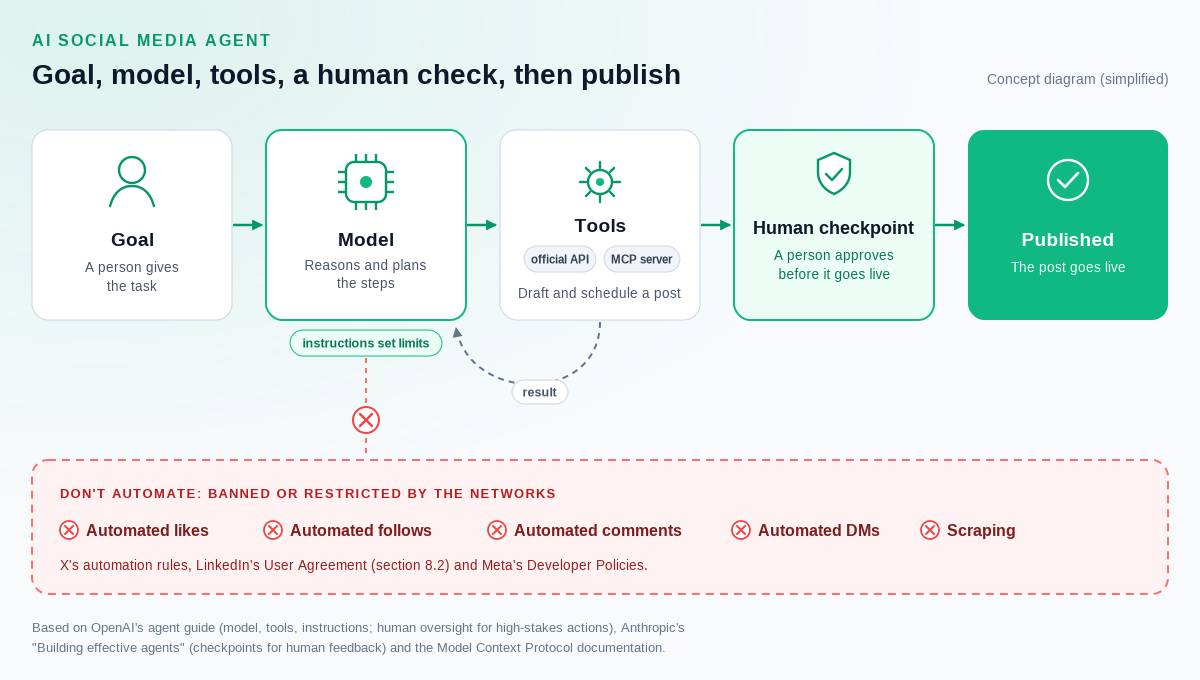
The stack for an autonomous marketing agent, layer by layer:
- Model. Reads the goal, plans the steps and picks the tool to call.
- Instructions. Brand tone, networks, what it may never do, and when to stop and ask.
- Tools. Draft a post, list accounts, schedule, cancel: a scheduler exposes these through its API or an MCP server.
- MCP. Anthropic open-sourced the protocol on 25 November 2024: developers expose data and actions through MCP servers, and AI apps (MCP clients) connect to them. Checked against Anthropic: Introducing the Model Context Protocol
- Official network APIs. The scheduler, not the agent, holds the connection to each network and publishes through that network’s API.
- A human checkpoint. Anthropic says agents can pause for human feedback at checkpoints and recommends extensive testing in sandboxed environments with guardrails. Checked against Anthropic Engineering: Building effective agents
Anthropic recommends the simplest solution that works, which may mean no agent at all, because agentic systems trade speed and cost for better task performance. Checked against Anthropic Engineering: Building effective agents And OpenAI said its ChatGPT agent, when signed into websites, created privacy risks including prompt injection, and that its safeguards did not eliminate all risks. Checked against OpenAI Help Center: ChatGPT agent
What do the platforms allow an AI agent to do?
Where a network’s rules address it, publishing through its official API is allowed; automated likes, follows and scraping are banned, and automated comments and DMs are banned or allowed only with opt-in. Here is what each network’s own rules say about automation. The banned items are listed so you can avoid them, not as tactics.
| Network | What the rules allow | What the rules ban |
|---|---|---|
| X | Helpful automated posts and opt-in auto-replies through the API Checked against X Help Center: Automation rulesArchived copy, 1 October 2026 View the archived copy | Scripting the X website and getting around rate limits; automated likes, bulk following and unfollowing Checked against X Help Center: Automation rulesArchived copy, 1 October 2026 View the archived copy; auto-replies from keyword searches, and AI reply bots without X’s prior written approval Checked against X Help Center: Automation rulesArchived copy, 1 October 2026 View the archived copy; unsolicited bulk or automated DMs and duplicate posts Checked against X Help Center: Automation rulesArchived copy, 1 October 2026 View the archived copy |
| The ban targets unauthorised automation Checked against LinkedIn User Agreement (effective 3 November 2025) | Bots that access LinkedIn, add contacts, send messages, or create, comment on, like or share posts Checked against LinkedIn User Agreement (effective 3 November 2025); scraping software Checked against LinkedIn User Agreement (effective 3 November 2025); plug-ins and extensions that automate activity on its website Checked against LinkedIn Help: Prohibited software and extensions | |
| Facebook and Instagram (Meta apps) | Apps that follow Meta’s Developer Policies and documentation Checked against Meta for Developers: Meta Platform Terms | Spam bots in Messenger and Instagram Messaging Checked against Meta for Developers: Developer Policies; messages without opt-in Checked against Meta for Developers: Developer Policies; buying, selling or exchanging likes, follows or comments Checked against Meta for Developers: Developer Policies; automated data collection from Instagram without permission Checked against Instagram Terms of Use |
| Threads | Apps can create and publish content for a person, capped at 250 API-published posts per profile in a rolling 24 hours Checked against Meta for Developers: Threads API overview | Robots, scrapers or other automatic tools that collect data from Threads Checked against Instagram Help Center: Threads Terms of Use |
| TikTok | Automated data collection only with TikTok’s written approval Checked against TikTok Terms of Service (United States), last updated July 15, 2026 | Scraping with bots Checked against TikTok Terms of Service (United States), last updated July 15, 2026; services that boost engagement and automation tools that bypass its systems Checked against TikTok Community Guidelines: Integrity and Authenticity — Deceptive Behaviors and Fake Engagement (effective 24 September 2026) |
| YouTube | Asking viewers to like, subscribe or comment Checked against YouTube Help: Fake engagement policy | Automatic systems that inflate views, likes, comments or other metrics Checked against YouTube Help: Fake engagement policy |
| Automation Pinterest has explicitly approved, such as listed partner tools Checked against Pinterest Policy: Community Guidelines | Unapproved automation, including services that act on your behalf Checked against Pinterest Policy: Community Guidelines | |
| Bluesky | Bot accounts that label themselves “bot”, as a best practice Checked against AT Protocol: Build a Bot tutorial (with atproto.com/guides/labels) | Automated or bulk interactions (messages, follows, likes, replies) and automated follower generation Checked against Bluesky Docs: Developer Guidelines; manipulating engagement metrics Checked against Bluesky Social: Community Guidelines |
Meta says its enforcement can include suspending or permanently removing an app and its access to the platform. Checked against Meta for Developers: Meta Platform Terms X says non-API automation can lead to permanent suspension. Checked against X Help Center: Automation rulesArchived copy, 1 October 2026 View the archived copy Bluesky’s developer rules target automated interactions; they do not ban publishing your own posts through the API. Checked against Bluesky Docs: Developer Guidelines
An agent that drafts and schedules your own posts through a scheduler is on the allowed side; one that likes, follows, comments or messages for you is not.
Where does a social media agent still need a human?
Before anything goes live, in replies to real people, in a crisis, and anywhere a mistake can’t be undone. OpenAI’s guide calls human intervention a critical safeguard and says sensitive, irreversible or high-stakes actions should trigger human oversight until you trust the agent’s reliability. Checked against OpenAI: A practical guide to building agents (PDF) A published post is public the moment it goes out, so treat publishing as high-stakes.
A checklist for where a person decides:
- Publishing. A person reads every post before it is scheduled or published.
- Facts and claims. OpenAI says ChatGPT can sound confident while giving wrong definitions, dates or facts and invented quotes or citations, so check important information against reliable sources. Checked against OpenAI Help Center: Does ChatGPT tell the truth?
- Replies to people. On X, automated replies are allowed only to people who opted in, and AI reply bots need X’s prior written approval. Checked against X Help Center: Automation rulesArchived copy, 1 October 2026 View the archived copy Draft replies with AI if you like; a person sends them.
- A crisis. Pause the agent and scheduled posts; a person decides what goes out.
- Platform rules. Keep the agent’s tools limited to drafting and scheduling, so it cannot like, follow, comment or message.
Outfeed’s check is your own confirmation, not a review workflow:
How to connect an AI agent to your scheduler
Use the scheduler’s MCP server or API: create an API key, add the server to an MCP client such as Claude, then ask the agent to draft and schedule, with a review step you build in yourself. The generic steps:
- Check what the scheduler offers. Look for an MCP server or a public API, and which plan includes it.
- Create an API key in the scheduler, and store it like a password.
- Add the MCP server to your MCP client. MCP connects AI apps such as Claude or ChatGPT to outside tools. Checked against Model Context Protocol: What is MCP?
- Write the instructions. Which accounts, which tone, “draft first and show me before scheduling”, and what it must never do.
- Test on one account with a few drafts before you let it schedule a full week.
Don’t assume the scheduler will stop and ask you before a tool call runs: build the review into your instructions. In Outfeed, this is how the API and MCP connection works:
The setup in Outfeed, step by step, is in our guide on how to connect an AI agent to Outfeed, and the endpoints are described on the social media scheduling API page.
Which AI agents for social media exist?
Three kinds: agents inside social media suites, general agents you connect to your own tools, and agents made by a platform for its ads. None is ranked.
Agents inside social media suites
- Hootsuite Wisdom fits if you already run Hootsuite. On every plan it lists an AI content and ideas generator, caption enhancements and hashtag suggestions. Checked against Hootsuite: Plans, Prices, and FeaturesVendor's own description Hootsuite said in June 2026 it was launching MCP connectors so AI agents can reach its data inside other AI tools Checked against Hootsuite press release: Introducing WisdomVendor's own description; its plans page lists a Lumen MCP connector on Enterprise. Checked against Hootsuite: Plans, Prices, and FeaturesVendor's own description
- Sprout Social Trellis fits if your team works in Sprout’s inbox and reports: drafted replies, briefings and post variations, using monthly credits per seat. Checked against Sprout Social: PricingVendor's own description
- Vista Social’s Ask Vista fits if you want one command centre for planning, publishing, reporting and replying, with MCP connections to AI tools on every plan. Checked against Vista Social: PricingVendor's own description
General agents you connect to tools
- ChatGPT Work fits longer multi-step tasks across connected apps and files, with approval of important actions. Checked against OpenAI Help Center: ChatGPT release notes (9 July 2026) ChatGPT plugins can include MCP apps, and installing one cannot bypass the provider’s or workspace’s permissions. Checked against OpenAI Help Center: Plugins in ChatGPT
- Claude or another MCP client fits if your scheduler has an MCP server. Schedulers that list MCP include Metricool, whose Free plan includes Metricool MCP Checked against Metricool: PricingVendor's own description, and SocialPilot, which lists MCP access on every plan. Checked against SocialPilot: PlansVendor's own description
Platform-made agents
- TikTok Symphony Agent fits ad video: from a brief to a video with a few prompts, inside TikTok’s Symphony Creative Studio. Checked against TikTok for Business blog: Meet TikTok Symphony, our new Creative AI suite (8 November 2026)
For tools that use AI without acting as agents, see social media AI tools by job, and for the scheduling side, the guide to the AI social media scheduler.
Outfeed’s Starter plan is $29 per month, billed monthly. Prices verified on outfeed.ai/#pricing MCP and API access come with every plan. See Outfeed pricing for every plan.
Try Outfeed AI with your own AI agent
Social media agent FAQ
What is a social media AI agent?
An AI system that takes a goal, such as planning and scheduling a week of posts, and carries out the steps itself with connected tools. OpenAI describes agents as systems that independently accomplish tasks on your behalf.
How is an AI agent different from a chatbot?
A chatbot answers each message; an agent decides its next step and uses tools to act. OpenAI says simple chatbots are not agents, and Google Cloud separates agents, which act on their own, from assistants, which leave decisions to you.
Can an AI agent post on social media for me?
It can publish through a network’s official API or a scheduler connected to it. Networks ban or tightly restrict automated likes, follows, comments and DMs, and AI can make confident mistakes, so a person should check each post before it goes live.
Do social media platforms allow automated posting?
Where their rules address it, yes, through official APIs. X allows helpful automated posts through its API but bans scripting its website, automated likes and bulk following; the Threads API lets apps publish for a person; and LinkedIn’s User Agreement bans unauthorised bots that post, comment, like or send messages.
What is MCP in AI agents?
The Model Context Protocol is an open-source standard for connecting AI applications such as Claude or ChatGPT to outside data sources and tools. Anthropic open-sourced it on 25 November 2024.