
AI in Social Media: How It Works, Uses and Risks
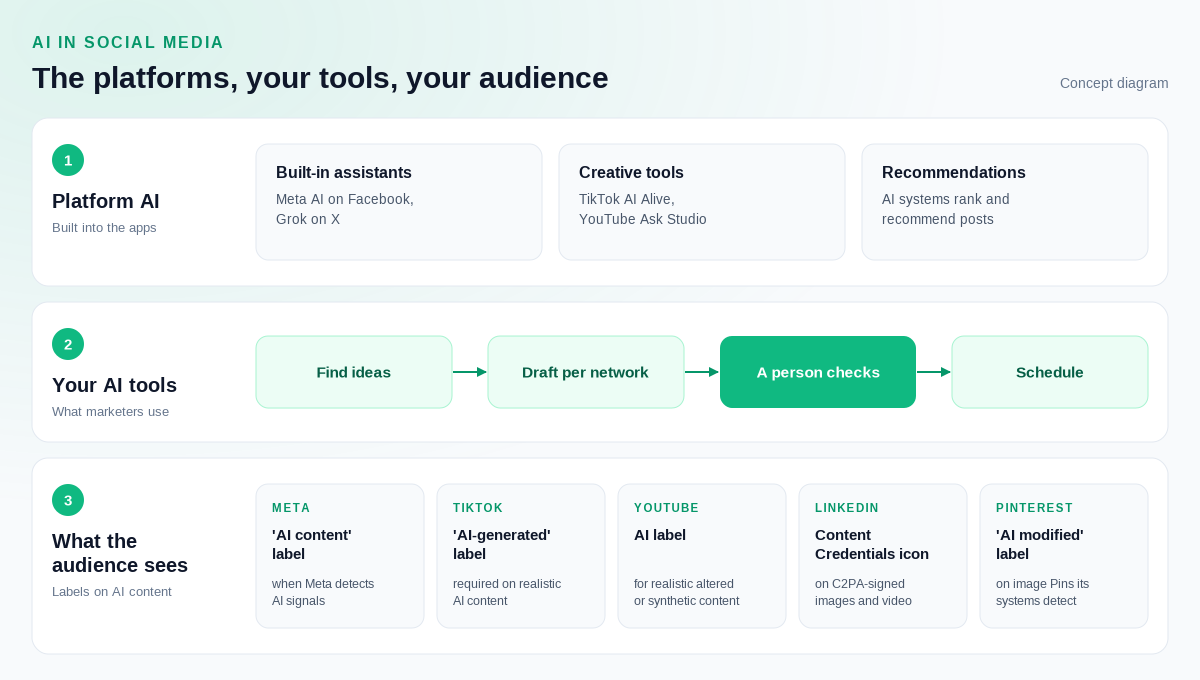
AI in social media works in three layers: the AI the platforms build into their own apps, the AI tools marketers use to find ideas, draft and schedule posts, and the labels audiences see when content was made or changed with AI. Each layer has its own rules. Platforms rank feeds and catch rule-breaking posts with AI, marketers mostly use it to work faster, and most major networks now have rules on when AI content must be labelled.
This guide covers all three from the platforms’ own help pages, regulators, dictionaries and primary research, plus one press report where LinkedIn has not documented a change itself. Each fact carries the date we checked it.
Table of Contents
- What is AI in social media?
- How do social media platforms use AI?
- How do marketers use AI on social media?
- What are the benefits of AI in social media?
- Which AI tools do social media managers use?
- Do you have to label AI content on social media?
- What are the risks of AI on social media?
- How to start using AI for social media this week
- AI in social media FAQ
What is AI in social media?
AI in social media (artificial intelligence in social media) is software that imitates intelligent human behaviour, used inside social apps and in the tools people use to post on them. Merriam-Webster defines artificial intelligence as the capability of computer systems or algorithms to imitate intelligent human behavior. Checked against Merriam-Webster: artificial intelligence
Two narrower terms do most of the work on social media today:
- Generative AI is, in the Cambridge Dictionary’s definition, the use or study of AI systems that are able to produce text, images and so on. Checked against Cambridge Advanced Learner's Dictionary & Thesaurus: generative AI It is what writes a draft caption or turns a photo into a video.
- A large language model (LLM) is a mathematical representation of language, built from very large amounts of data, that lets computers produce language that seems similar to what a human might say. Checked against Cambridge Advanced Learner's Dictionary & Thesaurus: large language model Chat assistants such as Meta AI and Grok run on them.
How do social media platforms use AI?
Platforms use AI in three places: to rank what each person sees, to find posts that break their rules, and in assistants and creative tools inside the apps. The first two apply to your posts whether or not you use AI yourself.
Ranking feeds and recommendations
The big networks rank feeds from signals about the post and the viewer, and Meta and LinkedIn say AI systems do that ranking.
- Meta: AI systems rank content across Facebook Feed, Instagram Reels, Marketplace and more. Their models predict what each person will find relevant from signals about the post, how others interacted with it and how the person engaged with similar content. Checked against Meta Transparency Center: Our approach to explaining ranking (updated 31 December 2023)
- LinkedIn: its AI systems and algorithms consider hundreds of signals, including the post’s context and your profile, network and activity. LinkedIn says age, race and gender are not visibility signals. Checked against LinkedIn Help: How the Feed ranks content
- YouTube: its recommendation system uses viewers’ watching behaviour, likes, dislikes, subscriptions and feedback, and finds videos for each viewer rather than promoting videos to an audience. Checked against How YouTube Works: Recommendations
- TikTok: For You is shaped by user interactions, content information and user information, with interactions such as watch time generally weighted most. Checked against TikTok Help Center: How TikTok recommends content
- Instagram: its Recommendations Guidelines keep some allowed content out of recommendations, such as unoriginal content repurposed with only minor edits, and it avoids recommending accounts that share photorealistic AI-generated people without the AI-generated profile label. Checked against Instagram Help Center: Recommendations on Instagram
Finding posts that break the rules
At Meta and YouTube, most rule-breaking content is found automatically, with people reviewing the unclear cases. Meta said in 2023 that its technology finds more than 90% of the content it takes action on before anyone reports it, for most violation categories, and sends content it is unsure about to review teams. Checked against Meta Transparency Center: How technology detects violations (updated 18 October 2023) YouTube says content that breaks its Community Guidelines is flagged by a mix of automated detection and human reporting, that most is detected automatically, and that creators can appeal. Checked against How YouTube Works: Our Policies Bluesky stacks moderation: every account gets Bluesky’s own, and since March 2024 you can subscribe to independent labelers that add their own labels. Checked against Bluesky blog: Bluesky’s Stackable Approach to Moderation
Assistants and creative tools inside the apps
Meta, X, TikTok and YouTube ship their own AI assistants or creative tools, LinkedIn has withdrawn its Page post-writing tool, and each network has its own rules on your data.
| Network | Built-in AI | What it says about your data |
|---|---|---|
| Facebook, Instagram, Messenger | Meta AI appears in Facebook search, below some public posts and as a chat in Messenger. Checked against Facebook Help Center: Ask Meta AI on Facebook | Meta uses your interactions with its AIs to improve AI at Meta, and messages that mention @Meta AI in encrypted chats are not encrypted. Checked against Facebook Help Center: Chat with Meta AI on Facebook |
| X | Grok, an AI assistant powered by a large language model from xAI, answers questions and helps brainstorm. Checked against X Help Center: About Grok (Internet Archive capture, 10 November 2026)Archived copy, 10 November 2026 View the archived copy | Public X data and your Grok interactions may train xAI’s models; you can opt out in Settings or by making your account private. Checked against X Help Center: About Grok (Internet Archive capture, 10 November 2026)Archived copy, 10 November 2026 View the archived copy |
| Its AI post-writing tool for Pages is marked “No longer available”. Checked against LinkedIn Help: AI-powered tool for LinkedIn Page posts - No longer available | LinkedIn uses data about your use of its platform, including posts, to improve its services. Checked against LinkedIn Help: LinkedIn and generative AI (GAI) FAQs The “Data for Generative AI Improvement” setting opts you out going forward. Checked against LinkedIn Help: LinkedIn and generative AI (GAI) FAQs | |
| TikTok | AI Alive turns a photo into a video from a text prompt, posted to your Story. Checked against TikTok Help Center: AI Alive AI Create makes an image or video from a prompt and your photos. Checked against TikTok Help Center: Editing TikTok videos and photos | TikTok stores AI Create prompts and uploads for up to 30 days. Checked against TikTok Help Center: Editing TikTok videos and photos |
| YouTube | Ask Studio can suggest thumbnails from a prompt using the video’s transcript. Checked against YouTube Help: Add custom thumbnails on YouTube Reimagine (March 2026) turns one frame of a Short into a new 8-second clip. Checked against YouTube Official Blog: Reimagine: A new AI-powered Remix tool in YouTube Shorts (18 Mar 2026) |
X warns that Grok may confidently give factually incorrect information and asks people to verify what it says. Checked against X Help Center: About Grok (Internet Archive capture, 10 November 2026)Archived copy, 10 November 2026 View the archived copy Our guide on whether you can turn off Meta AI covers what Meta lets you control. For a walkthrough of TikTok’s photo-to-video tool, see TikTok AI Alive.
Advertisers get separate tools. TikTok Symphony is TikTok for Business’s generative-AI creative suite for advertisers, not a feature of the TikTok app. Checked against TikTok for Business blog: Meet TikTok Symphony, our new Creative AI suite (8 November 2026) Meta’s text generation in Ads Manager writes up to five variations of an ad’s primary text and headline from your original. Checked against Meta Business Help Center: About text generation in Meta Ads Manager
How do marketers use AI on social media?
AI social media marketing is now mainstream: most B2B marketers use AI content tools, mainly for speed, and accuracy and quality control are their top worries. The best primary data covers B2B marketers and the general public, not social media managers alone.
- Adoption: in the Content Marketing Institute’s 2027 report, 88% of B2B marketers said their organisation uses AI-powered content creation tools. Checked against Content Marketing Institute: B2B Content and Marketing Trends: Insights for 2027 That survey reports on 861 B2B marketers, fielded June to August 2026. Checked against Content Marketing Institute: B2B Content and Marketing Trends: Insights for 2027
- What it is good for: the same marketers most often named speed (78%) and efficiency (59%) as AI’s contributions; 17% named quality, and ensuring accuracy and maintaining quality control (54% each) were their top AI content challenges. Checked against Content Marketing Institute: B2B Content and Marketing Trends: Insights for 2027
- The public: in Pew Research Center’s February 2026 survey of 5,119 U.S. adults, 49% said they use AI chatbots, and 38% of employed adults use them for tasks at work. Checked against Pew Research Center: Americans and AI 2026: Chatbots, Smart Devices and Views on Impact (17 June 2026)
- Writing time: in Gallup’s August 2026 survey of 21,648 U.S. employees (all jobs, not just marketing), 47% of frequent AI users spend less time writing or drafting, while about one in five spend more time reviewing and correcting work (and a similar share spend less). Checked against Gallup: How AI Is Changing the Way Employees Spend Time at Work (16 November 2026)
- Small businesses: the U.S. Small Business Administration lists generating and scheduling posts across platforms, and making content variations for different sites, among the uses of AI tools (it calls them “Super intelligence (SI)” tools) and advises owners to start small. Checked against U.S. Small Business Administration: Manage your business
In practice that splits into six jobs. The work on the left is where AI helps; the column on the right is where a person stays in charge.
| Job | What AI does | What a person still does |
|---|---|---|
| Ideas | Lists angles, questions and series from a brief | Picks the ones that fit the brand and the month |
| Drafting | Writes a first version per network | Edits for facts, voice and the network’s limit |
| Visuals | Platform tools make or change images and video | Checks likeness, rights and whether a label is needed |
| Scheduling | Suggests a plan for the week | Confirms the date and time of each post |
| Listening | Sorts mentions and sentiment in dedicated tools | Decides what needs a reply |
| Replies | Drafts an answer to a comment | Reads, edits and sends it |
That is the same work as social media management in general, done faster at the drafting stage.
Some uses are banned outright. Section 8.2 of LinkedIn’s User Agreement bans bots and other unauthorised automation that creates, comments on, likes or shares posts or otherwise drives inauthentic engagement. Checked against LinkedIn User Agreement (effective 3 November 2025) X’s Automation rules allow helpful automated posts through its API but ban non-API automation such as scripting the X website. Checked against X Help Center: Automation rulesArchived copy, 1 October 2026 View the archived copy In the US, the FTC’s rule on reviews and testimonials prohibits businesses from creating or selling AI-generated fake reviews. Checked against FTC press release: Federal Trade Commission Announces Final Rule Banning Fake Reviews and Testimonials (14 August 2024)
What are the benefits of AI in social media?
The benefits marketers report are speed and efficiency, not better quality: AI cuts drafting time and makes per-network versions quicker. In CMI’s 2027 report, B2B marketers most often named speed (78%) and efficiency (59%) as what AI contributes, and only 17% named quality. Checked against Content Marketing Institute: B2B Content and Marketing Trends: Insights for 2027 Gallup found 47% of frequent AI users at work spend less time writing or drafting. Checked against Gallup: How AI Is Changing the Way Employees Spend Time at Work (16 November 2026) The SBA points small businesses to the same gains: generating and scheduling posts, and making content variations for different sites. Checked against U.S. Small Business Administration: Manage your business
The time saved moves to checking. Accuracy and quality control were the same marketers’ top AI content challenges Checked against Content Marketing Institute: B2B Content and Marketing Trends: Insights for 2027, so plan for a person to review every draft.
Which AI tools do social media managers use?
The tools split by job: a general chat assistant for ideas and drafts, a writing tool for copy, a scheduler to publish, and a listening tool to track mentions. We do not rank tools on this page. Each guide below covers one job, with the honest limits of each tool.
| Job | Fits if you… | Our guide |
|---|---|---|
| Prompting any chat assistant | Already use a chat assistant and want better drafts from it | AI prompts for social media |
| Writing copy | Write ads, captions and emails and want a dedicated writing tool | AI copywriting tools |
| Post on LinkedIn and need tools that stay inside its User Agreement | AI tools for LinkedIn | |
| Planning and publishing in one place | Want one tool to draft, schedule and publish across networks | AI social media manager |
| Day-to-day help | Want an assistant that takes requests in plain language | AI social media assistant |
| ChatGPT specifically | Use ChatGPT and want a workflow built around it | Using ChatGPT for social media |
| Listening | Need to track mentions and sentiment about your brand | Social listening |
Do you have to label AI content on social media?
Sometimes. Most networks require a label only for realistic AI video, audio or images of people and events, and several add labels automatically. The network rules target realistic media, not text you drafted with an assistant; the EU rule below is the exception for some public-interest text. The table sums up each network’s rule; the stamps link the source.
| Network | When you must label | How you label | Automatic labels |
|---|---|---|---|
| Facebook, Instagram, Threads | May be required for photorealistic video or realistic-sounding audio made or altered digitally, including with AI; not for images. Meta says there may be penalties. Checked against Meta Help Center: How to identify AI content on Meta products | You may be able, and sometimes required, to add the “AI content” label yourself. Checked against Meta Help Center: How to identify AI content on Meta products | “AI content” on the post when Meta detects industry-standard AI signals; edited-only content gets the detail in the post menu. Checked against Meta Help Center: How to identify AI content on Meta products |
| TikTok | Realistic AI images, audio and video; TikTok encourages labelling anything fully made or heavily edited by AI. Checked against TikTok Help Center: AI-generated content | Turn on the AI-generated content setting before posting. Checked against TikTok Help Center: About AI-generated content | “AI-generated” for TikTok AI effects or C2PA uploads; an auto label can’t be removed. Checked against TikTok Help Center: About AI-generated content |
| YouTube | AI that makes a real person seem to say or do something, alters real footage, or generates a realistic scene. Checked against YouTube Help: Disclosing use of GenAI content | Answer Yes under “AI use” in YouTube Studio during upload. Checked against YouTube Help: Disclosing use of GenAI content | For YouTube’s own AI tools, C2PA metadata or YouTube’s detection. Checked against YouTube Help: Disclosing use of GenAI content |
| Synthetic media showing a person saying or doing something they did not, unless clearly disclosed. Checked against LinkedIn Professional Community Policies | Clearly disclose that the material is fake or altered. | A C2PA icon on images and video signed with Content Credentials. Checked against LinkedIn Help: Content credentials | |
| X | No self-label is described; deceptive synthetic media that may cause widespread confusion or harm is not allowed. Checked against X Help Center: Authenticity policy (Internet Archive capture, 15 November 2026)Archived copy, 15 November 2026 View the archived copy | Non-deceptive sharing is allowed. Checked against X Help Center: Authenticity policy (Internet Archive capture, 15 November 2026)Archived copy, 15 November 2026 View the archived copy | X’s policy describes no automatic AI label. |
| Pinterest’s help pages describe no creator labelling rule. | No step to label is described; creators can appeal a label through Pinterest’s support team. Checked against Pinterest Help Center: Gen AI labels | “AI modified” in close-up when its systems detect AI, since 30 April 2025 Checked against Pinterest Newsroom: Introducing Gen AI Labels (30 April 2025); Pinterest also labels Pins whose owner indicated AI use. Checked against Pinterest Help Center: Gen AI labels | |
| Bluesky | Bluesky’s own moderation describes no AI labelling rule. | Independent labelers you subscribe to add their own labels. Checked against Bluesky blog: Bluesky’s Stackable Approach to Moderation |
Four details the table cannot hold:
- Meta’s label has changed name. It was announced as “Made with AI” in April 2024, renamed “AI info” in July 2024, and is now called “AI content” in Meta’s Help Center. Checked against Meta Newsroom: Our Approach to Labeling AI-Generated Content and Manipulated Media (5 April 2024, updated 1 July and 12 September 2024) On ads, an AI info label can appear next to the “Sponsored” label. Checked against Meta Help Center: How AI-generated images in ads are identified and labeled on Meta
- TikTok bans some AI content even when labelled, including fake authoritative sources or crisis events, and the likeness of anyone under 18. Checked against TikTok Help Center: About AI-generated content
- LinkedIn cannot catch everything. It says it is not yet possible to identify and label all AI-generated content. Checked against LinkedIn Help: Content credentials The AI tools for LinkedIn guide covers what that means for your posts.
- The EU now requires labels too. Under the EU AI Act, deep fakes and AI text published to inform the public on matters of public interest must be clearly labelled, and the European Commission says these transparency rules came into effect in August 2026. Checked against European Commission: AI Act (Shaping Europe's digital future) This is a summary, not legal advice.
What are the risks of AI on social media?
The main risks are wrong facts, low-quality mass posting, deepfakes, unclear copyright, lost trust and legal exposure from fake reviews. Each one is sourced below.
Wrong facts
AI states false things with confidence, so every claim needs checking. The Cambridge Dictionary now has an AI sense of “hallucinate”: when an AI hallucinates, it produces false information. Checked against Cambridge Advanced Learner's Dictionary & Thesaurus: hallucinate LinkedIn’s User Agreement says its AI output might be inaccurate or misleading and asks members to review and edit it before sharing. Checked against LinkedIn User Agreement (effective 3 November 2025)
Low-quality mass posting
Posting AI filler in bulk now has a name, and on LinkedIn members can report it. Merriam-Webster chose “slop” as its 2025 Word of the Year: low-quality digital content produced usually in quantity by AI. Checked against Merriam-Webster: 2025 Word of the Year: Slop (14 December 2025) Social Media Today reported that LinkedIn launched an option in August 2026 to report content members think is AI “slop”, used more than one million times in under three weeks. Checked against Social Media Today (Andrew Hutchinson): LinkedIn ditches post enhancement, launches Post Proofreader (20 September 2026)Press report
Deepfakes
Realistic fakes of real people are what the network rules above focus on. Merriam-Webster defines a deepfake as a digital image, video or voice convincingly generated or altered to misrepresent someone as doing or saying something they did not. Checked against Merriam-Webster: deepfake The labelling table above shows how each network handles them.
Copyright
In the US, a purely AI-made post may not be yours to protect. The U.S. Copyright Office concluded in January 2025 that AI outputs can be protected only where a human author determined enough of the expressive elements, which can include arranging or modifying the output but not merely writing prompts. Checked against U.S. Copyright Office: NewsNet Issue 1060 (Part 2 of the Copyright and AI Report); release date from copyright.gov/ai This is a summary, not legal advice.
Audience trust
People want to know what AI made, and many doubt they can tell. In Pew’s June 2025 survey of 5,023 U.S. adults, 76% said it is very or extremely important to be able to tell whether content was made by AI or people, and 53% were not confident they could. Checked against Pew Research Center: How Americans View AI and Its Impact on People and Society (17 September 2025) In the same survey, 56% said they would think less of a news article they felt informed by on learning AI was involved. Checked against Pew Research Center short read: How would Americans react if they learned AI was used for a speech, song, painting or news article? (17 September 2025) In Pew’s June 2026 survey of 3,488 U.S. adults, 52% were more concerned than excited about the increased use of AI in daily life. Checked against Pew Research Center short read: Young US adults are increasingly wary of AI, concerned it will take jobs (18 August 2026) Marketers feel it too: 75% of B2B marketers in CMI’s 2027 report worry AI is making audiences more sceptical, yet 52% say their organisation has no policy on disclosing AI use. Checked against Content Marketing Institute: B2B Content and Marketing Trends: Insights for 2027
Legal exposure
The FTC has acted against deceptive uses of AI, with one reversal. In September 2024 the FTC announced Operation AI Comply, a sweep against companies using AI for deceptive or unfair conduct. Checked against FTC press release: FTC Announces Crackdown on Deceptive AI Claims and Schemes (25 September 2024) One part of it, the order against the AI writing tool Rytr, was set aside in December 2025, with the FTC saying it will keep holding accountable those who use AI to break the law. Checked against FTC press release: FTC Reopens and Sets Aside Rytr Final Order in Response to the Trump Administration's AI Action Plan (22 December 2025) The reviews rule’s ban on AI-generated fake reviews still stands. Checked against FTC press release: Federal Trade Commission Announces Final Rule Banning Fake Reviews and Testimonials (14 August 2024)
How to start using AI for social media this week
Start with one job, keep a person checking every step, and add tools only when the first job works. Five steps:
- Get ideas. Ask a chat assistant for ten post angles for one audience and one month. Copy-paste versions are in AI prompts for social media.
- Draft one version per network. Give the model each network’s character limit and two of your own past posts as examples, then edit the draft yourself.
- Check every fact. Names, numbers, dates and claims all get checked against a source before anything is posted. LinkedIn, for one, asks members to review and edit what its AI features produce before sharing. Checked against LinkedIn User Agreement (effective 3 November 2025)
- Label where required. If AI made realistic video, audio or images of people or events, set the network’s label using the table above.
- Schedule, then read results in each network. Put the approved posts on a calendar and pick each time yourself.
For step 5, here is what Outfeed does and does not do:
To mock up a post before you write it, try the free social media post creator. For what Outfeed is and how it works, see what is Outfeed AI.
AI in social media FAQ
How is AI used in social media?
In three ways. Platforms use it inside their apps: assistants such as Meta AI Checked against Facebook Help Center: Ask Meta AI on Facebook and Grok Checked against X Help Center: About Grok (Internet Archive capture, 10 November 2026)Archived copy, 10 November 2026 View the archived copy, creative tools, and feed ranking. Checked against Meta Transparency Center: Our approach to explaining ranking (updated 31 December 2023) Marketers use it to find ideas, draft posts and plan schedules. Audiences see labels when content was made or changed with AI.
Do I have to label AI-generated posts?
Sometimes. Meta may require a label for photorealistic AI video and realistic AI audio but not for images. Checked against Meta Help Center: How to identify AI content on Meta products TikTok Checked against TikTok Help Center: AI-generated content and YouTube Checked against YouTube Help: Disclosing use of GenAI content require disclosure of realistic AI content, and LinkedIn asks you to disclose synthetic media that shows a person saying or doing something they did not. Checked against LinkedIn Professional Community Policies The labelling table links each rule.
Will AI take social media jobs?
Not on official projections so far. The US Bureau of Labor Statistics has no social media manager occupation. Source: BLS OEWS May 2025 occupation profiles index and national data file, checked ; page date: May 2025 estimates, released 2026-05-15 For public relations specialists, one of the nearest occupations, it projects 2% job growth from 2025 to 2035 and says social media creates opportunities while AI may soften demand. Source: BLS Occupational Outlook Handbook, Public Relations Specialists, checked ; page date: page last modified 2026-08-27 The public is more pessimistic: in Pew’s June 2026 survey of 3,488 U.S. adults, 71% expected AI to lead to fewer jobs in the United States over the next two decades. Checked against Pew Research Center short read: Young US adults are increasingly wary of AI, concerned it will take jobs (18 August 2026) LinkedIn Checked against LinkedIn User Agreement (effective 3 November 2025) and X Checked against X Help Center: About Grok (Internet Archive capture, 10 November 2026)Archived copy, 10 November 2026 View the archived copy both tell people to review or verify what their AI produces, so AI drafts and people decide what goes out.
What are the risks of using AI on social media?
Inaccurate output, low-quality mass-produced posts, deepfakes, unclear copyright in purely AI-made work, lost audience trust and, for fake reviews or testimonials, legal risk under the FTC’s reviews rule. Checked against FTC press release: Federal Trade Commission Announces Final Rule Banning Fake Reviews and Testimonials (14 August 2024) The risks section sources each one.
Is AI-generated content allowed on Instagram and TikTok?
Yes, within each platform’s rules. Both label some AI content automatically. Checked against Meta Help Center: How to identify AI content on Meta products Checked against TikTok Help Center: About AI-generated content TikTok requires labels on realistic AI content and may remove, restrict or label unlabelled content Checked against TikTok Community Guidelines: Integrity and Authenticity (released 25 August 2026, effective 24 September 2026), and it bans some AI content even when labelled. Checked against TikTok Help Center: About AI-generated content Instagram does not recommend accounts that share photorealistic AI-generated people without the AI-generated profile label. Checked against Instagram Help Center: Recommendations on Instagram