
Non-Copyright Songs That YouTubers Can Use: Where to Look
The non-copyright songs that YouTubers can use are really songs they have a licence or permission to use: almost all music is under copyright. Start with YouTube’s own Audio Library, then Creative Commons and public-domain music, then a paid royalty-free library.
Only the first is music YouTube itself calls copyright-safe. Checked against YouTube Help: Use music and sound effects from the Audio Library Below: where to find music for YouTube videos, what each licence allows on a monetised channel, Content ID claims and credits. For trending audio, see our social media trends hub; for where music fits in a wider plan, see video marketing. This is general information for U.S. creators, not legal advice.
Table of Contents
- What does non-copyright music actually mean?
- Non-copyright songs that YouTubers can use: where to find them
- Is the YouTube Audio Library free for monetised videos?
- Can you use Creative Commons music on YouTube?
- What happens if your video gets a Content ID claim?
- Can you use popular songs in YouTube Shorts?
- How do you credit music in a YouTube description?
- Frequently asked questions
What does non-copyright music actually mean?
“Non-copyright” is not a legal category. A song is protected from the moment it is fixed, so what you need is a licence or the owner’s permission, not a song with “no copyright”. The U.S. Copyright Office says copyright protects original works, including musical compositions and sound recordings, as soon as they are fixed in a tangible form. Checked against U.S. Copyright Office: What is Copyright? Registration is not required for that protection, so “it isn’t registered” does not make a track free. Checked against U.S. Copyright Office: What is Copyright?
A recorded song is two separate works for copyright purposes: the musical composition and the sound recording. Copyright in the recording is not a substitute for copyright in the composition, and a registration for one does not cover the other. Checked against U.S. Copyright Office: Circular 56A, Copyright Registration of Musical Compositions and Sound Recordings
Royalty-free is a licence model, not a dictionary term. Neither Merriam-Webster nor Cambridge has an entry for it. Checked against Merriam-Webster and Cambridge Dictionary (no entry for royalty-free) In practice, a library such as Epidemic Sound describes it as paying for the subscription with no extra cost when you publish or monetise. Checked against Epidemic Sound: Pricing & LicensingVendor's own description The music is still copyrighted; you are buying permission.
Public domain is the only music with no copyright left, and it is narrower than it looks:
- All works published in the United States before 1 January 1931 are in the public domain. Checked against U.S. Copyright Office: What is Copyright?
- Works created on or after 1 January 1978 are protected for the author’s life plus 70 years. Checked against U.S. Copyright Office: What is Copyright?
- Sound recordings fixed before 15 February 1972 follow a separate federal schedule: protection runs 95 years from first publication plus a transition period, ending on 31 December 2021 for recordings published before 1923, with 5 extra years for those published 1923 to 1946, 15 extra years for 1947 to 1956, and until 15 February 2067 for all remaining pre-1972 recordings. Checked against U.S. Copyright Office: Classics Protection and Access Act An old song can be free while the recording you found is not.
- Creators can also give work away: Creative Commons’ CC0 tool dedicates a work to the public domain so anyone can use it for any purpose. Checked against Creative Commons: Public Domain (CC0)
Non-copyright songs that YouTubers can use: where to find them
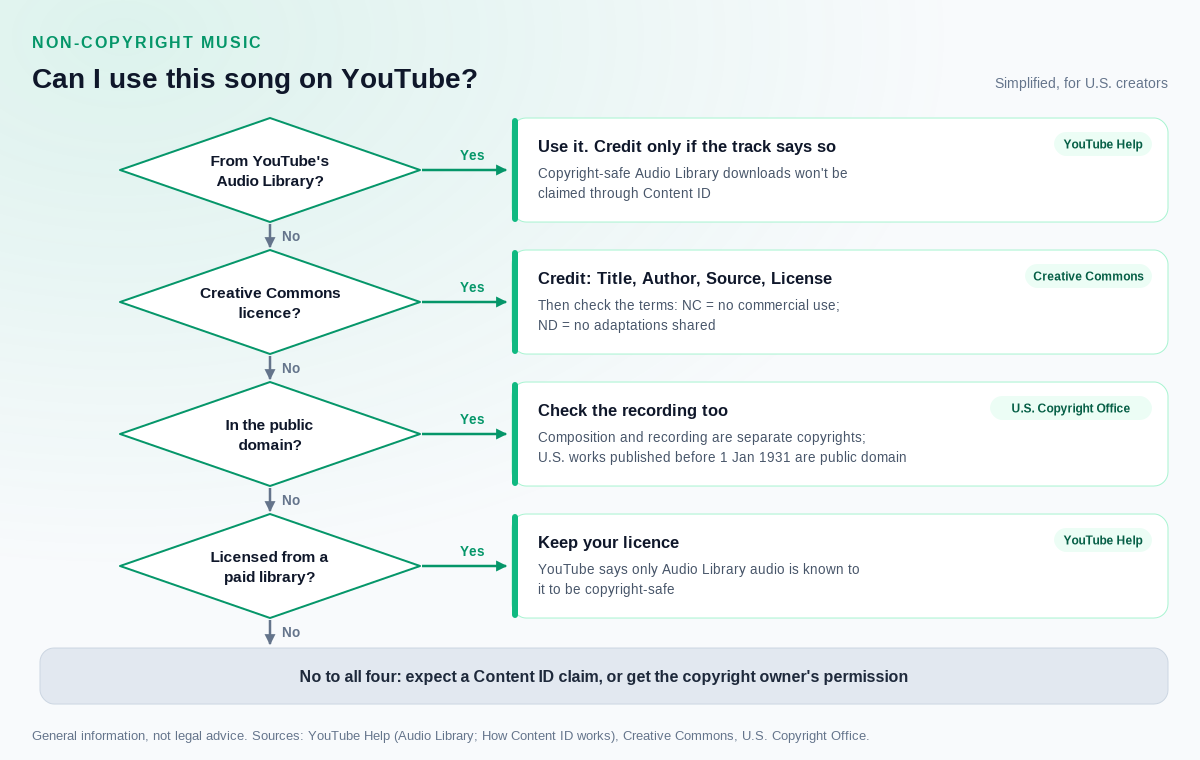
Go down this ladder in order: YouTube’s Audio Library first, then Creative Commons and public-domain sources, then a paid royalty-free library if you need more choice. The same ladder works for background music in tutorials, Shorts and vlogs and what makes someone a vlogger. YouTube says only Audio Library music and sound effects are known to it to be copyright-safe, and that it is not responsible for “royalty-free” audio from other channels or libraries. Checked against YouTube Help: Use music and sound effects from the Audio Library
Free and Creative Commons sources
| Source | Licence | Credit needed | Fits if |
|---|---|---|---|
| YouTube Audio Library | Standard YouTube Audio Library licence, or Creative Commons on some tracks Checked against YouTube Help: Use music and sound effects from the Audio Library | Only on Creative Commons tracks | You want the one source YouTube treats as copyright-safe, monetised videos included |
| Incompetech (Kevin MacLeod) | CC BY 4.0; a paid Standard License where credit is impossible Checked against Incompetech: Music FAQ and YouTube FAQVendor's own description | Yes, in the video description | You can always credit; it says monetised YouTube videos are fine |
| Free Music Archive | Mostly Creative Commons, chosen by each artist; check each song page Checked against Free Music Archive: License GuideVendor's own description | Yes (every CC licence requires it) | You will check the licence on every track; it says ND tracks cannot go in a video |
| Jamendo Music | Creative Commons, chosen by each artist Checked against Jamendo Music: Creative CommonsVendor's own description | Yes | You pick tracks without NC; Jamendo says an NC song can’t go in a monetised YouTube video |
| ccMixter | Creative Commons remixes and samples, each marked with its licence Checked against ccMixter: About ('Yea, But Is It Legal?')Vendor's own description | Yes | You want remixes and accept that many tracks are NonCommercial |
| Musopen | Recordings it describes as free “without copyright restrictions” Checked against Musopen: About (archived)Archived copy, 11 October 2026 View the archived copy | Check each recording | You want free recordings and will still read each one’s licence |
| Pixabay | Pixabay Content License: free, no attribution, may not be resold on its own Checked against Pixabay: Content License SummaryVendor's own description | No | You accept that some items may carry third-party rights you must check |
Pixabay’s licence summary says nothing about Content ID, so do not assume its tracks are claim-free. Checked against Pixabay: Content License SummaryVendor's own description ccMixter also warns that a contributor may upload material without permission. Checked against ccMixter: About ('Yea, But Is It Legal?')Vendor's own description
Paid royalty-free music for YouTube videos
| Library | Pricing model | YouTube and monetisation | Pricing page |
|---|---|---|---|
| Uppbeat | Free account with 3 free downloads for individual use on your own channels; paid plans billed monthly or yearly, cancel any time Checked against Uppbeat: PricingVendor's own description | Says paid plans are copyright-safe for monetisation and include safelisting a set number of YouTube channels | Uppbeat pricing |
| Epidemic Sound | Monthly or yearly subscriptions, creator and business plans; a free trial, not a free plan Checked against Epidemic Sound: Pricing & LicensingVendor's own description | Says creator plans license a set number of channels per platform, with no extra cost when you publish or monetise | Epidemic Sound pricing |
| Artlist | Stock music sold under separate Stock Catalog plans; Max plans combine stock and AI tools; custom business plans Checked against Artlist: PricingVendor's own description | We have not reviewed its stock music licence: read the Stock Catalog terms before you subscribe | Artlist pricing |
Descriptions are the vendors’ own; check each pricing page for current plans.
Is the YouTube Audio Library free for monetised videos?
Yes. YouTube says Partner Program members can monetise videos that use Audio Library tracks, and that copyright-safe Audio Library downloads won’t be claimed through Content ID. Checked against YouTube Help: Use music and sound effects from the Audio Library
The library sits in YouTube Studio, or at youtube.com/audiolibrary. You can search its royalty-free music and sound effects by title, artist, genre, mood, vocals, BPM, duration and attribution, and YouTube adds new releases twice a month. Checked against YouTube Help: Use music and sound effects from the Audio Library
Watch the attribution filter. Creative Commons tracks require crediting the artist in the description (the library generates the text), while standard-licence tracks can be filtered as “Attribution not required”. Checked against YouTube Help: Use music and sound effects from the Audio Library If you are starting a faceless YouTube channel that filter keeps descriptions simpler.
Can you use Creative Commons music on YouTube?
Yes, if you follow the licence. CC BY and CC BY-SA tracks are the simplest choice for a monetised channel, NonCommercial tracks need care, and NoDerivatives tracks cannot be used as a soundtrack.
Creative Commons lists six licences. All require credit to the creator (BY); ShareAlike (SA) means adaptations go out under the same terms, NoDerivatives (ND) means no adaptations are shared, and NonCommercial (NC) rules out commercial use. CC BY, BY-SA and BY-ND allow commercial use; the three NC licences do not. Checked against Creative Commons: About CC Licenses
| Licence | Commercial use | In a YouTube video |
|---|---|---|
| CC BY | Allowed | Allowed with credit |
| CC BY-SA | Allowed | Allowed with credit; the video must carry the same licence |
| CC BY-ND | Allowed | Not as a soundtrack: syncing music to video counts as an adaptation |
| CC BY-NC-ND | Not allowed | Not as a soundtrack, for the same reason |
| CC BY-NC, CC BY-NC-SA | Not allowed | Only where the video’s primary purpose is not commercial |
Checked against Creative Commons: Attribution-NoDerivatives 4.0 International legal code, Section 1(a).
That ND rule comes from the 4.0 licences; older versions may differ, so check the version on the track.
NonCommercial is where creators get stuck. Creative Commons defines it as “not primarily intended for or directed towards commercial advantage or monetary compensation” and says it cannot advise on what counts as commercial. Checked against Creative Commons: licence list and FAQ Its interpretation page adds that NC turns on the primary purpose of the use, and that when an NC song is the basis of a video, the video as a whole may not be used commercially. Checked against Creative Commons wiki: NonCommercial interpretation So if your video exists to earn money, CC’s own guidance points away from NC music; if in doubt, ask the licensor.
A CC licence can’t be withdrawn once you have the material, but it ends if you break its conditions. Checked against Creative Commons: Frequently Asked Questions
What happens if your video gets a Content ID claim?
A Content ID claim usually affects only that video, not your channel. A copyright strike is a separate, more serious step that follows a legal removal request.
Content ID scans every upload against audio and video files that copyright owners submit. On a match, it applies a claim that, depending on the owner’s settings, blocks the video, monetises it with ads (sometimes sharing revenue with you) or tracks its viewership, and the action can differ by country. Checked against YouTube Help: How Content ID works
| Copyright claim | Copyright strike | |
|---|---|---|
| What triggers it | A Content ID match | A valid legal removal request |
| What it affects | Usually the video only; claimed videos over three minutes stay viewable, and “monetize” is the most common policy for music | The channel: 3 strikes in 90 days and the channel is subject to termination |
| How it ends | Remove the claimed song, or dispute it; the claimant has 30 days to respond | Expires after 90 days only if you complete Copyright School; can also be resolved by a retraction or a valid counter notification |
Checked against YouTube Help: Learn about copyright claims.
Checked against YouTube Help: Understand copyright strikes.
You can fix a valid claim without re-uploading. YouTube lets you erase the claimed song (or all audio), trim out the segment, or replace the song with a track from the Audio Library. Checked against YouTube Help: Learn about copyright claims A dispute is for when you have all the rights, an exception such as fair use applies, or the match is wrong. Giving credit, owning a copy of the song or not monetising are not valid reasons, and YouTube warns that repeated or malicious disputes can bring penalties. Checked against YouTube Help: Dispute a copyright claim
Check before you publish. The Checks step in the upload flow screens your video for copyright claims. It runs in the background, you can publish before it finishes, and YouTube says the results aren’t final. Checked against YouTube Help: Upload YouTube videos (Android phone & tablet)
Fair use is narrow. U.S. courts weigh four factors: purpose of the use, nature of the work (songs are less likely to qualify than factual works), amount used, and market effect. Checked against U.S. Copyright Office: Fair Use Index There is no set amount you can use without permission. Checked against U.S. Copyright Office: Fair Use Index YouTube says transformativeness is usually key, that “I do not own this” does not turn a copy into fair use, and that only a court can decide. Checked against YouTube Help: Fair use on YouTube
Can you use popular songs in YouTube Shorts?
Only for personal, non-commercial Shorts, through the music YouTube offers inside the Shorts camera, and only for as long as each track allows. YouTube says most songs in the Shorts Audio Library can cover up to 90 seconds of a 3-minute Short, some only 60 or 30, and the app shows how many seconds a track will cover. That library is free to use but, in YouTube’s words, only for personal, non-commercial use unless you hold the right licences, and YouTube’s pages differ on the clip length. Checked against YouTube Help: Understand three-minute YouTube Shorts
If a Short does draw a claim, YouTube’s claims page says Shorts of one to three minutes with an active copyright claim are blocked whatever the claim policy. Checked against YouTube Help: Learn about copyright claims YouTube’s own Help articles also disagree on whether claimed Shorts over one minute are blocked or may stay playable. Checked against YouTube Help: Understand three-minute YouTube Shorts So the safest royalty-free music for YouTube Shorts is the Audio Library, the only music YouTube says it knows to be copyright-safe. Checked against YouTube Help: Use music and sound effects from the Audio Library Our guide to how to upload a YouTube Short covers the rest of the upload.
Other networks have their own business libraries:
- TikTok: the Commercial Music Library is a pre-cleared library of about 1 million songs, free for businesses. Checked against TikTok Business Help Center: How to use the Commercial Music Library More in our guide to TikTok sounds, and the tracks trending now are in TikTok songs.
- Instagram: some business accounts don’t get the licensed music library, which is for non-commercial use; they can use Meta’s Sound Collection of over 14,000 royalty-free songs and sounds, usable commercially. Checked against Instagram Help Center: Access to the licensed music library on Instagram More in our guide to Instagram audio, and what is popular now is in trending songs on Instagram.
How do you credit music in a YouTube description?
List the track’s title, author, source and licence in the description, and remember that credit is not permission. YouTube lists “giving credit” among common copyright myths. Checked against YouTube Help: Common copyright myths
Creative Commons recommends an attribution with the Title, Author, Source and License, known as TASL; the title is optional under the 4.0 licences. Checked against Creative Commons wiki: Recommended practices for attribution YouTube asks for the same four items when you credit a CC BY work. Checked against YouTube Help: License types on YouTube For Audio Library tracks, paste the attribution text the library generates. Checked against YouTube Help: Use music and sound effects from the Audio Library
Illustrative example of a description credit (replace each bracket with the track’s real details):
Music: "[Track title]" by [Artist name]
Source: [link to the track's page]
License: [licence name and link, e.g. CC BY 4.0]
To draft the rest of the description, try our free YouTube description generator, and see our guide to links in a YouTube description for where the credit links sit best.
For the timing side, see how to schedule YouTube videos.
Schedule your cleared YouTube uploads with Outfeed AI
Frequently asked questions
Which songs are copyright-free for YouTube?
Very few songs have no copyright at all. The safest source is YouTube’s own Audio Library: YouTube says its tracks are the only music it knows to be copyright-safe, and downloads from it won’t be claimed through Content ID. Creative Commons tracks can also work if you follow their licence terms, and so can public-domain recordings. Checked against YouTube Help: Use music and sound effects from the Audio Library
Can I use a song on YouTube if I give credit?
Not by itself. YouTube lists “giving credit” among common copyright myths: credit does not give you permission. You need a licence, such as an Audio Library or Creative Commons licence, or the rights holder’s permission. Checked against YouTube Help: Common copyright myths
Is the YouTube Audio Library free to use on monetized videos?
Yes. YouTube says YouTube Partner Program members can monetise videos that use Audio Library tracks. Checked against YouTube Help: Use music and sound effects from the Audio Library Some tracks carry a Creative Commons licence and require crediting the artist in the description. Checked against YouTube Help: Use music and sound effects from the Audio Library
Can I use 10 seconds of a copyrighted song?
Not safely. YouTube lists “a few seconds is fine” as a myth, Checked against YouTube Help: Common copyright myths and the U.S. Copyright Office says there is no set amount of a work you can use without permission; fair use is decided case by case. Checked against U.S. Copyright Office: Fair Use Index
What is the difference between royalty-free and copyright-free music?
Royalty-free is not a dictionary term; it describes a licence model. Checked against Merriam-Webster and Cambridge Dictionary (no entry for royalty-free) Epidemic Sound, for example, says its subscribers pay no extra cost when they publish or monetise, while the music stays under copyright. Checked against Epidemic Sound: Pricing & LicensingVendor's own description Copyright-free would mean no copyright exists, which is true only of public-domain works. Checked against U.S. Copyright Office: What is Copyright?