
Crisis Communications on Social Media: Plan and Examples
Crisis communications is how an organisation tells the public what it knows, quickly, when something unexpected happens that involves it and needs an immediate response. On social media the first hour carries extra risks: queued posts keep publishing, and other people describe the problem before you do. Below: CDC’s four phases, a first-hour checklist, holding statements and how to choose a response.
If your accounts are still being set up, start with the small business social media marketing playbook and come back to this page before you need it.
Table of Contents
- What is crisis communications?
- What are the stages of crisis communication?
- The first hour on social media: a checklist
- How to write a crisis statement (with examples)
- Crisis communication examples by type: choosing a response with SCCT
- What goes in a social media crisis communication plan
- Managing comments during a crisis
- After the crisis: recovery and review
- Crisis communications FAQ
What is crisis communications?
Crisis communication is giving the public facts about an unexpected emergency that involves your organisation and needs an immediate response. That is how CDC’s Crisis and Emergency Risk Communication (CERC) manual, written for public-health emergencies, describes it. Checked against CDC: CERC Introduction (Crisis and Emergency Risk Communication, 2018 update) Crisis researcher W. Timothy Coombs defines the crisis itself as a sudden, unexpected event that threatens to disrupt operations and poses a financial and a reputational threat. Checked against Coombs, W.T. (2007) 'Protecting Organization Reputations During a Crisis: The Development and Application of Situational Crisis Communication Theory', Corporate Reputation Review 10, 163–176 Cambridge has no entry for crisis communication; it defines crisis management as dealing with an emergency in an organised way. Checked against Cambridge Business English Dictionary
If you know about a problem in advance and can choose when to announce it, CERC calls that issues management. Checked against CDC: CERC Introduction (Crisis and Emergency Risk Communication, 2018 update) The slower, everyday work around both is brand reputation management.
What are the stages of crisis communication?
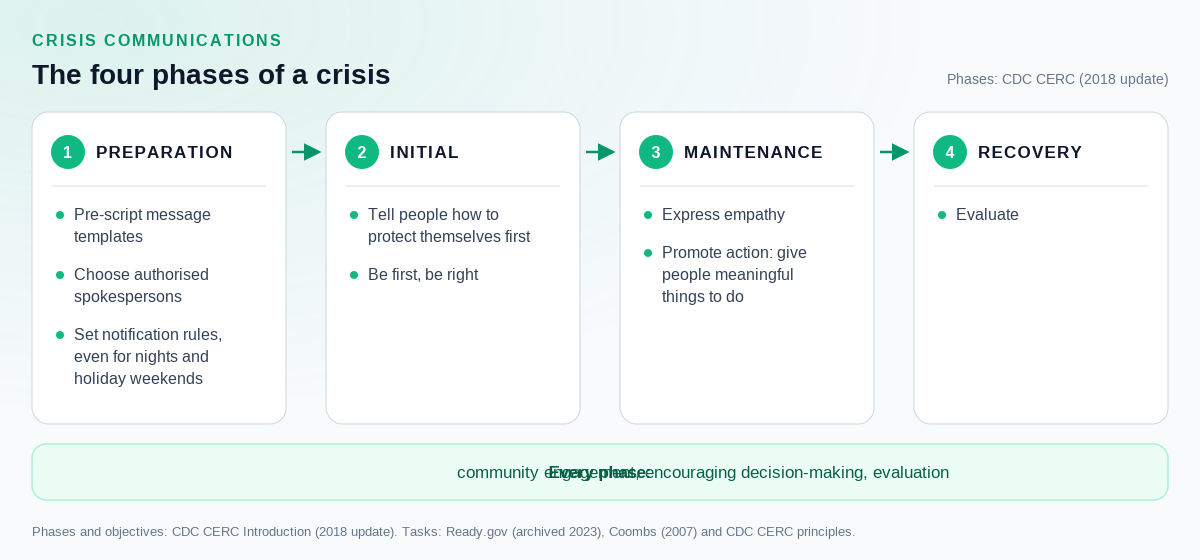
CDC’s CERC manual names four phases: preparation, initial, maintenance and recovery. Checked against CDC: CERC Introduction (Crisis and Emergency Risk Communication, 2018 update) In every phase, communicators keep three objectives: community engagement (two-way, with active listening), encouraging decision-making, and evaluation. Checked against CDC: CERC Introduction (Crisis and Emergency Risk Communication, 2018 update) Sources differ: Coombs’s overview for the Institute for Public Relations uses three, pre-crisis, crisis response and post-crisis. Checked against W. Timothy Coombs, 'Crisis Management and Communications', Institute for Public Relations (posted 30 Oct 2007; archived 1 Aug 2025)Archived copy, 1 August 2025
The first hour on social media: a checklist
Protect people first, tell management, speak with one voice, stop queued posts and get a short, accurate statement out. Spotting trouble early is social listening work, not a scheduler’s job:
- Put people first. Coombs says the first priority in any crisis is protecting stakeholders from harm, not the reputation, starting with instructing information that tells people how to protect themselves. Checked against Coombs, W.T. (2007) 'Protecting Organization Reputations During a Crisis: The Development and Application of Situational Crisis Communication Theory', Corporate Reputation Review 10, 163–176
- Tell management. Ready.gov’s archived guidance said notification rules should be clear even for nights and holiday weekends, because “Management does not want to learn about a problem from the news media.” Checked against Ready.gov (FEMA): Crisis Communications Plan (archived 17 Aug 2023)Archived copy, 17 August 2023
- Speak with one voice. Ready.gov advised that only authorised spokespeople, chosen in advance and given talking points, speak to the media. Checked against Ready.gov (FEMA): Crisis Communications Plan (archived 17 Aug 2023)Archived copy, 17 August 2023 Coombs adds that everyone who speaks should share the same facts and key messages. Checked against W. Timothy Coombs, 'Crisis Management and Communications', Institute for Public Relations (posted 30 Oct 2007; archived 1 Aug 2025)Archived copy, 1 August 2025
- Review or cancel scheduled posts in every scheduler you use. A cheerful promo mid-crisis reads as indifference. Each network’s own scheduler lets you find and change queued posts (see how scheduling social media posts works):
| Where | Find scheduled posts | Edit after scheduling | Source |
|---|---|---|---|
| Meta Business Suite (desktop and mobile app) for an Instagram account | Meta Business Suite > Content > Posts & reels (or Stories) > Scheduled. Also Planner (left menu) for a week/month calendar. Source for this value | Yes. Posts and reels: Edit post, Reschedule post, Move to drafts, Delete post. Stories: publish, reschedule or delete (the reschedule flow also lets you edit the content's details). Source for this value | Meta Business Help Center: Create and manage posts in Meta Business Suite on desktop |
| Facebook Page, via Meta Business Suite (desktop) | From your Page: Meta Business Suite (left menu) > Create post > Planner (left menu); click the post on the Week/Month calendar, then Options. | Yes: Edit post (text, media, link or location), Duplicate post, Reschedule post, Move to drafts, Delete post. | Facebook Help Center: Schedule a post and manage scheduled posts for your Facebook Page |
| LinkedIn Page (super admin or content admin view) | Page admin view > Page posts (left menu) > Start a post > schedule icon > View all scheduled posts. Source for this value | Yes: Post now, Edit post, Modify schedule, Delete post. Source for this value | LinkedIn Help: Schedule a LinkedIn Page post |
| x.com composer in a desktop browser Widely reported | Reported: composer > Unsent posts > Scheduled tab. | Reported: yes, from Unsent posts > Scheduled. | X Help Center: How to Post (no scheduling mentioned) |
| YouTube Studio (desktop) and the YouTube app: videos | YouTube Studio > Content (left menu) > select the video > Visibility. | Yes: Content > the video > Visibility. Keep it Private and click EDIT DRAFT to choose a new time, or set it to Public to publish now. | YouTube Help: Schedule video publish time |
Widely reported: observable and widely reported, but no page from the platform says it.
- Post a holding statement. CERC’s first principle is to be first: for the public, the first source of information often becomes the preferred one. Checked against CDC: CERC Introduction (Crisis and Emergency Risk Communication, 2018 update) Coombs recommends trying to have the initial response out within the first hour, checked for accuracy. Checked against W. Timothy Coombs, 'Crisis Management and Communications', Institute for Public Relations (posted 30 Oct 2007; archived 1 Aug 2025)Archived copy, 1 August 2025 In online crises, he notes, the people posting set the frame, and readers pick the source they find most credible. Checked against Coombs, W.T. (2007) 'Protecting Organization Reputations During a Crisis: The Development and Application of Situational Crisis Communication Theory', Corporate Reputation Review 10, 163–176
How to write a crisis statement (with examples)
Say what you know, what you don’t and what you’re doing; acknowledge the harm; give people something to do. CERC’s six principles are be first, be right, be credible, express empathy, promote action and show respect. Checked against CDC: CERC Introduction (Crisis and Emergency Risk Communication, 2018 update) Being right includes saying what is known, what is not, and what is being done to fill the gaps Checked against CDC: CERC Introduction (Crisis and Emergency Risk Communication, 2018 update); suffering should be acknowledged in words Checked against CDC: CERC Introduction (Crisis and Emergency Risk Communication, 2018 update); and giving people meaningful things to do calms anxiety. Checked against CDC: CERC Introduction (Crisis and Emergency Risk Communication, 2018 update) CDC’s wallet card adds: keep messages consistent, don’t over-reassure, acknowledge uncertainty. Checked against CDC: CERC Wallet Card (English, PDF) Coombs says the first message gives safety information, basic facts and concern for any victims. Checked against W. Timothy Coombs, 'Crisis Management and Communications', Institute for Public Relations (posted 30 Oct 2007; archived 1 Aug 2025)Archived copy, 1 August 2025
Three holding statements (illustrative examples, no real company):
| Situation | Holding statement | CERC principles |
|---|---|---|
| Possible product safety fault | ”Some [product] from batch [number] may [fault]. Please stop using it now and check the batch number on the label. We don’t yet know how many units are affected. Next update here by [time].” | Promote action, be right |
| Service outage | ”[Service] is down for many customers. We’re working on it and don’t have a fix time yet. We’ll post here every [interval] until it’s resolved.” | Be first, be right |
| An employee’s offensive post | ”We’ve seen the post from a member of our team and understand why people are upset. We’re looking into it and will say what we’re doing by [time].” | Express empathy, show respect |
A dated real example: on 19 July 2024, CrowdStrike CEO George Kurtz published a letter apologising for that day’s outage. It said the cause was a defect in a content update for Windows hosts, that Mac and Linux hosts were not affected and that it was not a cyberattack; it pointed customers to the Support Portal and blog for updates, warned that bad actors would try to exploit the event, and promised transparency. Checked against CrowdStrike blog: 'To Our Customers and Partners', George Kurtz, 19 July 2024Vendor's own description
Crisis communication examples by type: choosing a response with SCCT
Situational Crisis Communication Theory (SCCT), set out by Coombs in 2007, sorts crises by how much blame people assign and fits the response to it. Checked against Coombs, W.T. (2007) 'Protecting Organization Reputations During a Crisis: The Development and Application of Situational Crisis Communication Theory', Corporate Reputation Review 10, 163–176 The three clusters and example crisis types Checked against Coombs, W.T. (2007) 'Protecting Organization Reputations During a Crisis: The Development and Application of Situational Crisis Communication Theory', Corporate Reputation Review 10, 163–176, with the responses Coombs’s guidance matches to them Checked against W. Timothy Coombs, 'Crisis Management and Communications', Institute for Public Relations (posted 30 Oct 2007; archived 1 Aug 2025)Archived copy, 1 August 2025:
| Cluster | Blame people assign | Example crisis types | Response |
|---|---|---|---|
| Victim | Very weak | Natural disaster, workplace violence, product tampering, rumour | Instructing information and care; denial or attacking the accuser only for a rumour |
| Accidental | Minimal | Technical-error accident or product harm, a challenge | Instructing information and care; denial or attacking the accuser only for a challenge |
| Intentional | Very strong | Human-error accident or product harm, organisational misdeed | Instructing information and care, then compensation and/or apology |
In any cluster, compensation fits when victims suffer serious harm. Checked against W. Timothy Coombs, 'Crisis Management and Communications', Institute for Public Relations (posted 30 Oct 2007; archived 1 Aug 2025)Archived copy, 1 August 2025
SCCT groups responses as deny, diminish (it’s less bad than it looks, which needs solid evidence), rebuild (new positive actions) and bolstering (past goodwill); the more accommodating the response, the more responsibility you are seen to take. Checked against Coombs, W.T. (2007) 'Protecting Organization Reputations During a Crisis: The Development and Application of Situational Crisis Communication Theory', Corporate Reputation Review 10, 163–176 A history of similar crises or a poor prior reputation raises the blame. Checked against Coombs, W.T. (2007) 'Protecting Organization Reputations During a Crisis: The Development and Application of Situational Crisis Communication Theory', Corporate Reputation Review 10, 163–176
What goes in a social media crisis communication plan
A crisis plan names your audiences, spokespeople and notification rules, and holds pre-written messages for your likeliest scenarios. Ready.gov’s archived business guidance said a business must respond promptly, accurately and confidently in an emergency. Checked against Ready.gov (FEMA): Crisis Communications Plan (archived 17 Aug 2023)Archived copy, 17 August 2023 Put in:
- Audiences: customers, employees and their families, management and investors, regulators and government officials, neighbours and the news media, and who speaks to each. Checked against Ready.gov (FEMA): Crisis Communications Plan (archived 17 Aug 2023)Archived copy, 17 August 2023
- Message templates scripted in advance from your risk scenarios, because writing under time pressure is hard. Checked against Ready.gov (FEMA): Crisis Communications Plan (archived 17 Aug 2023)Archived copy, 17 August 2023 They are drafts for a person to approve, never posts set to go out on a trigger.
- Every account and scheduler you post from, and who can pause each.
- A review date. Coombs says organisations handle crises better with a plan updated at least annually, a designated team, yearly exercises and some pre-drafted messages. Checked against W. Timothy Coombs, 'Crisis Management and Communications', Institute for Public Relations (posted 30 Oct 2007; archived 1 Aug 2025)Archived copy, 1 August 2025
Managing comments during a crisis
Use each network’s own controls to slow a pile-on without deleting honest criticism.
- Instagram: Limits hides new comments and chats from groups you choose for up to four weeks at a time Checked against Instagram Help Center: Temporarily limit people from interacting with you on Instagram; Hidden Words hides comments containing words you list Checked against Instagram Help Center: Hide comments or message requests you don't want to see on Instagram (Manage custom words and phrases); Restrict makes a person’s new comments visible only to them unless you approve them. Checked against Instagram Help Center: Restrict or unrestrict someone on Instagram
- YouTube: hold comments for review at Basic, Strict or Hold all. Checked against YouTube Help: Learn about comment settings
- TikTok: allow comments from everyone (public accounts), followers (private accounts) or friends, or turn them off per post. Checked against TikTok Help Center: Who can comment on TikTok
- Threads: choose who can reply to each post, and approve replies before they appear. Checked against Instagram Help Center (Threads): Manage who can reply and quote your post on Threads
On review sites, the FTC tells businesses not to misuse reporting tools to remove honest negative reviews. Checked against FTC: Soliciting and Paying for Online Reviews: A Guide for Marketers (January 2022) Our community management moderation ladder and Instagram comment controls go step by step.
After the crisis: recovery and review
Recovery is a phase of its own: keep posting updates, explain what changed, evaluate, then fix the plan. CrowdStrike kept one public hub with dated updates and published a root-cause summary on 6 August 2024. Checked against CrowdStrike: Remediation and Guidance Hub: Channel File 291 Incident (page last updated 2024-08-06)Vendor's own description Evaluation is one of CERC’s three objectives Checked against CDC: CERC Introduction (Crisis and Emergency Risk Communication, 2018 update): note what worked, update your templates, and check every queued post before normal posting resumes.
Crisis communications FAQ
What is crisis communication?
CDC’s Crisis and Emergency Risk Communication manual describes it as providing facts to the public about an unexpected emergency, beyond an organisation’s control, that involves the organisation and requires an immediate response.
What are the four phases of crisis communication?
CDC’s CERC manual names four: preparation, initial, maintenance and recovery. Sources differ: W. Timothy Coombs’s overview for the Institute for Public Relations uses three, pre-crisis, crisis response and post-crisis.
How fast should a company respond to a crisis on social media?
CDC’s CERC principles say be first, because the first source often becomes the preferred one, and be right. Crisis researcher W. Timothy Coombs recommends trying to have the initial response out within the first hour, checked for accuracy.
What should you not do in crisis communication?
Don’t open with your reputation: Coombs says protecting people comes first. Don’t over-reassure or hide uncertainty (CDC’s CERC wallet card). Don’t deny a crisis you caused: Coombs keeps denial for rumour and challenge crises. And don’t misuse review platforms’ reporting tools against honest negative reviews (FTC).
What is an example of crisis communication?
Situational Crisis Communication Theory gives crisis types such as product tampering or a rumour (the organisation as victim), a technical-error accident, or an organisational misdeed. A dated real example is the letter CrowdStrike’s CEO published on 19 July 2024 about that day’s outage: an apology, the cause and scope, and where updates would be posted.