
Content Marketing and SEO: How They Work Together

Content marketing and SEO are two halves of one job: content marketing decides what you publish and for whom, and SEO helps search engines understand those pages and people find them. They work together because Google says content people find compelling and useful will likely influence your search presence more than any other suggestion in its SEO Starter Guide. Checked against Google Search Central: SEO Starter Guide
This guide follows Google’s own documentation and covers the social step too: posts as one way new pages get found. It extends our social media marketing playbook for small businesses to search; for what to publish, see content marketing strategies for social media.
What are content marketing and SEO?
Content marketing is publishing useful content to attract and keep an audience; SEO is making that content easy for search engines to understand and for searchers to find. Cambridge has no entry for content marketing Checked against Cambridge Dictionary (no entry), nor do Merriam-Webster or MASB Checked against Merriam-Webster: content marketing (no entry), so the working definition is the Content Marketing Institute’s (CMI): a strategic marketing approach focused on creating and distributing valuable, relevant and consistent content to attract and retain a clearly defined audience and, ultimately, drive profitable customer action. Checked against Content Marketing Institute: What Is Content Marketing?Press report
SEO has dictionary entries: Cambridge calls it methods of making sure a website’s address shows near the top of search results Checked against Cambridge Advanced Learner's Dictionary & Thesaurus, Oxford Learner’s the process of making a website appear high in a search engine’s results. Checked against Oxford Advanced Learner's Dictionary Google’s framing is more useful: helping search engines understand your content and helping users find your site and decide whether to visit it from a search. Checked against Google Search Central: SEO Starter Guide
Content marketing vs SEO: the difference and the overlap
Content marketing makes something worth finding; SEO makes it findable. The overlap is the page itself:
| What it is | What it produces | Where it pays off | Source | |
|---|---|---|---|---|
| Content marketing | Creating and distributing useful content for a defined audience | Articles, guides, videos, newsletters, posts | Every channel you publish on | Checked against Content Marketing Institute: What Is Content Marketing?Press report |
| SEO | Helping search engines understand pages and people find them | Clear titles, crawlable links, pages in searchers’ words | Search results | Checked against Google Search Central: Google Search Essentials (last updated 2025-12-10) |
| The overlap | Content people find compelling and useful | Pages that are easy to read, unique, current and people-first | Both | Checked against Google Search Central: SEO Starter Guide |
There is no shortcut around that overlap. Google says no secret will automatically rank a site first Checked against Google Search Central: SEO Starter Guide, and it doesn’t accept payment to crawl a site more often or rank it higher. Checked against Google Search Central: In-depth guide to how Google Search works
How content marketing and SEO work together
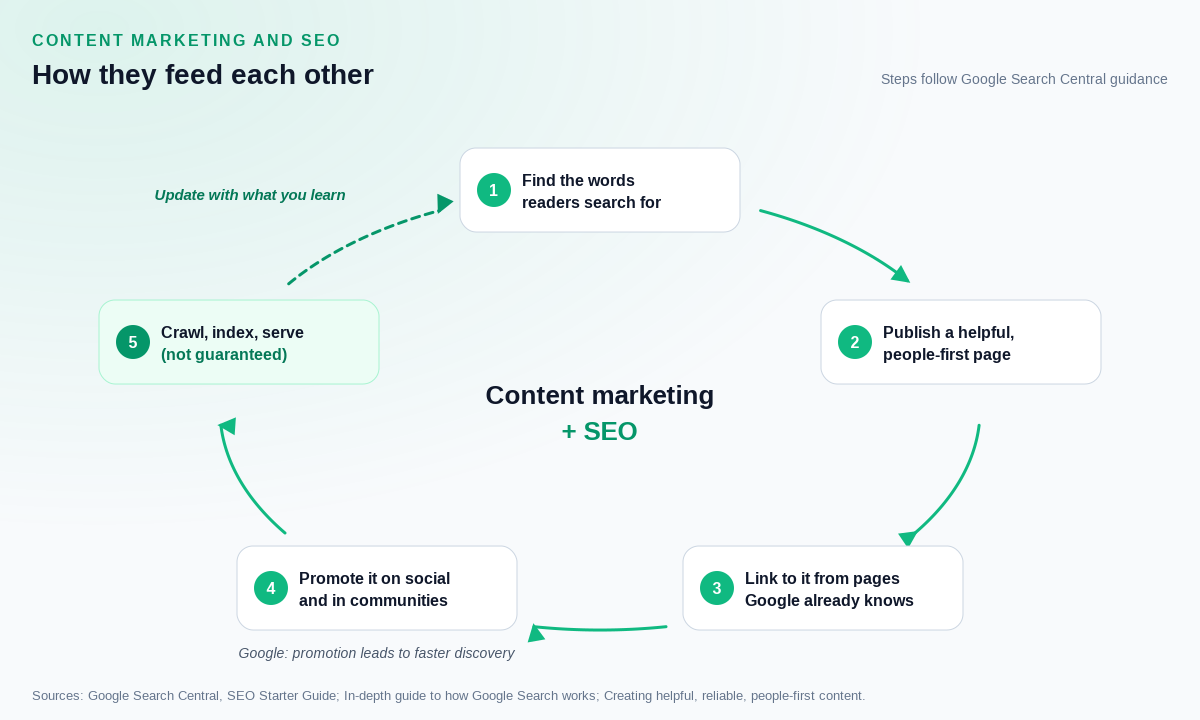
Content marketing and SEO work together as a loop: write in your readers’ words, help them, make the page findable, promote it, then improve it. Each step follows Google’s guidance:
- Find the words readers search for. Experts and newcomers use different terms; Google’s example is “charcuterie” versus “cheese board”. Checked against Google Search Central: SEO Starter Guide Use those words in titles, headings, alt text and link text. Checked against Google Search Central: Google Search Essentials (last updated 2025-12-10)
- Publish a helpful, people-first page, made primarily for people rather than to manipulate rankings. Checked against Google Search Central: Creating helpful, reliable, people-first content Google’s self-check asks whether readers leave having learned enough to reach their goal. Checked against Google Search Central: Creating helpful, reliable, people-first content Google’s result snippet usually comes from the page content, sometimes from the meta description, which should be short and unique to the page. Checked against Google Search Central: SEO Starter Guide
- Link to it from pages Google already knows. There is no central registry of pages, so Google finds new ones largely through links, such as a hub page linking to a new post. Checked against Google Search Central: In-depth guide to how Google Search works Links from other sites work the same way, which is one more reason to publish pages worth citing; if a link is paid for, Google asks for it to be marked rel=“sponsored”. Checked against Google Search Central: Qualify your outbound links to Google (last updated 2025-12-10)
- Promote it on social and in communities, which Google says speeds discovery (next section). Checked against Google Search Central: SEO Starter Guide
- Crawl, index, serve. Not every page makes it through each stage, and Google doesn’t guarantee that any page will be crawled, indexed or shown. Checked against Google Search Central: In-depth guide to how Google Search works
Then update the page with what you learned. To choose the topics, write a content marketing plan; to date them, keep a content calendar.
Does social media help SEO? How social posts get new pages found
Social media helps new pages get discovered: Google’s SEO Starter Guide says promoting new content on social media and in communities leads to faster discovery by interested people and by search engines. It also names advertising and word of mouth, calling word of mouth one of the most effective and lasting ways to promote a site.
Checked against Google Search Central: SEO Starter Guide.
Treat social as the discovery step, as Google does. For search inside a network, see our guide to Instagram SEO. One article can feed a week of posts (a key point, a quote, a checklist, a question), each written for its network; video cuts are covered in short-form content. That promotion step is where a scheduler fits:
Who does what on a small team
One person can own the words and another the findability, but the topic, brief and final page are shared. Our suggested split (editorial, not a standard):
| Task | Content side | SEO side | Shared |
|---|---|---|---|
| Topic research | Questions from sales and support | Words beginners and experts search with | Pick the topic |
| Brief | Angle, examples, reader | Target phrase, title, linking pages | Agree it |
| Writing | Draft, first-hand detail | Headings and alt text in searchers’ words | Edit |
| Promotion | Social posts, newsletter | Links from related pages | Schedule |
| Refresh | Update facts | Review its queries in Search Console | Decide rewrites |
Add a byline: Google strongly encourages accurate authorship information where readers expect it. Checked against Google Search Central: Creating helpful, reliable, people-first content It says trust matters most among experience, expertise, authoritativeness and trustworthiness, though E-E-A-T itself isn’t a specific ranking factor. Checked against Google Search Central: Creating helpful, reliable, people-first content B2B teams can go further with a B2B content marketing strategy.
What Google says not to do
Google treats attempts to manipulate its rankings, or its generative AI responses in Search, as spam; violating sites may rank lower or not appear at all. Checked against Google Search Central: Spam policies for Google web search The traps for content teams:
- Keyword stuffing: packing a page with keywords or numbers, such as lists of cities, to manipulate rankings. Checked against Google Search Central: Spam policies for Google web search
- Scaled content abuse: many pages made mainly to rank rather than help, by AI or otherwise. Checked against Google Search Central: Spam policies for Google web search (last updated 28 August 2026)
- Site reputation abuse: third-party content placed on a host site mainly to exploit its ranking signals. Checked against Google Search Central: Spam policies for Google web search
- Search-engine-first habits: covering many topics hoping some perform, summarising others without adding value, changing dates without real changes. Checked against Google Search Central: Creating helpful, reliable, people-first content
The second and third were among three spam policies Google announced in March 2024 Checked against Google Search Central Blog (March 2024): What web creators should know about our March 2024 core update and new spam policies, with a core update after which no single signal or system identifies helpful content. Checked against Google Search Central Blog (March 2024): What web creators should know about our March 2024 core update and new spam policies Two myths to drop: Google ignores the keywords meta tag Checked against Google Search Central: SEO Starter Guide, and there is no word-count target. Checked against Google Search Central: SEO Starter Guide And duplicate content isn’t a spam violation; search engines pick one canonical URL. Checked against Google Search Central: SEO Starter Guide
How to measure content marketing and SEO
Measure search in Google Search Console and visits by channel in your analytics. Search Console’s Performance report shows clicks, impressions, click-through rate and average position by query, page, country, device and date. Checked against Search Console Help: Performance report (Search results): Overview and basic setup Google Analytics 4 separates Organic Social from Paid Social, so you can see what promotion sends. Checked against Analytics Help: [GA4] Default channel group
Expect movement. In CMI’s 2027 B2B report, 31% of B2B marketers said website traffic rose over 12 months and 31% said it fell; 79% of those with falling traffic blamed AI-powered search Checked against Content Marketing Institute: B2B Content and Marketing Trends: Insights for 2027, in a self-reported survey of 861 B2B marketers fielded June to August 2026. Checked against Content Marketing Institute: B2B Content and Marketing Trends: Insights for 2027 For the social half, see these social media KPIs.
Content marketing and SEO FAQ
Is content marketing part of SEO?
They overlap rather than one containing the other. The Content Marketing Institute defines content marketing as creating and distributing valuable, relevant and consistent content to attract and retain a clearly defined audience; Google describes SEO as helping search engines understand your content and people find your site.
Should you share new articles on social media?
Yes, it helps new pages get discovered. Google’s SEO Starter Guide says promoting new content on social media and in communities leads to faster discovery by interested people and by search engines.
How long should SEO content be?
There is no target. Google says the length of content alone doesn’t matter for ranking and there is no magical word count, minimum or maximum.
Can you pay Google to rank higher?
No. Google says it doesn’t accept payment to crawl a site more often or to rank it higher, and appearing in Google Search results costs nothing.