
AI Brand Monitoring: Track Your Brand in AI Answers
AI brand monitoring is checking what AI assistants such as ChatGPT, Gemini and Perplexity say about your brand: whether they mention you, how they describe you, which competitors they name and which sources they cite. The phrase is also used for AI features inside social listening tools. This guide covers the first meaning: a manual monthly audit you can run in a spreadsheet, the tools that automate it, and what the assistants’ own documentation says about improving what they show. It is part of our guide to AI in social media.
Table of Contents
- What is AI brand monitoring?
- Why AI answers about your brand matter
- How to check what ChatGPT, Gemini and Perplexity say
- How to read the results
- LLM visibility tracking tools
- How to improve your presence in AI answers
- How to fix wrong or negative AI answers
- FAQ
What is AI brand monitoring?
AI brand monitoring tracks your brand inside answers written by AI assistants, the way classic brand monitoring tracks it in posts, news and reviews. No dictionary defines the phrase yet, and vendors use it for both meanings. Meltwater, for one, calls its GenAI Lens an AI brand monitoring solution that tracks how a brand appears in large language models such as ChatGPT, Gemini and Claude. Checked against Meltwater: GenAI LensVendor's own description
A large language model (LLM) is, in the Cambridge Dictionary’s definition, a complex mathematical representation of language, built from very large amounts of data, that lets computers produce language that seems similar to what a human might say. Checked against Cambridge Advanced Learner's Dictionary & Thesaurus: large language model Chat assistants run on them, so “LLM brand visibility” and “brand monitoring for AI results” name the same job.
Here is how the three related practices differ, as this guide uses the terms:
| AI brand monitoring | Classic brand monitoring | Social listening | |
|---|---|---|---|
| What you watch | Answers AI assistants give to questions about your category and brand | Mentions of your name in posts, news, reviews and forums | Conversations about your category, competitors and topics, not only your name |
| Where | ChatGPT, Gemini and Google’s AI features, Perplexity, Claude | Social networks and the web | Social networks and the web |
| Question it answers | Do assistants name us, and do they say true things? | Who is talking about us right now? | What is the market saying, and why? |
| Guide | This page | Brand monitoring | Social listening |
Why AI answers about your brand matter
Many people now put their questions to chatbots, and the answers name brands and link to sources. In Pew Research Center’s February 2026 survey of 5,119 U.S. adults, 49% said they use AI chatbots such as ChatGPT, Gemini or Copilot, up from about a third in 2024, and 42% said they use them to search for information. Checked against Pew Research Center: Americans and AI 2026: Chatbots, Smart Devices and Views on Impact (17 June 2026)
The answers draw on the live web, so the pages about you shape them:
- ChatGPT may search the web automatically when a question needs current information, and shows citations that OpenAI says can be incomplete, outdated or incorrect. Checked against OpenAI Help Center: Searching the web with ChatGPT
- Perplexity searches the web in real time and adds numbered citations linking to the original sources in each answer. Checked against Perplexity Help Center: How does Perplexity work?
- Claude grounds its answer in live web content when it uses web search, and every such response includes citations and source links. Checked against Claude Help Center: Enable and use web search
- Gemini may show a Sources button with links, but not every response includes sources. Checked against Gemini Apps Help: View related sources from Gemini Apps
LLM brand visibility has two parts: whether you are named, and whether the pages cited about you are ones you’d want a customer to read.
How to check what ChatGPT, Gemini and Perplexity say about your brand
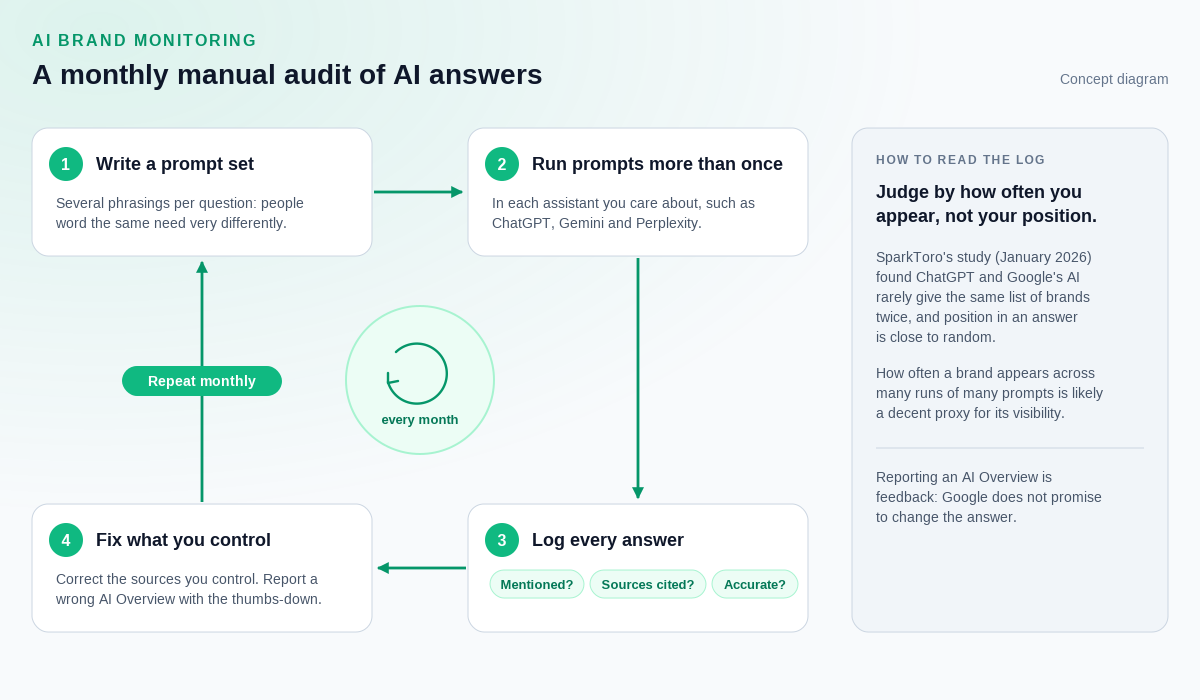
Write a fixed set of customer questions, run each one several times in each assistant, log what comes back, and repeat the set every month. One check tells you little, because answers change from run to run.
- Write 10 to 20 questions a customer might ask, each in two or three phrasings. Mix category questions, competitor questions and questions about your brand. Phrasing matters: in SparkToro’s study published 27 January 2026, the prompts volunteers wrote for the same intent were very different from each other, with an average semantic similarity of 0.081. Checked against SparkToro: AIs are highly inconsistent when recommending brands or products (27 Jan 2026)
- Run each prompt more than once in each assistant, in a clean session. In the same study, 600 volunteers ran 12 prompts through ChatGPT, Claude and Google’s AI Overviews and AI Mode a combined 2,961 times in November and December 2025; the authors estimate a less than 1-in-100 chance that ChatGPT or Google’s AI gives the same list of brands twice. Checked against SparkToro: AIs are highly inconsistent when recommending brands or products (27 Jan 2026) Your own account changes answers too: OpenAI says ChatGPT search typically rewrites your question into targeted search queries, sometimes adding a general location from your IP address or relevant saved memories. Checked against OpenAI Help Center: Searching the web with ChatGPT ChatGPT search also works for signed-out users Checked against OpenAI Help Center: Searching the web with ChatGPT, and a temporary chat does not create or update memories. Checked against OpenAI Help Center: Data controls in ChatGPT
- Log each run as a row: date, assistant, prompt, brand mentioned, competitors named, sources cited, and accuracy.
- Repeat the set monthly and compare the share of runs that mention you.
An example row (illustrative, not real data):
| Date | Assistant | Prompt | Brand mentioned? | Competitors named | Sources cited | Accurate? | Action |
|---|---|---|---|---|---|---|---|
| 2026-12-01 | ChatGPT | Q3, phrasing B, run 2 | Yes | Two named | Your pricing page, one review site | Partly: an old price | Update the pricing page |
Run the audit by hand, in each assistant’s normal app. Keep any check of social networks manual too: X’s Terms of Service prohibit crawling or scraping the service without X’s prior written consent Checked against X Terms of ServiceArchived copy, 3 October 2026 View the archived copy, Instagram’s Terms forbid collecting information in an automated way without its express permission Checked against Instagram Terms of Use, and TikTok’s US Terms forbid scraping with automated systems, including bots, unless approved in writing. Checked against TikTok Terms of Service (United States), last updated July 15, 2026 The paid tools further down run the repetition for you.
How to read the results: mentions, citations and sentiment
Judge your visibility by how often your brand appears across many runs, not by where it appears in one answer. SparkToro’s study concludes that position in an AI answer is close to random, but that how often a brand appears across many runs of many prompts is likely a decent proxy for how it really shows up in AI answers. Checked against SparkToro: AIs are highly inconsistent when recommending brands or products (27 Jan 2026)
From the log, track five things each month:
- Mention rate: runs that name you, divided by all runs, per prompt group. Note the number of runs; small samples swing.
- Against competitors: the same count for each competitor gives a rough share of voice inside AI answers.
- Cited sources: the domains cited when you are named, and when a competitor is named instead.
- Accuracy: mark each claim about you as right, outdated or wrong, and note its subject (price, product, location).
- Sentiment: label it with care. A 2023 study by Zhang and colleagues found large language models such as ChatGPT did satisfactorily on simple sentiment tasks but lagged behind smaller models trained on domain data on complex ones. Checked against arXiv 2305.15005: Sentiment Analysis in the Era of Large Language Models: A Reality Check (Zhang et al., May 2023) For social mentions, use dedicated sentiment analysis tools.
Don’t report an “AI rank”. A single position is noise; a mention rate over a fixed prompt set, month after month, is a trend you can act on.
LLM visibility tracking tools and what they measure
AI search optimization tools, as the vendors below describe them, run prompts through AI assistants on a schedule and report how often a brand is mentioned and cited. They automate the audit above, but can’t show how an assistant picks sources, because the assistants don’t publish it: Perplexity does not say how it ranks or selects sources Checked against Perplexity Help Center: How does Perplexity work?, and Google’s Gemini help page does not say how Gemini chooses which sources to show. Checked against Gemini Apps Help: View related sources from Gemini Apps
Tools that monitor brand mentions in AI chatbots, listed alphabetically; each description is the vendor’s own:
| Tool | What the vendor says it tracks | Assistants covered | Pricing model | Fits if |
|---|---|---|---|---|
| Ahrefs Brand Radar | Mentions, citations, AI share of voice and estimated impressions, from large sets of search-backed prompts. Checked against Ahrefs: Brand RadarVendor's own description | AI Overviews, AI Mode, ChatGPT, Copilot, Gemini, Perplexity; Claude for custom prompts | Prompt tracking and its AI Visibility Index are paid options; every paid Ahrefs plan (Lite and up) includes a daily custom-prompt quota. Checked against Ahrefs: Brand RadarVendor's own description | You already use Ahrefs for SEO |
| Jasper (GEO and AI Optimization) | Citation rates and content gaps in AI answers, alongside AI content production. Checked against Jasper: homepageVendor's own description | Not listed on the page read | Pro (per seat) and Business (custom), with a free trial. Checked against Jasper: Plans & PricingVendor's own description | You want monitoring and AI content production from one vendor |
| Meltwater GenAI Lens | Prevalence, AI share of voice and cited sources, refreshed on a 24-hour cycle; typically an add-on in the Meltwater platform. Checked against Meltwater: GenAI LensVendor's own description | ChatGPT, Gemini, Claude and other LLMs | Quote-only plans; no self-serve free trial, only a guided demo. Checked against Meltwater: Pricing & CostsVendor's own description | You already buy Meltwater for media monitoring |
| Peec AI | Visibility, position, sentiment and share of voice against competitors, with the sources each answer retrieved; prompts tracked daily. Checked against Peec AI: PricingVendor's own description | ChatGPT, Perplexity, Google AI Overviews, AI Mode, Gemini | Self-serve Starter, Pro and Advanced plans by tracked prompts and projects, plus a custom Enterprise plan. Checked against Peec AI: PricingVendor's own description | You want a self-serve tool and a fixed prompt list |
| Profound | Where and how a brand appears, its citations, sentiment, ranking and competitive presence, from structured prompts. Checked against Profound: Pricing FAQVendor's own description | ChatGPT, Perplexity, Google AI Mode, Gemini, Claude, Google AI Overviews | Self-serve Starter and Growth plans were retired in September 2026; Enterprise plans with custom pricing through a demo. Checked against Profound: Pricing (last updated 16 November 2026)Vendor's own description | You are a large brand with an enterprise budget |
If you meant the other sense of AI brand monitoring, AI features inside social listening tools, these track mentions on social media and the web, not AI answers:
- Brandwatch: Listen monitors brand, product and competitor mentions with Boolean queries, sentiment analysis and AI alerts on spikes and drops. Checked against Brandwatch: Listen (social listening software)Vendor's own description Its Iris AI answers questions about social data in plain language, writes Boolean queries and summarises trends and anomalies. Checked against Brandwatch: Iris AIVendor's own description
- Hootsuite Lumen: Hootsuite says Lumen detects brand mentions in images, video and audio, tracks sentiment over time and sends real-time alerts. Checked against Hootsuite: Listening (Lumen)Vendor's own description Its Enterprise plan adds a Lumen MCP connector for reading listening insights from AI assistants such as ChatGPT, Claude and Gemini. Checked against Hootsuite: Plans, Prices, and FeaturesVendor's own description
- Sprout Social: Listening lets teams build queries without Boolean knowledge and covers brand health, sentiment, competitor comparison and share of voice. Checked against Sprout Social: Social ListeningVendor's own description
Our guide to social listening tools compares that group, and AI tools for social media covers the wider set. Where Outfeed fits:
How to improve your brand’s presence in AI answers, including Perplexity
Let each assistant’s search crawler reach your site, and keep the pages and profiles it cites accurate; Google says its AI features need nothing beyond normal SEO. Google Search Central says there are no additional requirements or special optimizations to appear in AI Overviews or AI Mode. Checked against Google Search Central: AI features and your website (last updated 2025-12-10) It also says you don’t need new machine-readable files, AI text files or special schema.org markup for its AI features Checked against Google Search Central: AI features and your website; that is Google’s position only, not a statement about other assistants.
Google’s AI Overviews and AI Mode:
- A page must be indexed and eligible to appear in Search with a snippet to be shown as a supporting link, and meeting every requirement still doesn’t guarantee it will be served. Checked against Google Search Central: AI features and your website
- The fundamentals still apply: allow crawling in robots.txt and at your CDN, link important pages internally, keep important content in text, match structured data to visible text, and keep Merchant Center and Business Profile information up to date. Checked against Google Search Central: AI features and your website
- Both may use “query fan-out”, running several related searches across subtopics to build one response, and AI Overviews appear only when Google’s systems judge them additive. Checked against Google Search Central: AI features and your website
- Traffic from AI Overviews and AI Mode is counted in Search Console’s Performance report under the “Web” search type, not reported separately. Checked against Google Search Central: AI features and your website
ChatGPT, Perplexity and Claude each name the crawler that feeds their search answers:
| Assistant | Allow this for search answers | What the provider says |
|---|---|---|
| ChatGPT | OAI-SearchBot | Sites opted out of OAI-SearchBot are not shown in ChatGPT search answers; GPTBot (training) is a separate setting, and robots.txt changes take about 24 hours to apply to search. Checked against OpenAI: Overview of OpenAI Crawlers |
| Perplexity | PerplexityBot | PerplexityBot surfaces and links sites in Perplexity’s results, is not used to train foundation models, and Perplexity recommends allowing it. Its Perplexity-User fetcher acts on user requests and generally ignores robots.txt. Checked against Perplexity Docs: Perplexity Crawlers |
| Claude | Claude-SearchBot and Claude-User | Blocking either may reduce a site’s visibility in Claude’s search answers; ClaudeBot collects content that may be used for training. Checked against Claude Help Center: Does Anthropic crawl data from the web, and how can site owners block the crawler? |
OpenAI notes ChatGPT may be unable to read a site because of paywalls or its robots.txt preferences Checked against OpenAI Help Center: Does ChatGPT tell the truth?, so the first check for how to improve brand presence in Perplexity or ChatGPT is your own robots.txt.
Don’t flood your site with AI-written pages to get cited. Google’s guidance says using AI tools to generate many pages without adding value for users may violate its scaled content abuse policy. Checked against Google Search Central: Google Search's guidance on using generative AI content on your website (last updated 1 October 2026)
Keep your public profiles accurate and complete. Bios and About sections are pages you control; our Instagram SEO guide shows the habits.
How to fix wrong or negative AI answers about your brand
You can’t edit an AI answer; you can correct the sources it draws on, report clear errors, and check again next month. Errors are built in: the Cambridge Dictionary now gives an AI sense of “hallucinate”, producing false information Checked against Cambridge Advanced Learner's Dictionary & Thesaurus: hallucinate, and OpenAI says ChatGPT can give wrong facts or dates and fabricate quotes, studies or citations while sounding confident. Checked against OpenAI Help Center: Does ChatGPT tell the truth? Models are trained on data up to a cutoff and don’t know later events unless they search. Checked against OpenAI Help Center: Does ChatGPT tell the truth?
- Find the source in your log’s citations. If one of your own pages is outdated, fix that first.
- Fix what you control: your website, Business Profile and other listings, and social profiles.
- Report clear errors. In Google’s AI Overviews, use the thumbs-down icon at the bottom of the overview, then “Report a problem” and a category; Google does not promise the answer will change. Checked against Google Search Help: AI Overviews Anthropic says members of the public can report problematic content in a Claude output, and that site owners control what Claude’s web search can use by removing or password-protecting content or adding a noindex tag. Checked against Claude Help Center: Report, block, and remove content from Claude
- Re-run the same prompts next month and compare the mention rate and accuracy column.
To fix negative brand sentiment in AI, read what the cited sources say. If answers repeat real complaints, the lasting fix is the product or service, then accurate pages about it. Tracking how customers feel over time is brand health tracking.
Many fixes end up as posts on your own accounts: an updated price, a corrected location. For drafting them, start with our free social media tools. When you are ready to schedule them, try Outfeed AI.
Frequently asked questions
What is AI brand monitoring?
AI brand monitoring is tracking what AI assistants such as ChatGPT, Gemini and Perplexity say about your brand: whether they mention it, how they describe it, which competitors they name and which sources they cite. Some listening tools also use the term for AI-assisted tracking of social mentions.
How do I see what ChatGPT says about my brand?
Write a set of questions your customers might ask, in a few different phrasings, run each one in ChatGPT several times, and log whether your brand appears, what is said and which sources are cited. Repeat the same set every month and compare.
Can I track my brand’s ranking in AI answers?
Not reliably. SparkToro’s 2026 study found ChatGPT and Google’s AI rarely return the same list of brands twice, so a position in one answer means little. How often your brand appears across many runs of many prompts is a more useful measure.
Do I need an llms.txt file or special markup to appear in AI Overviews?
No. Google says there are no extra requirements, AI text files or special schema needed to appear in AI Overviews or AI Mode; the same SEO best practices apply.
How do I fix wrong information about my brand in AI answers?
Correct the sources AI tools draw on, such as your website, profiles and listings, and report clear errors: in Google’s AI Overviews you can use the thumbs-down icon and Report a problem. AI answers can still be wrong, so check them again after changes.