
What Does Ratioed Mean? Getting Ratioed on X, Explained
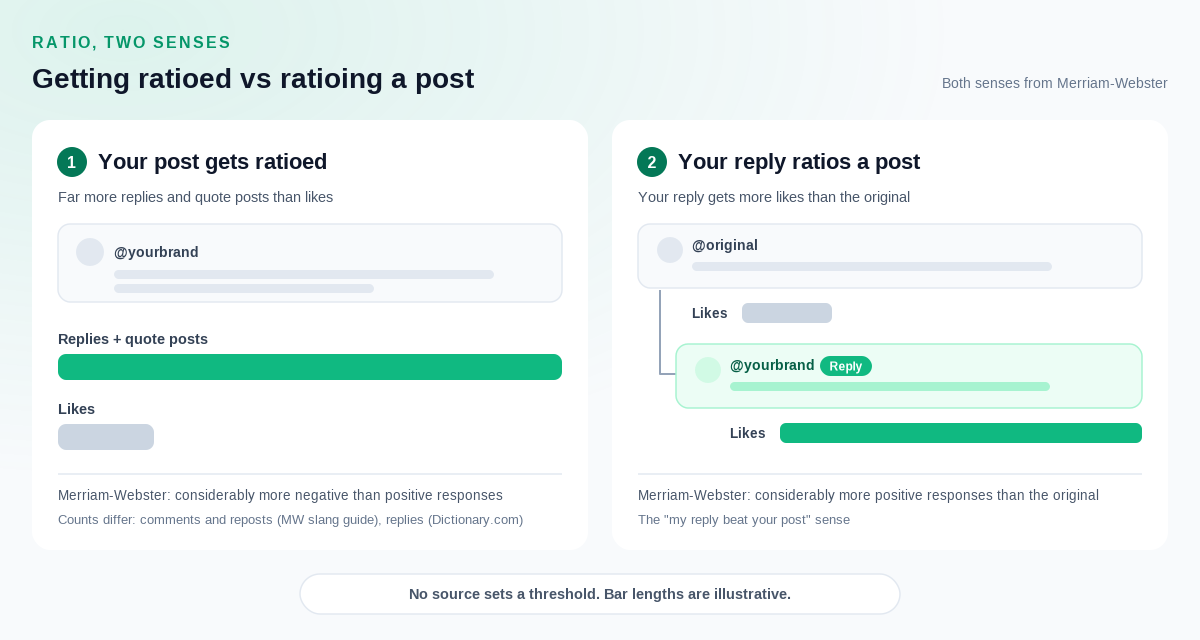
Getting ratioed means your post drew far more replies or quote posts than likes, a sign that people disagree with it. Merriam-Webster defines the verb ratio as giving a post “considerably more negative than positive responses or reactions”; the word also has a second, opposite sense, covered below. Checked against Merriam-Webster Dictionary
More slang lives in our social media glossary.
What does ratioed mean?
A post is ratioed when the responses pushing back on it clearly outnumber its likes. Merriam-Webster’s slang guide says a post on X, Facebook or other platforms has been ratioed when it has more comments and reposts than likes, implying it was tremendously unpopular. Checked against Merriam-Webster: Slang & Trending: ratio (4 Jun 2026) Dictionary.com puts it as replies to a tweet vastly outnumbering its likes or retweets, meaning people object to it. Checked against Dictionary.com Its note still uses X’s old Twitter vocabulary. You’ll also see the word misspelled “ratiod”.
An illustrative case: a brand posts a hot take; within an hour the replies and quote posts are mostly people disagreeing, while the like count barely moves. That post got ratioed.
How a ratio works: replies and quote posts vs likes
A ratio is a judgement people make by eye, not a status a platform assigns. The sources don’t even count the same things: Merriam-Webster’s slang guide weighs comments and reposts against likes, while Dictionary.com weighs replies against likes or retweets. Checked against Merriam-Webster: Slang & Trending: ratio (4 Jun 2026) Checked against Dictionary.com (Reposts are the old retweets: see what RT means.)
No dictionary sets a threshold. The April 2017 Esquire article that described “The Ratio” said opinions on the exact numbers vary, and the rule of thumb it quoted, from one user’s tweet, was more than two replies for every retweet: a folk rule, not a platform one. Checked against Esquire (Luke O'Neil), "How to Know If You've Sent a Horrible Tweet" (11 Apr 2017), archived capture (1 May 2017)Archived copy, 1 May 2017 View the archived copy Judging by eye also misleads: X says the number next to a post’s reply icon counts only its direct replies, not every reply in the conversation. Checked against X Help Center: About conversations on X (archived capture, 18 Oct 2026)Archived copy, 18 October 2026 View the archived copy
The word has a second, opposite sense. Merriam-Webster also defines ratio as replying to another post and getting considerably more positive reactions than the original. Checked against Merriam-Webster Dictionary In that sense, your reply ratios their post.
Where did “ratio” come from?
The social media sense of ratio comes from Twitter, around 2017. Merriam-Webster gives circa 2017 as the first known use of the verb, built on the noun ratio, which dates to 1660 and comes from Latin for computation or reason. Checked against Merriam-Webster Dictionary Dictionary.com says the sense originated on Twitter, and that the higher the proportion of replies, the “bigger” the ratio. Checked against Dictionary.com Slang Dictionary: L + ratio (15 Jun 2022)
Know Your Meme, a community-edited site that documents internet culture, records that the ratio began being noticed on Twitter in early 2017, with users comparing replies to retweets and likes from March 2017. Checked against Know Your Meme (community-edited): The Ratio / RatioedCommunity-documented Esquire’s 11 April 2017 article by Luke O’Neil, “How to Know If You’ve Sent a Horrible Tweet”, described “a phenomenon known as The Ratio”: when replies vastly outpace likes and retweets, something has gone wrong, because on Twitter replying more often means disagreeing. Checked against Esquire (Luke O'Neil), "How to Know If You've Sent a Horrible Tweet" (11 Apr 2017), archived capture (1 May 2017)Archived copy, 1 May 2017 View the archived copy The article described the term; it didn’t claim to coin it.
What does “L + ratio” mean?
“L + ratio” is a mocking reply to a post someone thinks is especially bad. Dictionary.com calls it a mocking insult on social media and says it appears to have emerged in 2020. Checked against Dictionary.com Slang Dictionary: L + ratio (June 15, 2022) The L stands for loss, the opposite of a win, as in “you just took the L”. Checked against Dictionary.com Slang Dictionary: L + ratio (June 15, 2022) People chain more insults after it, including “touch grass”. Checked against Dictionary.com Slang Dictionary: L + ratio (June 15, 2022)
More on W and L in slang and what “touch grass” means. A brand account should never reply with it.
Can you get ratioed outside X?
Yes: the word travels, but it’s user slang, not a platform feature. Merriam-Webster’s slang guide names X, Facebook and other platforms, and says ratio can also mean getting more downvotes than upvotes on sites that have them. Checked against Merriam-Webster: Slang & Trending: ratio (4 Jun 2026)
On Threads, the repost icon under any post lets people repost it or quote it in a thread of their own. Checked against Instagram Help Center (Threads): Like, repost or quote a thread or reply on Threads Threads also lets you choose who can reply to and quote each post, and approve replies before they appear. Checked against Instagram Help Center (Threads): Manage who can reply and quote your post on Threads
What to do if your brand gets ratioed
Slow down: read, correct what’s wrong, answer once, and never send followers after anyone. Our playbook:
- Read before reacting. Work out whether people are disagreeing with an opinion, correcting a fact or reacting to tone.
- Correct facts once, plainly. If you got something wrong, say so in one clear post.
- Answer the main criticism once. One reply or follow-up post, not fifty replies.
- Don’t delete in anger. Screenshots outlive deletions, and a quiet deletion can read as hiding.
- Never organise a pile-on or a counter-ratio. X’s Abuse and harassment policy says you may not target others with abuse or harassment, or encourage other people to do so. Checked against X Help Center: Abuse and harassment policy (archived capture, 15 Nov 2026)Archived copy, 15 November 2026 View the archived copy The same policy says it doesn’t act on criticism of institutions, practices and ideas: disagreeing with a post is not what it targets; targeting people is. Checked against X Help Center: Abuse and harassment policy (archived capture, 15 Nov 2026)Archived copy, 15 November 2026 View the archived copy
You can narrow who can reply to an X post after it’s live, but X says the limit covers replies only, and quote posts don’t inherit it. Checked against X Help Center: About conversations on X (archived capture, 18 Oct 2026)Archived copy, 18 October 2026 View the archived copy A sharp comeback usually adds fuel; see what a clapback is. To see how far the post actually travelled, check its impressions on X.
Joking about your own ratio in a caption can work; replying “ratio” to someone else doesn’t. For calmer drafts, try our X post generator.
Draft and schedule your posts with Outfeed AI
Ratioed meaning: FAQ
What does it mean to get ratioed?
Getting ratioed means your post drew far more critical replies or quote posts than likes, a sign people disagree with it. Merriam-Webster defines the verb ratio as giving a post considerably more negative than positive responses.
How many replies does it take to get ratioed?
There is no official number. No dictionary or platform sets a threshold. A 2017 Esquire article quoted one user’s rule of thumb of more than two replies for every retweet, but that is a folk rule; people call it a ratio when replies or quote posts clearly outnumber likes.
What does “L + ratio” mean?
“L + ratio” is a mocking reply to a post seen as particularly bad. L stands for loss, the opposite of a win, and Dictionary.com says the insult appears to have emerged in 2020.
Can getting a ratio be a good thing?
Yes, in its second sense. Merriam-Webster also defines ratio as replying to a post and getting far more positive reactions than the original, so your reply “ratios” the post.
Where did ratio come from?
From Twitter, now X. Merriam-Webster dates the verb to about 2017, and Know Your Meme, a community-edited site, says users began comparing replies with likes and retweets in early 2017.