
Construction Social Media Marketing: What to Post and Where
In construction social media marketing, every post is proof: finished work and progress for homeowners, capability for general contractors and owners, and real crews for the people you want to hire. This guide splits platforms by residential and commercial work, lists 12 post types with the network each fits, gives a four-point check for job-site photos, covers recruiting, and ends with a weekly plan and a way to track leads.
Table of Contents
- Why do construction companies use social media?
- Construction social media marketing: which platforms work for contractors?
- Social media content for construction companies: 12 post types
- Job-site photos and video: what to check before you post
- How do you recruit construction workers on social media?
- A weekly posting plan for a small contractor
- How to measure leads from social media
- Schedule a week of job-site posts with Outfeed
- Construction social media FAQ
Why do construction companies use social media?
Construction companies use social media for three jobs: to show homeowners finished work and progress, to show general contractors and owners what the firm can deliver, and to recruit crews. It is one chapter of the social media marketing playbook for small businesses, with two audiences that want different proof:
- Residential: homeowners comparing finishes, tidiness on site, how long jobs take and what past clients say.
- Commercial: general contractors, developers and facility owners checking project types, capacity, safety culture and who leads the work.
Both audiences read the same feed, and so do the tradespeople deciding where to work next.
Construction social media marketing: which platforms work for contractors?
Residential contractors usually start with Facebook and Instagram plus YouTube for longer project videos; commercial firms and subcontractors bidding for work put LinkedIn first. For context, Pew Research Center’s 2026 survey of 5,511 U.S. adults found YouTube (84%) and Facebook (70%) the most used, then Instagram (51%), TikTok (37%) and LinkedIn (31%). Checked against Pew Research Center: Americans' Use of Social Media in 2026 (fact sheet, 19 Oct 2026)
| Network | Residential use | Commercial use |
|---|---|---|
| Local reach, finished jobs, reviews, community news | Local news and hiring | |
| Before-and-after photos, progress Reels | Project photography and crew culture | |
| YouTube | Walkthroughs and time-lapses | Method explainers and project films |
| Hiring and supplier relations | First choice: milestones, bids won, company news | |
| TikTok | Short process clips and trade tips | Recruiting younger tradespeople |
On LinkedIn, the firm needs a Page, not a profile. A LinkedIn Page is free to create and lets an organisation present its brand, services and job opportunities; you need a personal profile to create one. Checked against LinkedIn Help: Create a LinkedIn Page LinkedIn says profiles represent individuals and Pages represent organisations, and you can’t convert a profile into a Page. Checked against LinkedIn Help: Differences between a LinkedIn profile and a LinkedIn Page Here is how to set up a LinkedIn Company Page.
Local residential firms should also keep a Google Business Profile current: it lets a business publish Updates, Offers and Events posts with photos or video that people see on Search and Maps, and posts older than 6 months are archived unless a date range is set. Checked against Google Business Profile Help: Create & manage posts on your Business Profile
Social media content for construction companies: 12 post types
The 12 post types in this guide fall into three groups: show the work, show the people, and earn trust. Each comes with the network it fits and an illustrative caption, not one from a real firm.
Show the work
| # | Post type | Fits | Illustrative caption |
|---|---|---|---|
| 1 | Before-and-after | Instagram, Facebook | ”Same kitchen, eight weeks apart. Swipe for the before.” |
| 2 | Progress series | Instagram, Facebook, LinkedIn | ”Week 6 on the rear extension: roof’s on, windows next.” |
| 3 | Time-lapse | YouTube, Instagram, TikTok | ”Ten days of framing in 40 seconds.” |
| 4 | Project milestone | LinkedIn, Facebook | ”Topped out today. Thank you to every trade on site.” |
| 5 | Materials or method explainer | YouTube, LinkedIn | ”Why we pour this slab in two stages.” |
Show the people
| # | Post type | Fits | Illustrative caption |
|---|---|---|---|
| 6 | Crew spotlight | Instagram, Facebook, LinkedIn | ”Meet our site lead: 14 years in, still first on site.” |
| 7 | Safety moment | LinkedIn, Facebook | ”Monday toolbox talk: this week, ladder safety.” |
| 8 | Behind the estimate | Instagram, YouTube | ”What goes into a bathroom quote, line by line.” |
| 9 | Community job | Facebook, Instagram | ”New ramp at the community hall, done on a Saturday.” |
Earn trust
| # | Post type | Fits | Illustrative caption |
|---|---|---|---|
| 10 | Client review, shared with permission | Facebook, Instagram | ”Shared with the owner’s OK: ‘They left the site cleaner than they found it.‘“ |
| 11 | FAQ answer | Facebook, YouTube, Instagram | ”Do I need a permit for a deck? Here’s how to find out.” |
| 12 | Hiring post | LinkedIn, Facebook, TikTok | ”We’re hiring two carpenters. Day rate and start date below.” |
Never write, buy or reward reviews. The FTC’s rule on consumer reviews and testimonials took effect on 21 October 2024 and lets it seek civil penalties against knowing violators. Checked against FTC press release: Federal Trade Commission Announces Final Rule Banning Fake Reviews and Testimonials (14 August 2024) Google Maps doesn’t allow businesses to offer incentives for reviews or to ask only happy customers; asking for honest reviews of real jobs is fine. Checked against Google Maps User Generated Content Policy Help: Prohibited & restricted content
For more formats, see more post ideas for businesses, these Facebook post ideas and these LinkedIn post ideas for B2B work.
Job-site photos and video: what to check before you post
Before a job-site photo goes out, check four things: everyone is wearing the protective equipment the task needs, the client agreed, the post reveals no private address or interior, and your license number is on it if your state requires that in advertising.
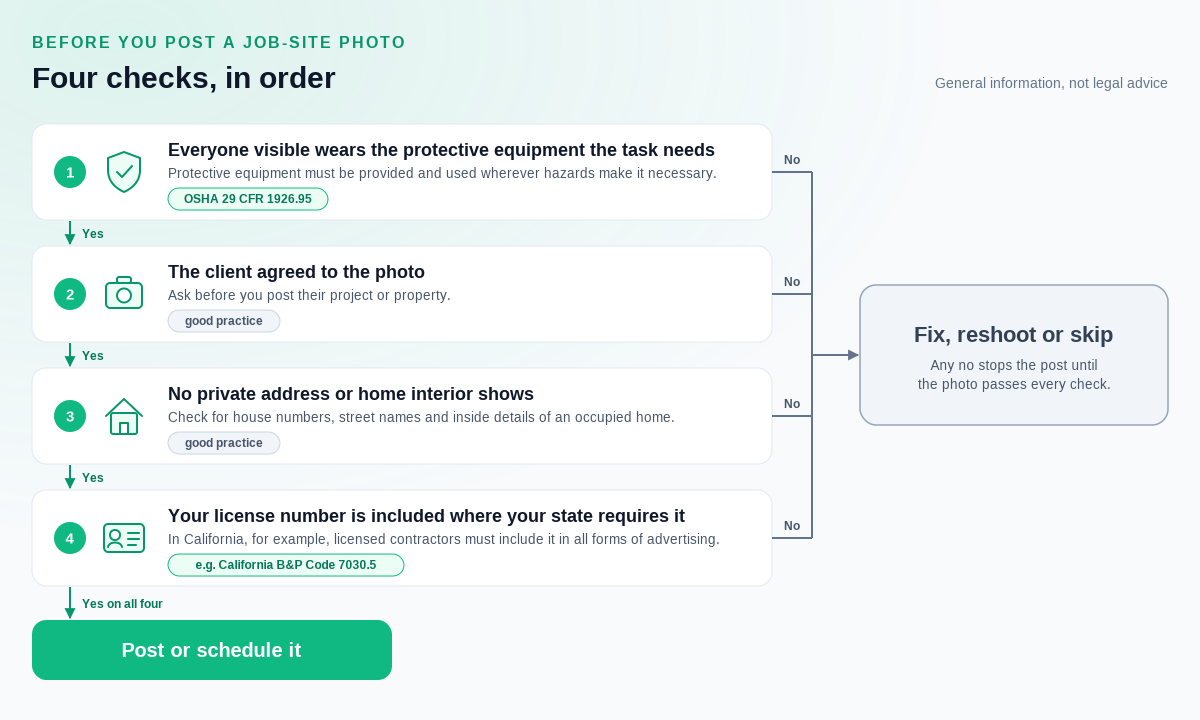
- Protective equipment. OSHA’s construction standard 29 CFR 1926.95 requires protective equipment for eyes, face, head and extremities, protective clothing, respiratory devices and shields to be provided, used and maintained wherever hazards make it necessary. Checked against OSHA: 29 CFR 1926.95 — Criteria for personal protective equipment Two rules are worth knowing by name: helmets where there is a possible danger of head injury Checked against OSHA: 29 CFR 1926.100, Head protection and fall protection on unprotected edges 6 feet or more above a lower level. Checked against OSHA: 29 CFR 1926.501, Duty to have fall protection OSHA’s preliminary list for fiscal year 2026 puts fall protection first among its most cited standards, with scaffolding 4th, ladders 5th, fall protection training 8th and eye and face protection 9th. Checked against OSHA: Top 10 Most Frequently Cited Standards (FY2026, preliminary) A photo that shows a lapse advertises the wrong thing.
- Client permission. Ask before photographing someone’s home or project, and say where the photos will appear.
- No private details. Crop out house numbers, street signs, car plates and interiors of occupied homes.
- License number. In California, for example, Business and Professions Code section 7030.5 requires licensed contractors to include their license number in all forms of advertising, as prescribed by the registrar. Checked against California Business and Professions Code § 7030.5 (California Legislative Information, archived)Archived copy, 16 June 2025 View the archived copy Florida requires a contractor’s registration or certification number in each advertisement, regardless of medium. Checked against The 2026 Florida Statutes, § 489.119 (Online Sunshine, Florida Legislature) Other states set their own rules.
This is general information, not legal advice; check with your state contractor board or safety adviser.
How do you recruit construction workers on social media?
Post the jobs where tradespeople already scroll, show the crew and the work they would do, and make applying one tap away. The competition is real: BLS data show 298,000 construction job openings at the end of September 2026 (preliminary), a 3.4% openings rate, up from 206,000 a year earlier. Checked against U.S. Bureau of Labor Statistics: JOLTS Table 1. Job openings levels and rates by industry and region, seasonally adjusted
Recruiting posts that give a candidate something to judge you on:
- A day in the life of a crew, from the morning briefing to clean-up.
- An apprentice’s first year, told by the apprentice.
- Pay, hours, tools provided and benefits, stated by the firm in plain numbers.
- What the first week looks like for a new hire.
- The project they would join, with photos.
On LinkedIn, the company Page is where an organisation presents its job opportunities. Checked against LinkedIn Help: Create a LinkedIn Page Find relevant tags for trade roles with the LinkedIn hashtag generator.
A weekly posting plan for a small contractor
Three to five planned posts a week is a workable rhythm for a small contractor: one progress post, one finished-work post, one people post, and a hiring or tip post when you have one. This week is illustrative:
| Day | Post type | Network | Asset |
|---|---|---|---|
| Monday | Progress update | Instagram, Facebook | Three photos from Friday’s site visit |
| Tuesday | Crew spotlight or safety moment | LinkedIn, Facebook | One portrait and a two-line story |
| Wednesday | FAQ answer | Facebook, YouTube | A 60-second phone video |
| Thursday | Finished job (before-and-after) | Instagram, Facebook | Paired photos from the same angle |
| Friday | Hiring post or project milestone | LinkedIn, TikTok | Job details or milestone photo |
Batch the photos on site during the week and write the posts in one sitting. The content calendar template keeps the week in one place. Builders who work with agents can swap ideas with these real estate social media ideas. If your firm runs several branches or franchised locations, our guide to franchise social media marketing covers one calendar across locations.
How to measure leads from social media
Track leads with links you can attribute and one question at intake: tag every link with UTM parameters, ask new clients how they found you, and read each network’s own analytics monthly. A simple monthly sheet works: network, posts published, enquiries, quotes sent and jobs won. After three months, compare networks by jobs won, not likes.
Schedule a week of job-site posts with Outfeed
Take the week’s photos on site, write each post once with a version per network where it needs one, and schedule the week in one sitting. One limit matters for commercial firms that put LinkedIn first: Connected with LinkedIn sign-in to your personal LinkedIn profile. Outfeed posts as you, the member; it does not post to LinkedIn Company Pages. So on LinkedIn, Outfeed suits posts on your own profile, not the firm’s Page. For what it publishes on each network, see how Outfeed’s social media scheduler works. Here is what Outfeed does with that week:
Firms that sell to other businesses can compare notes with social media marketing for manufacturers.
Schedule your job-site posts with Outfeed AI
Construction social media FAQ
What should a construction company post on social media?
Before-and-after photos, progress series and time-lapses, crew and safety spotlights, finished-project milestones, answers to common client questions, client reviews shared with permission, and hiring posts.
What is the best social media platform for contractors?
For residential work, Facebook and Instagram, with YouTube for longer project videos. For commercial work and subcontractors bidding for jobs, LinkedIn first. Pick the one or two networks your clients use and post there consistently.
How do contractors get leads from social media?
By showing finished work and progress where local clients look, making it easy to get in touch from every post, and tracking where leads come from with tagged links and a “how did you hear about us” question at intake.
Do contractors have to put their license number on social media posts?
It depends on the state. In California, for example, Business and Professions Code section 7030.5 requires licensed contractors to include their license number in all forms of advertising as prescribed by the registrar. Checked against California Business and Professions Code § 7030.5 (California Legislative Information, archived)Archived copy, 16 June 2025 View the archived copy Florida Statutes section 489.119 requires a contractor’s number in each advertisement regardless of medium. Checked against The 2026 Florida Statutes, § 489.119 (Online Sunshine, Florida Legislature) Check your own state’s contractor board; this is general information, not legal advice.
How often should a construction company post?
Three to five planned posts a week is a workable rhythm for a small contractor: one progress post, one finished-work post, one people post, and a hiring or tip post when you have one. Pick a rhythm you can keep every week rather than a burst followed by silence. The weekly posting plan above shows an illustrative week.