
Franchise Social Media Marketing: Brand vs Local Pages
Franchise social media marketing is one brand run by many owners: the franchisor builds the national accounts and the rules, and each franchisee wins customers in its own area. Most decisions follow from one question this guide answers first: who holds the accounts. That answer sits in your franchise agreement. Then come the three account structures, a brand kit, what local pages should post, one calendar across locations, measurement and the tool limits that matter at scale.
Table of Contents
- What is franchise marketing, and where does social media fit?
- Franchise social media marketing: who should own the accounts?
- Central, local or hybrid: three account structures compared
- Brand guidelines and a shared content library for locations
- What should local franchise pages post?
- A franchise marketing plan: one calendar across locations
- How to measure franchise social media across locations
- Tools for multi-location posting: seats, accounts and approvals
- Franchise social media FAQ
What is franchise marketing, and where does social media fit?
Franchise marketing promotes one brand through many independently owned locations: the franchisor builds the national brand, each franchisee wins customers locally, and social media is where those two jobs meet on the same networks. This guide adds the multi-location layer to the social media marketing plan for small businesses.
The rules of the system are written down before anyone posts. The FTC Franchise Rule requires franchisors to give prospective franchisees a disclosure document (the FDD) with 23 specific items about the franchise, its officers and other franchisees. Checked against FTC: Franchise Rule (16 CFR Parts 436 and 437) Item 11 describes the advertising programme, including what share of advertising funds goes to selling new franchises. Checked against eCFR: 16 CFR 436.5(k) — Item 11: Franchisor's Assistance, Advertising, Computer Systems, and Training
So a franchise marketing strategy has two layers. The national layer is brand campaigns, the advertising fund and any co-op. The local layer is each location’s posts, events and offers. Franchise content marketing joins them: the brand produces a library, and locations adapt it to their streets.
Franchise social media marketing: who should own the accounts?
Your franchise agreement decides, so read it first: FDD Item 11 must say when franchisees may use their own advertising material and how advertising funds and co-ops work. Item 11 must also say whether a franchisee advertising council exists, whether franchisees must join a local or regional cooperative, and how unspent funds are used. Checked against eCFR: 16 CFR 436.5(k) — Item 11: Franchisor's Assistance, Advertising, Computer Systems, and Training Prospective franchisees get the current FDD at least 14 calendar days before signing or paying, Checked against eCFR: 16 CFR 436.2 — Obligation to furnish documents which is the time to read its social media terms.
The platforms then decide who controls an account in practice:
- Facebook Pages. A Meta business portfolio holds an organisation’s Pages, Instagram accounts and the people who access them. Checked against Meta Business Help Center: About business portfolios When a portfolio adds a Page, that business becomes the Page’s owner. Checked against Meta Business Help Center: Add a Facebook Page to your organization's business portfolio in Meta Business Suite A partner can be given access, even full control, but only the owner can share the asset with another business. Checked against Meta Business Help Center: Give a partner access to business assets in your business portfolio Individual managers get Facebook access, task access or Community Manager access, and only full control manages settings, access and deletion. Checked against Facebook Help Center: Create and manage a Facebook Page
- Instagram. Each Instagram professional account can be in only one business portfolio. Checked against Meta Business Help Center: How do I add an Instagram account to my business portfolio in Meta Business Suite? Instagram’s Terms of Use bar buying, selling or transferring any part of an account, including its username, Checked against Instagram Help Center: Terms of Use so settle who holds each location’s account before it launches, not when a franchisee leaves.
- LinkedIn. Page admin roles are Super admin (every permission, including managing admins), Content admin (posts and events) and Analyst (analytics only). Checked against LinkedIn Help: LinkedIn Page admin roles
This is general information, not legal advice; ask your franchise lawyer how your agreement applies.
Central, local or hybrid: three account structures compared
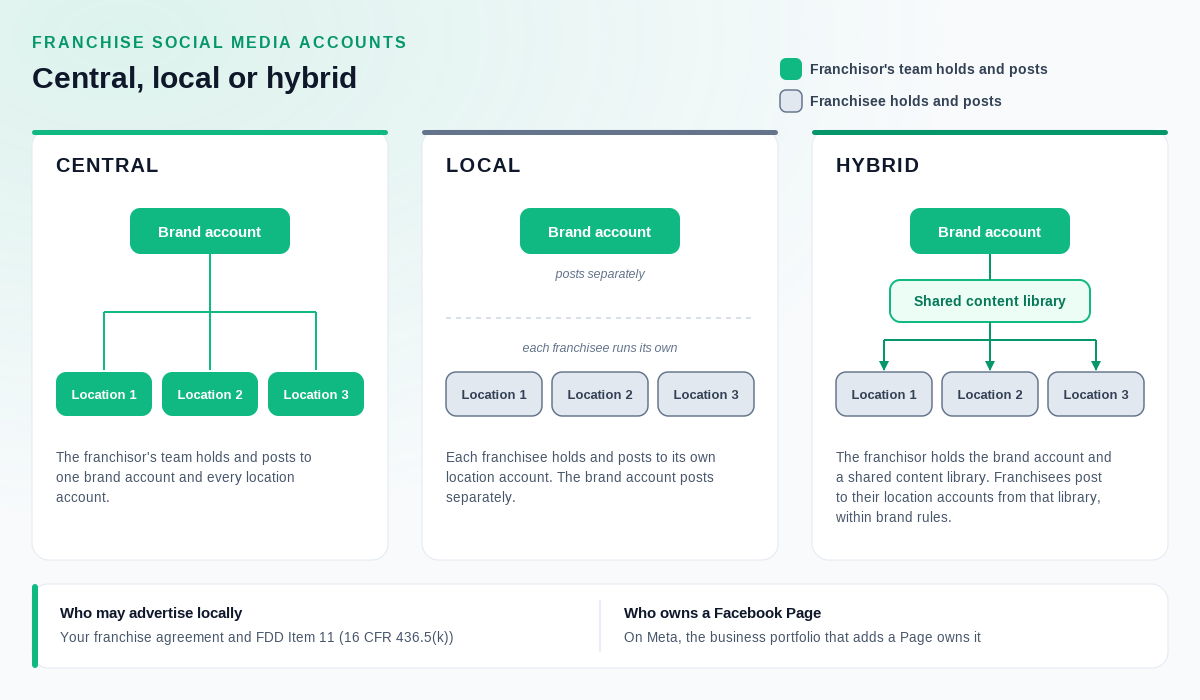
Central means the franchisor runs every account, local means each franchisee runs its own, and hybrid means one brand account plus local accounts that post from a shared library within brand rules. None is best in general; the right one is the one your agreement allows and your team can staff.
| Structure | Who holds the accounts | Who posts | Who reviews before posting | Best for | Watch out for |
|---|---|---|---|---|---|
| Central | Franchisor | Franchisor’s team | Franchisor’s team | Young systems, strict brands, few locations | Local posts feel generic; the central team becomes a bottleneck |
| Local | Each franchisee | Each franchisee | The franchisee, against brand rules | Owner-operators with time and local knowledge | Uneven quality; abandoned pages; ownership disputes at exit |
| Hybrid | Brand account: franchisor. Location accounts: as the agreement sets | Franchisor nationally, franchisees locally | Franchisor, where the agreement requires it | Systems that want local posts inside brand rules | Needs a maintained library and a clear review rule |
Meta’s store Pages are only available to managed Facebook clients, its help page says; for those businesses they set up a main Page plus a store Page for each location. Checked against Meta Business Help Center: About stores on Facebook; Manually add, edit and remove stores Unless your business works with a Meta account representative, plan around ordinary Pages.
Brand guidelines and a shared content library for locations
Give every location the same short brand kit and a library of ready-to-post assets, so local posts look like the brand without the franchisor writing every one. The kit fits on two pages:
- Logo files for light and dark backgrounds, and the brand colours.
- Three example posts in the brand’s tone, and three it would never write.
- Claims locations must not make (prices, guarantees, health or earnings claims).
- Offer rules: who may run discounts and how they are worded.
- Disclosure wording for sponsored and gifted posts.
- Who to ask, and how fast they answer.
To write the kit itself, build a social media brand kit first. One rule belongs in it word for word: when franchisees or staff post about the brand in return for perks, the connection must be disclosed. The FTC says a material connection the audience wouldn’t expect, such as payment, free products or a business relationship, must be disclosed clearly and conspicuously. Checked against eCFR: 16 CFR § 255.5(a) Disclosure of material connections
What should local franchise pages post?
Local pages should post what the brand cannot: the people in that location, local events and community work, location news, and replies that show a real team behind the counter.
| Brand supplies | Location adds |
|---|---|
| National campaign creative and dates | Photos of this team and this shop |
| Product launches and seasonal offers | Local events, sponsorships and charity days |
| Brand videos and templates | Staff milestones and new hires |
| Answers to common questions | Opening hours, closures and parking news |
| Review-request wording | Replies to local comments and reviews |
Reviews need care at both levels. The FTC’s rule on consumer reviews and testimonials took effect on 21 October 2024 and lets it seek civil penalties against knowing violators. Checked against FTC press release: Federal Trade Commission Announces Final Rule Banning Fake Reviews and Testimonials (14 August 2024) Google Maps doesn’t allow businesses to offer incentives for reviews or to ask only happy customers for them. Checked against Google Maps User Generated Content Policy Help: Prohibited & restricted content
Google Business Profile matters for every location. A business with 10 or more locations can verify its profiles in bulk, if it is not a service-area business. Checked against Google Business Profile Help: Verify Business Profiles in bulk Each profile can publish Updates, Offers and Events posts that people see on Search and Maps. Checked against Google Business Profile Help: Create & manage posts on your Business Profile
A franchise marketing plan: one calendar across locations
Social media marketing for franchises runs on one shared calendar: national campaigns go in first with fixed dates, and each location fills the open slots with local posts. A monthly cadence, illustrative:
| Week | National post (brand) | Local slot (each location) |
|---|---|---|
| 1 | Monthly campaign launch | Team photo with the campaign in store |
| 2 | Product or service spotlight | Local event or community post |
| 3 | Customer question answered | Staff spotlight |
| 4 | Campaign reminder or last chance | Next month’s local dates |
Keep it in a shared content calendar template, and read the content calendar guide for how to run one. Natively, Meta Business Suite’s Planner shows published and scheduled posts, stories and reels by week or month, filterable by Facebook Page or Instagram account. Checked against Meta Business Help Center: Use Planner in Meta Business Suite on desktop The Meta Business Suite guide walks through it, and our guide to social media management covers the weekly routine that keeps a calendar like this running.
How to measure franchise social media across locations
Measure every location with the same few numbers on the same date each month, so you compare like with like and can spot which locations need help. Pick four or five: followers, posts published, engagement, enquiries from tagged links, and reviews received. Tag every link in local posts with UTM parameters that name the location, read each network’s own analytics, and add a row per location to one sheet. Compare each location with its own last three months before comparing it with others.
Tools for multi-location posting: seats, accounts and approvals
Check three limits before you pick a tool for many locations: how many accounts a plan connects, whether you pay per user seat, and whether it has an approval step. Each vendor below describes its own product.
| Tool | What its plans page says | Source |
|---|---|---|
| Hootsuite | 10 social accounts on Standard, unlimited on Professional, Advanced and Enterprise; user seats bought one at a time | Checked against Hootsuite: Plans, Prices, and FeaturesVendor's own description |
| Hootsuite | Post approval workflows on Advanced and Enterprise only | Checked against Hootsuite: Plans, Prices, and FeaturesVendor's own description |
| Sprout Social | 5 social profiles on Essentials and Standard, unlimited on Professional and Advanced; every plan billed per seat | Checked against Sprout Social: PricingVendor's own description |
| Later | Access Groups, each with its own media library and calendar: 1 on Starter, unlimited on Growth and Scale | Checked against Later: PricingVendor's own description |
| Buffer | Team plan adds unlimited team members, access levels and approvals; Free and Essentials have one user | Checked against Buffer: PricingVendor's own description |
| Agorapulse | Simple approval workflows, multi-step approvals on its Custom plan | Checked against Agorapulse: Pricing PlansVendor's own description |
| Planable | A separate approval flow for each workspace | Checked against Planable: PricingVendor's own description |
A tool fits if its account cap covers every location plus the brand account, its seat model matches how many people post, and it has an approval step if your agreement requires review. Per-seat vs per-account pricing shows how the costs move as you add locations, and social media management tools compared covers the wider field. For running the accounts day to day, see how to manage many social media accounts.
Outfeed fits the posting part, not the review part. For what it publishes on each network, see how Outfeed’s social media scheduler works.
Outfeed Pro costs $59 per month, billed monthly, and Agency costs $149 per seat/month, billed monthly. Prices verified on outfeed.ai/#pricing See Outfeed’s plans and prices for the full breakdown.
Try Outfeed AI for your locations’ posts
Franchise social media FAQ
Should franchisees have their own social media accounts?
It depends on your franchise agreement and the structure the brand chooses. One option is a hybrid: one brand account plus local accounts that post from a shared library within brand rules. FDD Item 11 must say when franchisees may use their own advertising material. Checked against eCFR: 16 CFR 436.5(k) — Item 11: Franchisor's Assistance, Advertising, Computer Systems, and Training
Who owns a franchise location’s Facebook Page?
The franchise agreement sets who should own it. On Meta, the business portfolio that adds a Page becomes its owner, Checked against Meta Business Help Center: Add a Facebook Page to your organization's business portfolio in Meta Business Suite and only the owner can share the Page with another business, Checked against Meta Business Help Center: Give a partner access to business assets in your business portfolio so agree which portfolio holds each location Page before it is created. This is general information, not legal advice.
How do franchisors keep brand consistency across locations?
With a short brand kit, a shared library of ready-to-post assets, one calendar that fixes national campaign dates, and a review step before local posts go out where the agreement requires one.
What should a franchise social media policy cover?
Who holds each account and who may post to it, as the franchise agreement sets; the brand kit (logos, colours, tone examples); claims locations must not make; offer and discount rules; disclosure wording for sponsored or gifted posts; any review step before local posts go out; and who to ask when in doubt. The brand guidelines section lists the kit item by item.
How do you measure franchise social media?
Track the same few measures for every location on the same date each month, such as followers, engagement and enquiries from tagged links, then compare locations with each other and with the brand account.