LinkedIn Banner Size 2026: 1584x396 + 1512x256 Page
Last verified: 27 September 2026
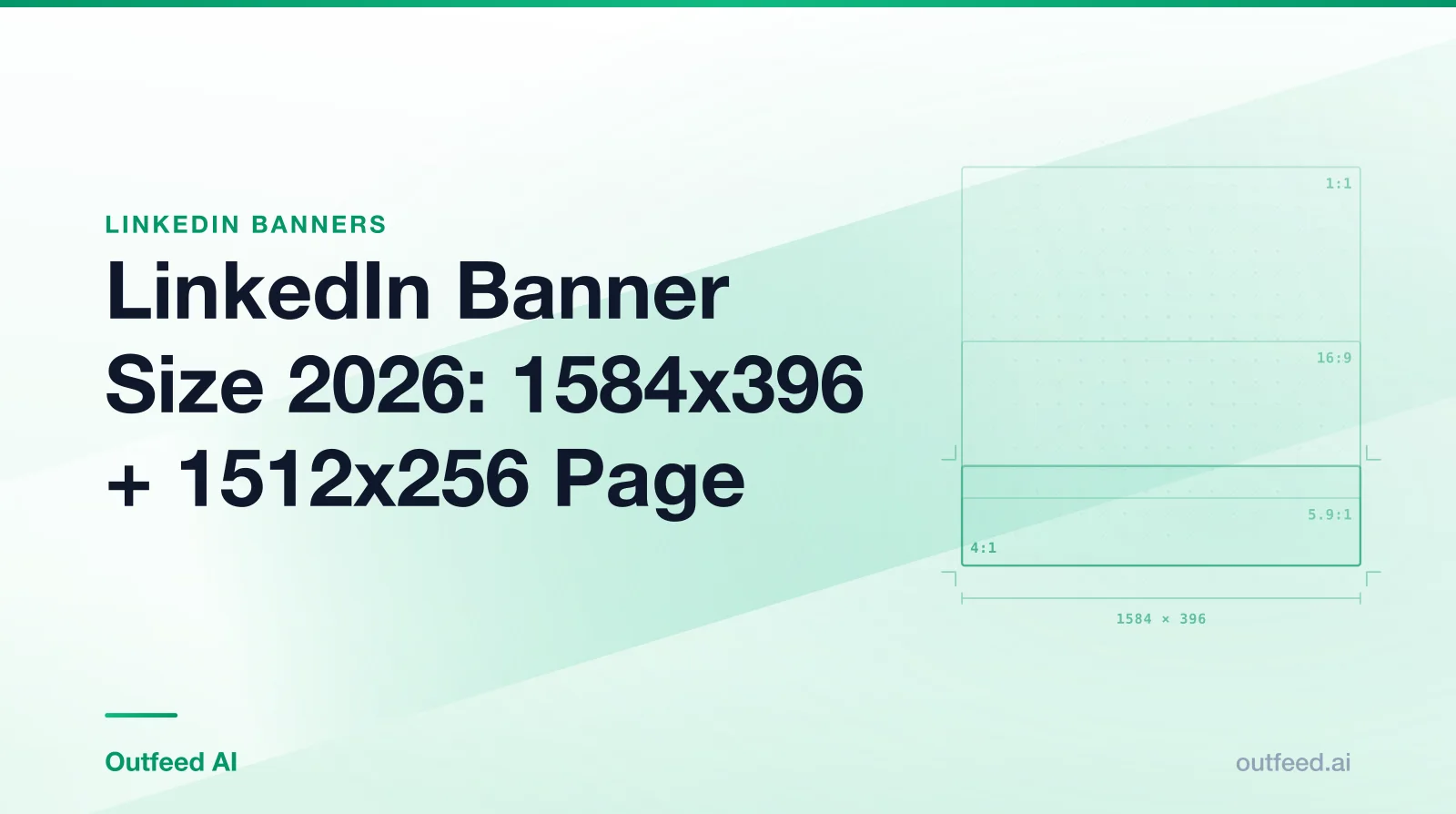
The LinkedIn banner size is 1584 x 396 pixels for a personal profile and 1512 x 256 pixels for a Company Page cover. They are two different shapes, 4:1 against 189:32 (about 5.9:1), with different file caps: 8 MB for the profile banner and 3 MB for the Page.
The Page figure is new: LinkedIn replaced its 4200 x 700 recommendation with 1512 x 256 in mid-2026, and the dated history is below. The personal banner has a different problem, because your profile photo sits over its lower left, so the crop section shows where text is safe.
Table of Contents
- What is the LinkedIn banner size in 2026?
- Why do guides still say 1128x191 or 4200x700?
- Can you use the same banner on a profile and a Company Page?
- What file size and format does LinkedIn accept for banners?
- Where does LinkedIn crop the banner, and where does the profile photo sit?
- What size is a LinkedIn profile picture and company logo?
- What size are LinkedIn feed images and link previews?
- How Outfeed handles LinkedIn images
- Frequently Asked Questions
- Sources and check dates
What is the LinkedIn banner size in 2026?
A personal profile banner is 1584 x 396 pixels, a 4:1 strip that LinkedIn accepts as JPG and PNG files under 8 MB. A Company Page cover is 1512 x 256 pixels, which LinkedIn lists as both the minimum and the recommended size, with PNG and JPEG files accepted up to 3 MB. The profile photo, the Page logo and the images inside your posts each have their own specs, and all six are in one table:
| Placement | Upload size (px) | Aspect ratio | Max file size | File types | Safe zone | Source |
|---|---|---|---|---|---|---|
| Personal profile cover (banner) | 1584 x 396 | 4:1 | 8 MB LinkedIn Help: 'Lesser than 8MB'. | JPG, PNG | Not recorded | LinkedIn Help: Add or change the cover image on your profile |
| Company Page cover image | 1512 x 256 Min 1512 x 256 | 189:32 | 3 MB | PNG, JPEG | Guidance only, no safe-zone dimensions published | LinkedIn Help: Image specifications for your LinkedIn Pages and Career Pages |
| Personal profile photo | 400 x 400 Min 400 x 400 · Max 7680 x 4320 | 1:1 Widely reported | 8 MB | Not recorded | Not recorded | LinkedIn Help: Photo won't upload to your profile |
| Company Page logo | 400 x 400 Min 268 x 268 | 1:1 | 3 MB | PNG, JPEG | Not recorded | LinkedIn Help: Image specifications for your LinkedIn Pages and Career Pages |
| Feed image post | 1080 x 1350 4:5 → 1080 x 1350 · 1:1 → 1080 x 1080 · 3:1 → 1080 x 360 · Min 552 x 276 | 4:5, 1:1, 1.91:1, 3:1 From 3:1 to 4:5 (width:height); wider images are centred and cropped to the max ratio. | 5 MB | Not recorded | Not recorded | LinkedIn Help: Share photos on LinkedIn |
| Link preview image | 1200 x 627 | 1.91:1 | Not recorded | Not recorded | Not recorded | LinkedIn Help: Image specifications for your LinkedIn Pages and Career Pages |
Widely reported: the platform does not publish it.
Free tool: resize your image to the exact LinkedIn spec in your browser. It is free and needs no account.
Is a LinkedIn cover image the same as a banner?
Yes. LinkedIn calls both banners a “cover image”, so a LinkedIn cover image size and a banner size are the same question. What LinkedIn publishes for each is only part of the picture:
- Upload size is what you export: every pixel figure in the table.
- Display size is what LinkedIn actually renders on a given screen. LinkedIn publishes no fixed display size for either banner, and it says a Page cover may be adjusted to fit the screen.
- Safe zone is the area where text and logos survive every crop and overlap. LinkedIn publishes no pixel safe zone for either banner, only written guidance, covered in the crop section below.
So when someone quotes a “LinkedIn cover photo size”, check which of the three they mean. LinkedIn itself only gives upload sizes.
Why do guides still say 1128x191 or 4200x700?
Because LinkedIn changed the Company Page cover in 2026 and most size guides have not caught up. LinkedIn’s Page image specifications listed 4200 x 700 as the minimum and recommended cover size in a Wayback Machine copy from 20 July 2026. By 19 September 2026 the same page listed 1512 x 256 for both and said it had been updated a month earlier. 1128 x 191 is older still, and no current LinkedIn page gives it.
Here is the dated record for LinkedIn’s Page image table:
- 20 July 2026: 4200 x 700, minimum and recommended, in an archived copy of LinkedIn’s Page image specifications.
- 19 September 2026: 1512 x 256, minimum and recommended. The page said “Last updated: 1 month ago”.
- 27 September 2026: re-read for this page, and still 1512 x 256, per the live Page image specifications on LinkedIn Help.
So the change happened between 20 July and 19 September 2026. What that means for the figures you will meet:
- 4200 x 700 was LinkedIn’s own number until mid-2026, so a guide that prints it was right when it was written. It is a 6:1 strip, close to the new cover’s shape but not the same, and far larger than the size LinkedIn now recommends.
- 1128 x 191 has no current LinkedIn source at all. It is almost exactly the same shape as the current cover, but smaller in both dimensions than LinkedIn’s stated minimum of 1512 x 256, so a file exported at 1128 x 191 falls short of the spec. Some widely read size guides, including ones updated in September 2026, still print it.
If your Page already has a 4200 x 700 cover, check that nothing important sits near its edges, since LinkedIn says covers can be trimmed to fit the screen. Export any new cover at 1512 x 256 pixels.
The personal profile banner is a separate spec on a separate help page, and it still reads 1584 x 396. Only the Company Page figure moved.
Can you use the same banner on a profile and a Company Page?
Not without re-cropping. A personal banner is 4:1; a Company Page cover is 189:32, about 5.9:1, so the Page cover is a much flatter strip. Scale a 1584 x 396 design down to 1512 pixels wide and it is 378 pixels tall. The Page cover is 256, so 122 pixels, roughly a third of the height, has to come off the top, the bottom or both.
A single centred line of text usually survives that; a photo or a stacked logo lockup does not. Three ways to handle it:
- Make the Page cover its own canvas. Start at 1512 x 256 pixels rather than cropping a finished personal banner at the end.
- Keep the message in the middle band. Text, logo and any product shot belong in the vertical centre, which is the only part that survives both shapes.
- Build one wide master if you must reuse artwork. Design flat and wide with empty space above and below the key content, then crop each version. The free aspect ratio calculator converts either ratio to pixels at whatever width you are exporting.
What file size and format does LinkedIn accept for banners?
The personal profile banner accepts JPG and PNG files under 8 MB, and GIFs are not supported. Company Page covers and Page logos accept PNG and JPEG files up to 3 MB. The two caps come from two different LinkedIn help pages, so a file that uploads fine as your profile banner can still be too heavy for a Page.
A banner exported at the recommended size usually lands well inside either cap; the caps bite when you export at several times that size or save a photo-heavy design at maximum quality.
Why does a LinkedIn banner look blurry?
LinkedIn does not document how it compresses banners, so focus on what you control:
- Export at the recommended size, not below it. A banner smaller than 1584 x 396 (profile) or 1512 x 256 (Page) has to be scaled up to fill the strip, and upscaling softens it.
- Use PNG for text and flat graphics, JPG for photos. Both banners accept both.
- Set text large. Phone screens are far narrower than desktop ones, so small type that looks crisp in your design tool can be unreadable on mobile.
What is the LinkedIn banner size in inches?
LinkedIn specifies banners in pixels only. If a design tool asks for inches and a print resolution, switch the canvas to pixels and enter 1584 x 396 directly. Inches only matter for print.
To swap the image once it is ready, LinkedIn’s help article on how to add or change the cover image on your profile has the current steps.
Where does LinkedIn crop the banner, and where does the profile photo sit?
LinkedIn publishes no pixel safe zone for either banner. On a personal profile, the profile photo overlaps the lower-left of the banner, and LinkedIn gives no measurement for how much it covers. For Company Page covers, LinkedIn’s guidance is written, not numeric: the cover “might be adjusted to fit the screen, which might trim the image horizontally or vertically”, so keep key details away from the edges, “especially in the lower-right corner”. LinkedIn adds that the centre is always visible.
About the “1200 x 300” safe zone
Many banner templates draw a centred 1200 x 300 box on the personal banner and label it LinkedIn’s safe zone. LinkedIn does not publish that figure. It is a designer’s rule of thumb, a reasonable margin but not a spec. That is also why this page offers no LinkedIn safe-zone overlay: drawing one would mean inventing the numbers.
What the guidance does support:
- Personal banner: keep text and logos out of the lower-left, where the photo sits. Right of centre is the natural place for a tagline or call to action.
- Company Page cover: put the key message in the centre and keep the lower-right corner clear, as LinkedIn asks.
- Both: look at the result on a phone and on a desktop before you leave it live. LinkedIn publishes no separate mobile crop, so a visual check is the only reliable test.
X is a useful contrast. It has the same profile-photo overlap on its header, but it does publish a crop figure: on some monitors and browsers, up to 60 px can be cut from the top and bottom. The X header size and safe zone guide covers that one.
What size is a LinkedIn profile picture and company logo?
LinkedIn accepts a personal profile photo between 400 x 400 and 7680 x 4320 pixels, up to 8 MB. A Company Page logo should be 400 x 400 pixels, no smaller than 268 x 268, in PNG and JPEG up to 3 MB. Both are square, 1:1.
Two details worth knowing:
- The profile photo figure is a range, not a recommendation. LinkedIn gives a minimum and a maximum and no ideal size, so 400 x 400 is the floor, not the target. Upload a square image comfortably above it.
- Transparent logos sit on white. LinkedIn shows a transparent Page logo on a white background, and the logo appears on both light and dark backgrounds. A transparent PNG with white lettering can vanish, so test the logo against both.
Your headline and custom profile address complete the profile header. The free LinkedIn headline generator drafts headline options, and our explainer on what a vanity URL is covers the custom address.
What size are LinkedIn feed images and link previews?
LinkedIn recommends feed images 1080 pixels wide: 1080 x 1350 portrait, 1080 x 1080 square or 1080 x 360 landscape. Photos must be at least 552 x 276 and under 5 MB. A link preview image is 1200 x 627 pixels at 1.91:1.
Ratio range: From 3:1 to 4:5 (width:height); wider images are centred and cropped to the max ratio. A multi-photo post takes up to 20 photos, and those display no taller than 4:5. LinkedIn’s help article on how to share photos on LinkedIn has the full requirements.
For link previews, LinkedIn’s Page image specifications add one condition: the image must be more than 200 pixels wide, and a narrower one shows as a small thumbnail on the left instead of a full-width card.
This page stops at images. Text limits, from the 3,000 characters of a post to every profile field, are in the LinkedIn post character limit guide. For bold or italic lines, the free LinkedIn text formatter does the styling, and our data on the best time to post on LinkedIn covers when to publish. For the same specs on eight other platforms, see every platform’s image sizes in one table.
How Outfeed handles LinkedIn images
Outfeed AI is a chat-first social media scheduler for nine platforms, LinkedIn included. It publishes posts, so it does not touch your banner, profile photo or Page logo; you set those inside LinkedIn.
For the images in your posts, two things are true of Outfeed’s publisher today. It blocks a LinkedIn image over 36,152,320 pixels, the limit in LinkedIn’s Images API. And it currently publishes only the first media item of a LinkedIn post, so a single-image post schedules cleanly, while a multi-photo post is still one to publish from LinkedIn itself.
Schedule your LinkedIn posts with Outfeed AI
Frequently Asked Questions
What is the ideal LinkedIn banner size?
LinkedIn recommends 1584 x 396 pixels, a 4:1 ratio, for a personal profile banner, and accepts JPG and PNG files under 8 MB. A Company Page cover is a different shape: LinkedIn’s Page image specifications now give 1512 x 256 pixels as both the minimum and the recommended size, with PNG and JPEG files accepted up to 3 MB. Design the two as separate files.
What size is a LinkedIn Company Page banner?
1512 x 256 pixels. LinkedIn’s help page on Page image specifications lists it as both the minimum and the recommended cover size, with PNG and JPEG files accepted up to 3 MB. The same page listed 4200 x 700 in an archived copy from 20 July 2026 and 1512 x 256 by 19 September 2026. The older 1128 x 191 figure appears on no current LinkedIn page.
Is there an official LinkedIn banner safe zone?
No. LinkedIn publishes no pixel safe zone for either banner. On a personal profile the profile photo overlaps the lower-left of the banner, and LinkedIn gives no measurement for that overlap. The centred 1200 x 300 box in many templates is a designer convention, not a LinkedIn figure. For Company Page covers, LinkedIn asks you to keep key details away from the edges, especially the lower-right corner.
What file size and format should a LinkedIn banner be?
A personal profile banner accepts JPG and PNG files under 8 MB, and GIFs are not supported. A Company Page cover accepts PNG and JPEG files up to 3 MB, the same cap as the Page logo. The limits come from two different LinkedIn help pages, so a file that uploads fine as a profile banner can still be too heavy for a Company Page.
What size is a LinkedIn profile picture?
LinkedIn accepts a profile photo between 400 x 400 and 7680 x 4320 pixels, up to 8 MB, and it doesn’t state a shape. The photo is shown in a circle, so a square (1:1) upload is the widely used choice. LinkedIn gives a range rather than one recommended size, so 400 x 400 is the minimum, not a target. A Company Page logo is different: 400 x 400 pixels recommended, 268 x 268 minimum, PNG and JPEG files up to 3 MB.
Why does my LinkedIn banner look cropped?
Because LinkedIn fits the banner to the screen it is shown on and does not publish a fixed display size. LinkedIn says a Company Page cover might be trimmed horizontally or vertically to fit the screen, and on a personal profile the profile photo covers the lower-left of the banner. Keep text and logos in the centre and away from the edges on both.
Sources and check dates
Every LinkedIn figure above comes from LinkedIn’s own Help pages, read on 27 September 2026 unless another date is given, with three exceptions: the 36,152,320-pixel image limit is from LinkedIn’s developer documentation for its Images API, the 1200 x 300 box is a designer convention labelled as such, and ratios and scaled sizes are worked out from LinkedIn’s figures.
- LinkedIn Help: Add or change the cover image on your profile. Personal banner size, formats and file cap.
- LinkedIn Help: Image specifications for your LinkedIn Pages and Career Pages. Company Page cover, logo, link preview and cropping guidance. Read on 19 and 27 September 2026.
- Wayback Machine copy of the Page image specifications, 20 July 2026. The previous 4200 x 700 cover figure.
- LinkedIn Help: Photo won’t upload to your profile. Profile photo range and file cap.
- LinkedIn Help: Share photos on LinkedIn. Feed image sizes, ratio range and file cap.
Deliberately not stated here: a pixel safe zone for either banner, a mobile display size or a group banner size. LinkedIn’s Help pages give none of these, so this page does not invent them.