
Emoji Meanings: The Emoji Dictionary for Social Posts
Emoji meanings come from how people use them, not from Unicode. Unicode gives every emoji a code and a short name, each platform draws its own artwork, and usage dictionaries record what each one has come to mean. This dictionary covers the emojis you meet in posts, group by group, with every meaning sourced and dated and the easily misread ones flagged.
Each group gets a short answer, a sample and a link to its full list.
Table of Contents
- How do you read emoji meanings?
- What is an emoji?
- Who decides what emojis mean?
- Smileys and faces: what do the best-known ones mean?
- Hands and fingers: what do the gestures mean?
- What do the heart colours mean?
- What do everyday symbol emojis mean?
- Which emojis mean something different now?
- Which emojis can be misread?
- What are the newest emojis?
- How do emojis behave in social posts?
- How do you type emojis, including TikTok’s hidden ones?
- Frequently Asked Questions
How do you read emoji meanings?
Read an emoji in three layers: its name, its use and its look. The name says what the picture is, the use is what people mean by it, and the look depends on the device. When name and use disagree, go with the use, and let context decide between uses.
- Name. Unicode calls 😭 the “loudly crying face”.
- Use. Our sources lead with this: Often used in an exaggerated, humorous way for overwhelming emotion, including laughter, joy, excitement or love.
- Look. The artwork comes from your device, not from Unicode.
Checked against Unicode's emoji-test.txt (Emoji 18.0), Emojipedia and Dictionary.com Emoji Dictionary.
What is an emoji?
An emoji is a picture character: text, like a letter, that your device draws as a small image. Unicode defines each one, so it arrives as the same character on any device, even if it looks different there. Emojis were originally associated with mobile phone use in Japan, and the word is Japanese: e (picture) plus moji (character), according to the Unicode Emoji FAQ (checked ).
Each emoji carries three labels from Unicode:
- A code point. 🫠 is U+1FAE0. Some emojis are sequences, such as a hand plus one of Unicode’s 5 skin-tone modifiers.
- A short name from Unicode’s CLDR project, here “melting face”. Unicode Technical Standard #51 says the short name “may change over time”; the formal Unicode name never does.
- An Emoji version. 🫠 arrived in Emoji 14.0 (2021). The newest set is Emoji 18.0, released 15 September 2026.
The year is when Unicode first defined the emoji, not when phones added it: vendors roll new emoji out later, at different times. Emoji show in your device's own font, so they look different on other phones and computers. Unicode’s FAQ accepts both “emoji” and “emojis” as plurals.
Checked against Unicode's emoji-test.txt (Emoji 18.0) and the Emoji Versions table in Unicode Technical Standard #51.
Who decides what emojis mean?
Nobody, officially. Unicode names emojis but does not assign meanings. Its FAQ says emojis are encoded “based primarily on their general appearance, not on an intended meaning”, that a Unicode character name “may not encompass all the possible meanings of an emoji, and in some cases may even be misleading”, and that a meaning “can vary depending on language, culture, or context, and may change or be repurposed over time.”
So this dictionary records use:
- Sources. Meanings are paraphrased from Emojipedia, which Unicode’s FAQ calls “a good source of information about the current meanings of emoji”, and Dictionary.com’s emoji dictionary.
- Hedges. A meaning that only one source supports says so.
- Cautions. Cultural differences, hate-symbol uses and innuendo sit beside the meaning, in one neutral clause.
- Dates. Every meaning here was checked on .
For the slang and platform terms around emojis, see our social media glossary.
Smileys and faces: what do the best-known ones mean?
Smiley emoji mostly mean what their faces show, but several of the best-known are used for something their names don’t suggest. Each row shows the first meaning in our sources, with any caution beside it.
| Emoji | Name | Code point(s) | Emoji version (year) | Common meaning |
|---|---|---|---|---|
| 😂 | face with tears of joy | U+1F602 | E0.6 (Unicode 6.0) 2010 | Shows that something is very funny, like typing "LOL" or "haha". |
| 😭 | loudly crying face | U+1F62D | E0.6 (Unicode 6.0) 2010 | Often used in an exaggerated, humorous way for overwhelming emotion, including laughter, joy, excitement or love. |
| 💀 | skull | U+1F480 | E0.6 (Unicode 6.0) 2010 | Means figuratively "dying", most often from laughing, as in "I'm dead".Note: Not to be confused with ☠️ Skull and Crossbones, which is more often a warning about danger or poison. |
| 🙂 | slightly smiling face | U+1F642 | Emoji 1.0 2015 | Conveys subdued happiness or friendliness.One source only: Emojipedia.Note: Its tone can be patronising, passive-aggressive or ironic, as if saying "this is fine" when it is not. |
| 🫠 | melting face | U+1FAE0 | Emoji 14.0 2021 | Shows embarrassment, shame, dread or feeling overwhelmed. |
Characters, names, code points and versions from Unicode's emoji-test.txt (Emoji 18.0) and the Emoji Versions table in Unicode Technical Standard #51, checked . The year is when Unicode first defined the emoji, not when phones added it: vendors roll new emoji out later, at different times. E0.6 and E0.7 are Unicode's labels for emoji added in Unicode 6.0 (2010) and Unicode 7.0 (2014), before Emoji 1.0 was released in 2015. Emoji show in your device's own font, so they look different on other phones and computers. Meanings paraphrased from Emojipedia and Dictionary.com Emoji Dictionary, checked ; meanings vary by person and context.
Full list: emoji faces and what every smiley means
Hands and fingers: what do the gestures mean?
Hand emojis copy real gestures, so they inherit real gestures’ problems: a sign that is friendly in one country can be rude in another.
| Emoji | Name | Code point(s) | Emoji version (year) | Common meaning |
|---|---|---|---|---|
| 🙏 | folded hands | U+1F64F | E0.6 (Unicode 6.0) 2010 | Means "please" or "thank you", the meaning of the gesture in Japanese culture.Note: Some people read it as a high-five, though Emojipedia notes that use is rare. |
| 👋 | waving hand | U+1F44B | E0.6 (Unicode 6.0) 2010 | Says "hello" or "goodbye".One source only: Emojipedia.Note: Emojipedia notes that on WeChat in China it can suggest you are no longer friends. |
| 👍 | thumbs up | U+1F44D | E0.6 (Unicode 6.0) 2010 | Shows approval, agreement or encouragement.Note: In some contexts it can read as passive-aggressive or sarcastic.Note: Dictionary.com notes the thumbs-up gesture is considered rude in some places, including Australia, Greece and parts of the Middle East. |
| 🤞 | crossed fingers | U+1F91E | Emoji 3.0 2016 | Wishes for luck or a good outcome, like saying "fingers crossed".One source only: Emojipedia. |
| 🫵 | index pointing at the viewer | U+1FAF5 | Emoji 14.0 2021 | Stands for the word "you", pointing straight at the reader.One source only: Emojipedia. |
Characters, names, code points and versions from Unicode's emoji-test.txt (Emoji 18.0) and the Emoji Versions table in Unicode Technical Standard #51, checked . The year is when Unicode first defined the emoji, not when phones added it: vendors roll new emoji out later, at different times. E0.6 and E0.7 are Unicode's labels for emoji added in Unicode 6.0 (2010) and Unicode 7.0 (2014), before Emoji 1.0 was released in 2015. Emoji show in your device's own font, so they look different on other phones and computers. Meanings paraphrased from Emojipedia and Dictionary.com Emoji Dictionary, checked ; meanings vary by person and context.
Full lists: what each hand gesture says and every finger emoji explained
What do the heart colours mean?
Nearly every heart colour starts from love, friendship or support, and the colour adds the specifics, such as a team, a cause or a mood. Linked colours have their own page.
- ❤️ Red heart: Expresses love and romance, the classic meaning of a red heart. Note: Dictionary.com notes it can also be used flirtatiously, so context matters.
- 🩷 Pink heart: Shows love, friendship and warmth.
- 🧡 Orange heart: Shows love, support or admiration for things linked to orange, such as autumn or a team in orange.
- 💛 Yellow heart: Shows friendship and liking, often where a red heart would feel too romantic.
- 💚 Green heart: Shows love, support or admiration for things linked to green, such as nature or a team in green. Note: Can also hint at jealousy, as in "green with envy".
- 💙 Blue heart: Shows love, support or admiration, often toward things linked to the colour blue, such as a team, a school or a cause.
- 🩵 Light blue heart: Shows love or affinity for people, places, groups or things linked to light blue. One source only: Emojipedia.
- 💜 Purple heart: Shows love, support or admiration, often toward things linked to purple.
- 🤎 Brown heart: Shows love, affection and close bonds.
- 🖤 Black heart: Despite its colour, most often used for love and affection. Note: Dictionary.com notes it is also used to show support for the Black Lives Matter movement.
- 🩶 Grey heart: Shows love or affinity for people, places, groups or things linked to grey or silver. One source only: Emojipedia.
- 🤍 White heart: Shows love, support and close bonds.
Meanings paraphrased from Emojipedia and Dictionary.com Emoji Dictionary, checked ; meanings vary by person and context.
Checked against Unicode's emoji-test.txt (Emoji 18.0) and the Emoji Versions table in Unicode Technical Standard #51.
Every heart, colour by colour: heart emoji meanings
What do everyday symbol emojis mean?
Symbol emojis mostly work as one-character reactions: approval, excitement, attention or “done”. All six sit in the top six rows of Unicode’s 2019 frequency ranking, a median across several sources, in which the face with tears of joy and the red heart were the two most-used emoji. Unicode now files that page as an archive.
Checked against Unicode's emoji frequency page (2019 data).
| Emoji | Name | Code point(s) | Emoji version (year) | Common meaning |
|---|---|---|---|---|
| 🔥 | fire | U+1F525 | E0.6 (Unicode 6.0) 2010 | Says something is impressive, exciting or excellent, like the slang "fire" or "lit".Note: Dictionary.com notes that, because "lit" and "fire" are also drug slang, it is sometimes used that way. |
| ✨ | sparkles | U+2728 | E0.6 (Unicode 6.0) 2010 | Adds positive feelings such as excitement, love, beauty or gratitude.Note: Since late 2023 a similar sparkle icon is widely used to mark AI features in apps.Note: Dictionary.com notes it is occasionally used with a sexual meaning. |
| 💯 | hundred points | U+1F4AF | E0.6 (Unicode 6.0) 2010 | Means "100%", "absolutely" or "keep it real" (keep it 100). |
| 👀 | eyes | U+1F440 | E0.6 (Unicode 6.0) 2010 | Draws attention to something, often drama or gossip the sender is enjoying watching.Note: Sometimes used to say someone in a photo is attractive. |
| 🎉 | party popper | U+1F389 | E0.6 (Unicode 6.0) 2010 | Means congratulations or celebration, for birthdays, graduations, New Year and other good news.One source only: Emojipedia. |
| ✅ | check mark button | U+2705 | E0.6 (Unicode 6.0) 2010 | Shows that something is done, approved, agreed or correct.One source only: Emojipedia.Note: Emojipedia notes X does not allow it in display names, possibly to avoid confusion with a verified checkmark. |
Characters, names, code points and versions from Unicode's emoji-test.txt (Emoji 18.0) and the Emoji Versions table in Unicode Technical Standard #51, checked . The year is when Unicode first defined the emoji, not when phones added it: vendors roll new emoji out later, at different times. E0.6 and E0.7 are Unicode's labels for emoji added in Unicode 6.0 (2010) and Unicode 7.0 (2014), before Emoji 1.0 was released in 2015. Emoji show in your device's own font, so they look different on other phones and computers. Meanings paraphrased from Emojipedia and Dictionary.com Emoji Dictionary, checked ; meanings vary by person and context.
Popularity in more detail: the most used emojis and what they mean
Which emojis mean something different now?
Several of the best-known emojis are often used for something other than what they picture. The name stays literal while the use moves on:
- 😭 Crying that isn’t sad. Our sources put laughter and joy first and grief last. They add: Fans use it when something they love moves them, as if sobbing with excitement.
- 💀 Death as a joke. Besides “I’m dead”, it is used for things joked about as deadly, such as a hard workout or deep embarrassment, and around Halloween.
- 🙂 A smile that can bite. Its tone can read as patronising or passive-aggressive, a caution that comes from Emojipedia alone.
- 🙃 A flipped smile. Conveys irony, sarcasm, joking or silliness. Often means "smiling through the pain", a resigned "this is fine".
- 🫠 Melting, but not from heat. Shows embarrassment, shame, dread or feeling overwhelmed.
Before you post one, read it the way your audience will, not the way its name suggests.
Meanings paraphrased from Emojipedia and Dictionary.com Emoji Dictionary, checked .
Which emojis can be misread?
Emojis get misread in three main ways: a gesture that is rude in some countries, a symbol that has also been used to abuse people or signal hate, and an emoji that reads as innuendo or looks different on another platform. A brand account should check these three before posting; the speak-no-evil monkey carries the same caution as the see-no-evil monkey.
| Emoji | Name | Code point(s) | Emoji version (year) | Common meaning |
|---|---|---|---|---|
| 👌 | OK hand | U+1F44C | E0.6 (Unicode 6.0) 2010 | Means "OK", "sounds good" or "yes, that's right".Note: The same hand sign is offensive in some places, including parts of Europe, the Middle East and South America.Note: Since the late 2010s it has also been used as a white-supremacist symbol, so context matters.Note: Dictionary.com notes it can be combined with other emoji for a sexual meaning. |
| 🖕 | middle finger | U+1F595 | Emoji 1.0 2015 | Represents "giving someone the finger", a rude or insulting gesture.Note: Considered obscene in many cultures and inappropriate in formal or brand contexts. |
| 🙈 | see-no-evil monkey | U+1F648 | E0.6 (Unicode 6.0) 2010 | A playful "I can't believe what I'm seeing" or "I can't look", often laughing or cringing.Note: Emojipedia notes it is considered racist when used to insult or abuse people with dark skin. |
Characters, names, code points and versions from Unicode's emoji-test.txt (Emoji 18.0) and the Emoji Versions table in Unicode Technical Standard #51, checked . The year is when Unicode first defined the emoji, not when phones added it: vendors roll new emoji out later, at different times. E0.6 and E0.7 are Unicode's labels for emoji added in Unicode 6.0 (2010) and Unicode 7.0 (2014), before Emoji 1.0 was released in 2015. Emoji show in your device's own font, so they look different on other phones and computers. Meanings paraphrased from Emojipedia and Dictionary.com Emoji Dictionary, checked ; meanings vary by person and context.
Artwork causes misreadings too. Take the grimacing face 😬: Emojipedia warns its look has differed a lot between platforms, and Dictionary.com notes some people mistake it for a toothy grin.
Before posting, read the note beside any gesture, keep emojis with a recorded abuse or hate use out of posts where context could be lost, and look up any emoji that is new to you. Our social media emoji guide for brands goes further.
What are the newest emojis?
The newest set is Emoji 18.0, which Unicode released on 15 September 2026. Among its additions are the cracking face , the leftwards thumb sign and rightwards thumb sign , a lighthouse and a meteor . If they show as boxes or blanks, your device doesn’t support them yet; Unicode’s FAQ says it has “no control over which emoji are supported by platform vendors”.
Only the two thumb signs have a meaning in our sources so far, from Emojipedia alone, which gives both the same entry: According to its Unicode proposal, points toward a person or thing, sometimes in jest, or toward oneself. Can show hitchhiking, telling someone to leave, or indecision between 👍 and 👎. Approved in September 2026 and expected on most devices during 2027, so many people cannot see it yet.
Checked against Unicode's emoji-test.txt (Emoji 18.0) and the Emoji Versions table in Unicode Technical Standard #51.
How do emojis behave in social posts?
On some networks an emoji costs more than one character. X counts posts in X-weighted characters (emoji 2, links 23) against the standard 280-character limit, so a post made only of emojis is full at 140. Bluesky allows 300 characters and counts them as graphemes (an emoji counts 1). Sources: X Developer Platform: Counting characters and AT Protocol lexicon: app.bsky.feed.post, verified 27 September 2026.
The illustration shows one emoji caption as Outfeed’s Instagram, X and Threads previews, and what X’s counting does to it:
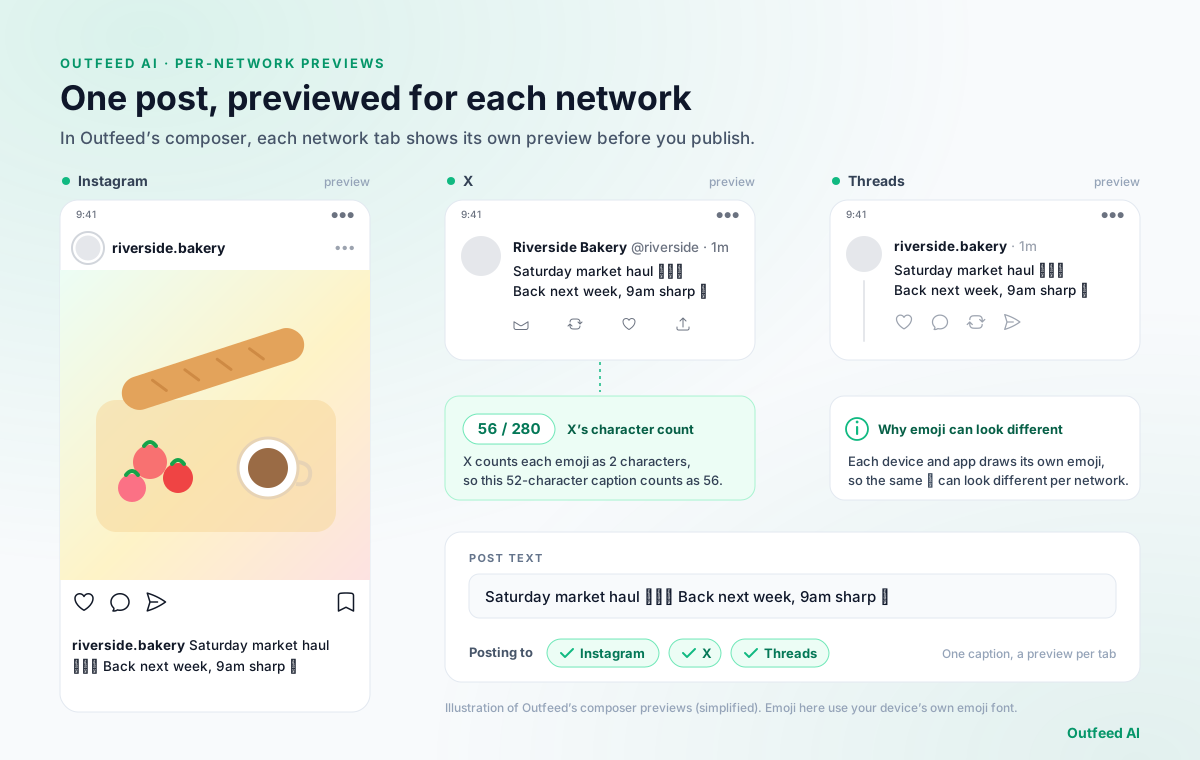
Our free X character counter counts a draft the same way. Where to go next:
- Instagram: Instagram emoji and how to use them
- Profiles: bio emoji ideas for every platform
- Ready-made sets: travel emoji and sport emoji to copy and paste
- A date for the calendar: World Emoji Day, every July 17 ( Checked against World Emoji Day, FAQ and World Emoji Day, home page)
- The words around them: the free Instagram caption generator, or the rest of our free social media tools
How do you type emojis, including TikTok’s hidden ones?
Every major system opens its emoji picker with one shortcut or button:
- Mac: Fn/Globe-E
- Windows: Windows logo key + . (period)
- Chromebook: Search + Shift + Space
- iPhone: Emoji button or Next Keyboard (globe) key
- Android: Gboard: tap Emoji. These are Gboard's steps. Android phones can ship with a different default keyboard (for example a manufacturer's own), whose buttons may differ.
Checked against Apple Support, Mac User Guide: Use emoji and symbols on Mac, Apple Support, Mac keyboard shortcuts, Microsoft Support, Windows keyboard tips and tricks, Chromebook Help, Find emojis, symbols, emoticons & GIFs, Chromebook Help, Use Quick Insert to add & create content, Apple Support, iPhone User Guide: Add emoji, Memoji, and stickers with the iPhone keyboard and Gboard Help, Use your keyboard (Android).
Full steps: emoji keyboard shortcut on Mac and emoji keyboard shortcuts for Windows, Mac and phones.
TikTok also has hidden emojis that no keyboard shows. TikTok doesn’t publish them, so what follows comes from third-party guides: community-reported, not tested by Outfeed, checked . Type the code word in lowercase inside square brackets, such as [smile], and post. TikTok swaps the bracketed word for its own emoji image after the comment or caption is posted, so the brackets can still show while you are typing. Comments are the one place every checked guide says the codes work. The full list is on our TikTok secret emoji codes page.
Write and schedule your next post in Outfeed AI
Frequently Asked Questions
What are emojis?
Emojis are picture characters: text, like letters, that your device draws as small images. Unicode gives each one a code and a short name, such as “face with tears of joy”. Unicode’s FAQ says emojis were originally associated with mobile phone use in Japan, and the word is Japanese: e (picture) plus moji (character).
Do emojis mean the same on every phone?
Not always. Unicode defines the character and its name, but each platform draws its own artwork, and Unicode says it has no control over those images. Emojipedia warns that the grimacing face, for one, has looked very different from platform to platform. Meaning also varies with language, culture and context.
Who decides what an emoji means?
Nobody, officially. Unicode encodes emoji primarily by their general appearance, not an intended meaning, and its FAQ says a meaning can vary by language, culture or context and change over time. Meaning comes from how people use emojis, which dictionaries such as Emojipedia and Dictionary.com record.
What is the newest emoji?
The newest set is Emoji 18.0, which Unicode released on 15 September 2026. Its additions include cracking face, leftwards thumb sign, rightwards thumb sign, lighthouse and meteor. Devices get new emoji through software updates, at different times, so many can’t show them yet.