
Social Media Emoji Guide: How Brands Should Use Emojis
Social media emoji help a brand when they add tone the words can’t, and they hurt when they replace words, break a character limit or carry a meaning you didn’t intend. The rules below hold on every network, and each one traces to a source you can check: the networks’ own documentation, Unicode, Microsoft’s style guide and two emoji dictionaries.
You won’t find engagement statistics here, only emoji marketing rules you can verify. For what a particular emoji means, see our emoji meanings dictionary.
Table of Contents
- What social media emoji rules hold on every network?
- How does each network count an emoji?
- How do screen readers handle emoji?
- Which emojis can embarrass a brand?
- How many emojis belong in a post, and where?
- How do you keep emoji use consistent across a team?
- Frequently Asked Questions
What social media emoji rules hold on every network?
Five, and each section below expands one:
- Count before you post. Networks count emoji differently, and on X each one costs more than a letter.
- Put them at the end. Finish a sentence or post with emoji; never use them in place of words.
- Keep them few. Three in a row is a sensible ceiling.
- Check the meaning. Some common emoji carry readings a brand wouldn’t intend.
- Write it down. A shared team list stops each person improvising.
How does each network count an emoji?
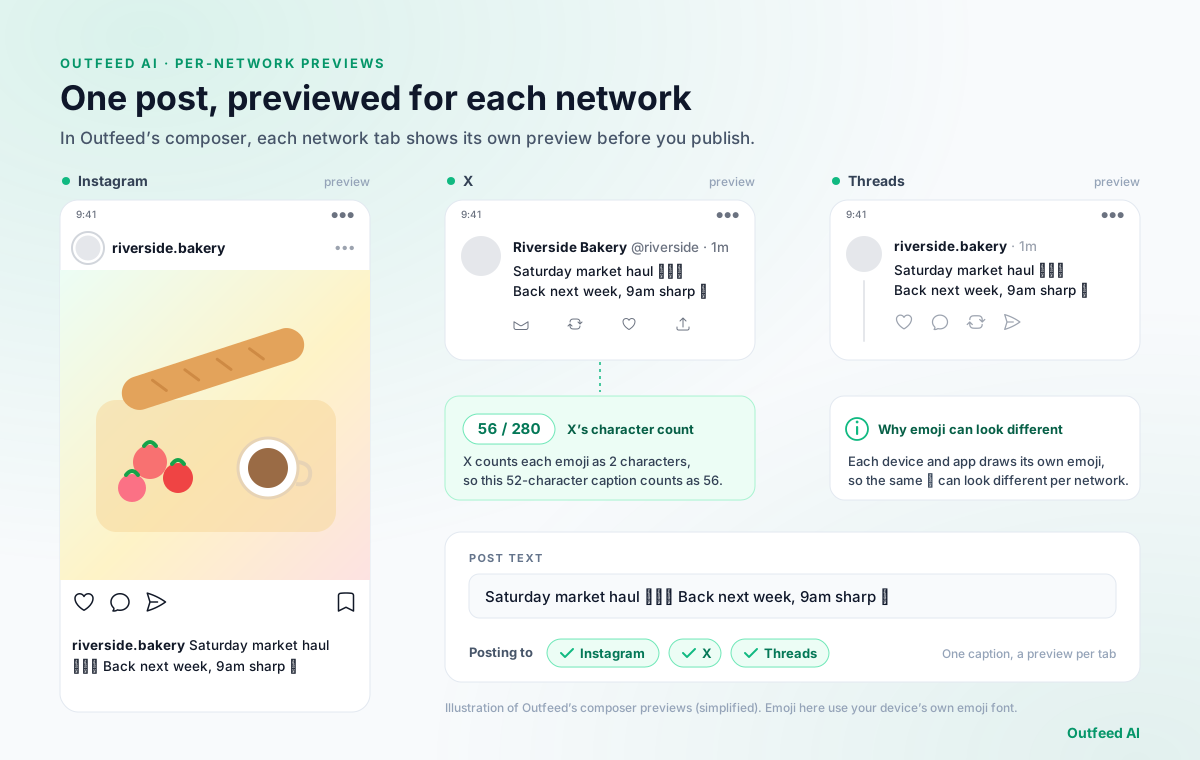
Not the same way. X counts posts in X-weighted characters (emoji 2, links 23), Bluesky counts graphemes (an emoji counts 1), and Instagram, Threads and LinkedIn don’t publish how they count an emoji at all.
| Network | Post limit | How an emoji counts | Source |
|---|---|---|---|
| X | 280 weighted characters | X-weighted characters (emoji 2, links 23) | X Developer Platform: Counting characters |
| Bluesky | 300 characters (graphemes) | graphemes (an emoji counts 1) | AT Protocol lexicon: app.bsky.feed.post |
| Instagram caption | 2,200 characters | Not published | Instagram Graph API: IG User Media |
| Threads | 500 characters | Not published | Threads API: overview |
| 3,000 characters | Not published | LinkedIn Help: Post and share updates |
Limits last verified 27 September 2026. X Premium subscribers can post longer, up to 25,000 characters.
Where a network doesn’t publish its method, treat the limit as approximate for emoji, which may count as more than one character, and leave a margin. The free Twitter character counter counts emoji the way X does, and the Instagram character counter shows live limits for Instagram, Threads, Bluesky and more.
Here is one emoji caption as Outfeed’s Instagram, X and Threads previews, with X’s count beside it:
How do screen readers handle emoji?
They read out each emoji’s name, if they support emoji at all. Unicode’s emoji standard (UTS #51) calls each emoji’s CLDR short name its “TTS name”, for text-to-speech “when reading text for accessibility purposes”. Microsoft’s style guide says screen readers use that name as alt text, and warns that not all screen readers support emoji, so the post has to make sense without them. Both checked 3 October 2026.
That makes placement an accessibility decision. Microsoft’s guide sets three rules worth adopting:
- Put emoji at the end of a sentence, or better, at the end of the paragraph, message or post, not in the middle of a sentence.
- Don’t use emoji in place of words.
- Don’t start consecutive lines with emoji to simulate a bulleted list.
A word swapped for an emoji is heard as the emoji’s name, which may not be the word you meant.
Which emojis can embarrass a brand?
Any emoji whose second meaning clashes with your message. These seven common social media emojis carry cautions in the emoji dictionaries we cite, from gestures that are rude in some countries to innuendo, so read the notes before you post them from a brand account.
| Emoji | Name | Code point(s) | Emoji version (year) | Common meaning |
|---|---|---|---|---|
| 👌 | OK hand | U+1F44C | E0.6 (Unicode 6.0) 2010 | Means "OK", "sounds good" or "yes, that's right".Note: The same hand sign is offensive in some places, including parts of Europe, the Middle East and South America.Note: Since the late 2010s it has also been used as a white-supremacist symbol, so context matters.Note: Dictionary.com notes it can be combined with other emoji for a sexual meaning. |
| 👍 | thumbs up | U+1F44D | E0.6 (Unicode 6.0) 2010 | Shows approval, agreement or encouragement.Note: In some contexts it can read as passive-aggressive or sarcastic.Note: Dictionary.com notes the thumbs-up gesture is considered rude in some places, including Australia, Greece and parts of the Middle East. |
| 🙈 | see-no-evil monkey | U+1F648 | E0.6 (Unicode 6.0) 2010 | A playful "I can't believe what I'm seeing" or "I can't look", often laughing or cringing.Note: Emojipedia notes it is considered racist when used to insult or abuse people with dark skin. |
| 🙊 | speak-no-evil monkey | U+1F64A | E0.6 (Unicode 6.0) 2010 | A playful "I can't believe I just said that" or a cheeky "oops!".Note: Emojipedia notes it is considered racist when used to insult or abuse people with dark skin. |
| 🔥 | fire | U+1F525 | E0.6 (Unicode 6.0) 2010 | Says something is impressive, exciting or excellent, like the slang "fire" or "lit".Note: Dictionary.com notes that, because "lit" and "fire" are also drug slang, it is sometimes used that way. |
| 🥺 | pleading face | U+1F97A | Emoji 11.0 2018 | Shows begging or pleading with "puppy dog eyes", such as asking for a favour or forgiveness.Note: Both sources note it can also be used suggestively, depending on context. |
| 🖕 | middle finger | U+1F595 | Emoji 1.0 2015 | Represents "giving someone the finger", a rude or insulting gesture.Note: Considered obscene in many cultures and inappropriate in formal or brand contexts. |
Characters, names, code points and versions from Unicode's emoji-test.txt (Emoji 18.0) and the Emoji Versions table in Unicode Technical Standard #51, checked . The year is when Unicode first defined the emoji, not when phones added it: vendors roll new emoji out later, at different times. E0.6 and E0.7 are Unicode's labels for emoji added in Unicode 6.0 (2010) and Unicode 7.0 (2014), before Emoji 1.0 was released in 2015. Emoji show in your device's own font, so they look different on other phones and computers. Meanings paraphrased from Emojipedia and Dictionary.com Emoji Dictionary, checked ; meanings vary by person and context.
Three of the seven are hand gestures, and our guide to hand emoji meanings covers the other hand emoji. For what Unicode’s data says people use most, see the most used emojis.
How many emojis belong in a post, and where?
As few as do the job, at the end of a sentence or post. There’s no universal number, but Microsoft’s style guide gives a general rule of three emoji at most per message or post, and three in a row at most with a space between them. Treat that as a ceiling, not a target.
Decide per network as well as per brand. A line of emoji that fits an Instagram caption can push an X post over its limit, because of the weighting in the table above. For the words themselves, see our guide to writing engaging captions; for profiles, bio emoji ideas applies the same rules to a much smaller space.
How do you keep emoji use consistent across a team?
Write it down. A one-page emoji guide stops each person improvising, and it needs four parts:
- An approved list. The handful of emoji that fit your brand voice, each with the meaning you intend.
- A never list. Start from the cautions table above.
- Network notes. How each network counts emoji, from the counting table.
- A check before scheduling. Someone reads each post for meaning, placement and length before it goes out.
For a first draft to edit, try the free Instagram caption generator or the rest of our free social media tools.
Plan your next posts in Outfeed AI
Frequently Asked Questions
Should brands use emojis on social media?
Yes, where they add tone the words can’t, but not in place of words or on serious topics. Microsoft’s style guide sets both of those rules and suggests no more than three emoji per post. Check each emoji’s meaning first, because some common ones carry readings a brand wouldn’t intend.
Do emojis count toward character limits?
Yes. X’s developer docs count each emoji as 2 toward the 280-character limit, and every link as 23. Bluesky counts graphemes, so an emoji counts once toward its 300. Instagram, Threads and LinkedIn don’t publish how they count emoji, so leave a margin under their limits.
Are emojis accessible to screen readers?
Mostly. Microsoft’s style guide says every emoji has a kind of alt text, its short name, that screen readers can read out, but not all screen readers support emoji. Put emoji at the end of a sentence, never in place of words, and make sure the post still makes sense without them.
Which emojis should brands avoid?
Any whose other readings clash with your message. The emoji dictionaries we cite record cautions for the OK hand (offensive in some places, and used as a white-supremacist symbol since the late 2010s), the see-no-evil and speak-no-evil monkeys (considered racist when used to abuse people with dark skin) and the middle finger. Some everyday faces and the fire emoji can carry innuendo or slang readings too.
How many emojis should you use in a post?
As few as do the job. There’s no universal number, but Microsoft’s style guide gives a general rule of three emoji at most per message or post, and three in a row with a space between them, placed at the end of a sentence or post rather than in the middle.