
Earned Media: Definition, Examples and How to Get It
Earned media is attention you don’t pay for: press coverage, reviews, reposts and word of mouth that other people choose to give your brand. You can’t buy it or fully control it, which makes it the hardest of the media types to plan.
This guide traces the terms to where they actually come from, sorts the grey areas (gifted posts, paid reviews) with a decision table, and ends with free ways to track mentions. It is one part of our social media marketing playbook for small businesses.
Table of Contents
- What is earned media?
- Earned vs owned vs paid vs shared media
- Is social media earned media?
- Earned or paid? Influencers, gifts and reviews
- Earned media examples
- How to get earned media: an earned media strategy
- How to track earned media for free
- Earned media FAQ
What is earned media?
Earned media is content about you that a third party publishes without being paid. MASB’s Universal Marketing Dictionary (2022) defines it as content distributed through third-party-owned channels without a fee, such as PR-driven news mentions and word of mouth. Checked against MASB Universal Marketing Dictionary: PEO (Paid-Earned-Owned) Model
Don’t look for it in a general dictionary: when we checked, neither Merriam-Webster nor Cambridge had an entry for “earned media”, and Cambridge had none for owned or paid media either. Checked against Merriam-Webster: search for 'earned media'
The marketing use was set out in a 16 December 2009 Forrester post by analyst Sean Corcoran, who described earned media as an old PR term for getting a brand into free media instead of paying for advertising, which had evolved into the word of mouth created through social media. Checked against Forrester blog: 'Defining Earned, Owned And Paid Media' (Sean Corcoran, 16 Dec 2009) — Internet Archive captureArchived copy, 4 October 2021 Forrester described the model; it did not claim to have coined it.
So what is earned content? The individual pieces: the article, the review, the repost, the recommendation in someone else’s video.
Why it carries weight is an old idea. Routledge describes Katz and Lazarsfeld’s Personal Influence (1955) as showing that media messages may be passed on by informal “opinion leaders” to the people around them. Checked against Routledge: Personal Influence: The Part Played by People in the Flow of Mass Communications (Katz, Lazarsfeld)Industry convention More recently, in Nielsen’s 2021 Trust in Advertising Study, an online survey of more than 40,000 consumers in five regions, 88% of global respondents trusted recommendations from people they know more than any other channel. Checked against Nielsen: 'Beyond martech: building trust with consumers…' (29 Nov 2021)
Earned vs owned vs paid vs shared media
Paid media is bought, owned media is yours, earned media is given to you, and shared media is a fourth label one framework adds for social media. The three-way split comes from the 2009 Forrester post; the four-way PESO Model comes from Spin Sucks, a PR agency, which says the framework officially launched in 2014 with its book Spin Sucks. Checked against Spin Sucks: What Is the PESO Model? (8 Sep 2020)Vendor's own description
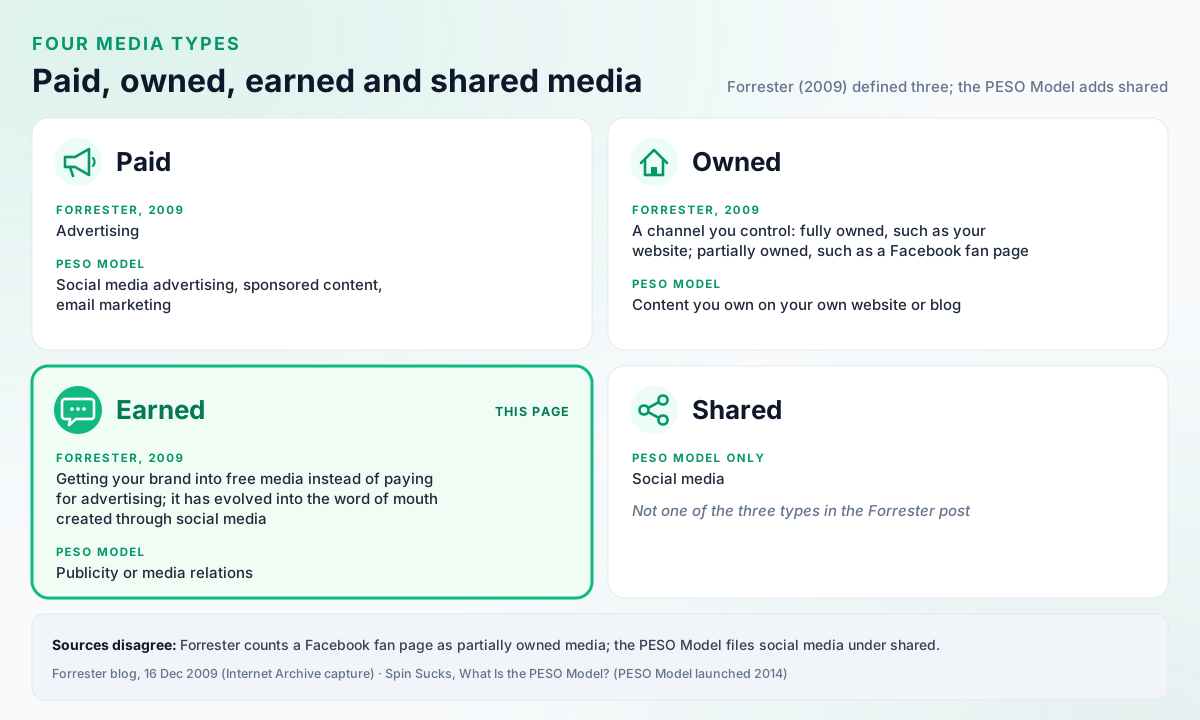
| Media type | Forrester (2009) | Spin Sucks PESO Model | MASB (2022) |
|---|---|---|---|
| Paid | ”Aka advertising” | Social media advertising, sponsored content, email marketing | Third-party channels, for a fee |
| Owned | A channel you control: fully owned (your website) or partially owned (a Facebook fan page or Twitter account) | Content on your own website or blog | Properties the marketer owns or controls |
| Earned | Free media instead of advertising, now word of mouth through social media | Publicity or media relations | Third-party channels, without a fee: news mentions, word of mouth |
| Shared | Not one of the three types in the post | Social media | Not one of its three core types; it describes shared media, as the PESO extension, as third-party content on social platforms, forums and online communities |
Checked against Forrester blog: 'Defining Earned, Owned And Paid Media' (Sean Corcoran, 16 Dec 2009) — Internet Archive capture.Archived copy, 4 October 2021
Checked against Forrester blog: 'Defining Earned, Owned And Paid Media' (Sean Corcoran, 16 Dec 2009) — Internet Archive capture.Archived copy, 4 October 2021
Checked against Forrester blog: 'Defining Earned, Owned And Paid Media' (Sean Corcoran, 16 Dec 2009) — Internet Archive capture.Archived copy, 4 October 2021
Checked against Spin Sucks: What Is the PESO Model? (8 Sep 2020).Vendor's own description
Checked against MASB Universal Marketing Dictionary: PEO (Paid-Earned-Owned) Model.
Where the frameworks disagree: Forrester counts a Facebook fan page as partially owned media, Checked against Forrester blog: 'Defining Earned, Owned And Paid Media' (Sean Corcoran, 16 Dec 2009) — Internet Archive captureArchived copy, 4 October 2021 while Spin Sucks says owned media is not hosting your content on Medium or Facebook Notes, and files social media under shared. Checked against Spin Sucks: What Is the PESO Model? (8 Sep 2020)Vendor's own description “Paid” differs too: MASB’s paid examples include TV, radio and print, while PESO’s paid means social ads, sponsored content and email. Checked against MASB Universal Marketing Dictionary: PEO (Paid-Earned-Owned) Model When you use the terms in a plan, say which framework you mean.
Is social media earned media?
Partly: your own posts are not earned, but what other people do with them is. A post on your own profile is owned media in Forrester’s terms (partially owned) Checked against Forrester blog: 'Defining Earned, Owned And Paid Media' (Sean Corcoran, 16 Dec 2009) — Internet Archive captureArchived copy, 4 October 2021 or shared media in the PESO Model. Checked against Spin Sucks: What Is the PESO Model? (8 Sep 2020)Vendor's own description An ad is paid. A mention, a tag, a repost or a review written by someone else is earned: it is the word of mouth Forrester said earned media had evolved into, and MASB lists word of mouth as earned. Checked against MASB Universal Marketing Dictionary: PEO (Paid-Earned-Owned) Model
That is why earned social media starts with posts worth passing on, and why tracking it means looking beyond your own analytics to what others say (see social listening).
Earned or paid? Influencers, gifts and reviews
If you gave anything for the mention, it is not cleanly earned, and in the US the audience usually has to be told. The FTC says a material connection the audience would not expect must be disclosed clearly and conspicuously, and that it includes payment, free or discounted products, early access and the chance to win a prize. Checked against eCFR: 16 CFR § 255.5(a) Disclosure of material connections
| Situation | Earned or paid? | What the rules say |
|---|---|---|
| A reporter covers your launch after reading your announcement | Earned | No fee, a third-party channel: earned by MASB’s definition |
| A customer posts an unprompted review or recommendation | Earned | No connection to disclose |
| You pay a creator for a post | Paid | Payment is a material connection: disclose it |
| You send free product and the creator posts about it | Not earned: gifted | FTC staff say a bare “Gifted” is ambiguous, but “Gifted by XYZ” should be enough when free product is all they received Checked against FTC: FTC's Endorsement Guides: What People Are Asking |
| A creator earns commission through your affiliate link | Paid (performance) | The FTC’s guides give affiliate commissions as an example of a connection to disclose Checked against eCFR: 16 CFR § 255.5(a) Disclosure of material connections |
| You reward customers for reviews | Not earned: incentivized | The reward is a connection to disclose. The FTC’s reviews rule, in effect since 21 October 2024, bans buying or selling fake reviews and paying for reviews on condition they express a particular sentiment, and lets the FTC seek civil penalties against knowing violators Checked against FTC press release: Federal Trade Commission Announces Final Rule Banning Fake Reviews and Testimonials (14 August 2024) |
So is influencer marketing earned media? Cambridge defines an influencer as a person active on social media who is able to influence people’s opinions or to persuade them to follow a particular lifestyle or buy a particular product. Checked against Cambridge Dictionary: influencerIndustry convention Most influencer marketing pays or gifts that person, which makes it sponsored content; what sponsored posts must disclose covers the labels. A creator who reviews your product because they bought it and liked it is earned, as is a customer’s own post (see what UGC means). This is regulator guidance, not legal advice.
Earned media examples
Earned media is anything about you that someone else chose to publish. Common types, described as illustrations rather than cases:
- Press coverage: a local paper or trade site writes about your opening, product or research.
- Reviews: a customer leaves a review on a marketplace, map listing or their own account.
- Reposts and mentions: another account reshares your post, quotes it or tags you in its own.
- Recommendations in other people’s content: a podcast host, newsletter writer or creator mentions you without being paid.
- Word of mouth: customers tell friends, in person or in group chats you will never see.
- Citations and links: a blog or industry report links to a resource you published.
How to get earned media: an earned media strategy
You can’t buy earned media, but you can plan for it: give people something worth sharing, then make it easy to find and pass on. A one-page earned media plan covers six steps:
- Pick the audience. Name who you want talking about you and what they read; a buyer persona keeps this specific.
- Make something worth covering. News, original data, a useful guide or a clear visual such as an infographic gives others a reason to mention you.
- Publish it on owned media first, so every mention has a page to link to.
- Pitch the right people, one at a time, with a short, specific note. Influencer outreach covers pitching creators; anything you offer in return moves the post into the paid or gifted rows above.
- Ask happy customers for honest reviews, never rewarded for a positive one.
- Reshare what you earn on your own channels, with credit, and thank the person who posted it.
If you also pay creators, keep that programme separate in your plan: the influencer marketing strategy guide covers it.
For context on where budgets sit: asked for the top three areas where they expect to invest most or increase investment in 2027, B2B marketers in CMI’s report named owned media (42%, up 10 points on 2026) well ahead of social/earned media (25%), a category CMI groups together. Checked against Content Marketing Institute: B2B Content and Marketing Trends: Insights for 2027 The figures come from CMI and MarketingProfs’ B2B Content and Marketing Trends: Insights for 2027, published 4 November 2026, which reports on 861 B2B marketers, mostly from North America, surveyed 23 June to 11 August 2026. Checked against Content Marketing Institute: B2B Content and Marketing Trends: Insights for 2027
How to track earned media for free
Set up free alerts for web mentions, watch your own search data, and follow social mentions on each network. Then report what the coverage changed, not what it would have cost as advertising.
- Google Alerts emails you when new Google Search results appear for a topic, such as your brand name, with options for frequency, source types, language and region. Checked against Google Search Help: Create an alert It watches Google Search results, not posts inside social apps, so treat it as a free way to catch web mentions. Checked against Google Search Help: Create an alert
- Google Search Console is a free Google service that shows how often your site appears in Google Search, for which queries, and how often searchers click. Checked against Search Console Help: About Search Console A rise in searches for your brand name after coverage is a useful signal.
- Social mentions sit inside each network; social listening explains how to follow them.
Don’t report advertising value equivalents (AVEs). AMEC, the International Association for Measurement and Evaluation of Communication, says AVEs price coverage as if it were advertising, usually at published rate-card prices, and does not recognize them as a valid metric. Checked against AMEC Policy on AVEs (PDF) Its Barcelona Principles, first agreed in 2010 Checked against AMEC Policy on AVEs (PDF) and now at version 4.0 (June 2025), say to measure outcome and impact instead, starting from clear, measurable objectives. Checked against AMEC: Barcelona Principles 4.0 (eBook PDF, June 2025) Social media KPIs has metrics that fit, and social media growth covers the organic levers that sit alongside earned coverage.
Earned media FAQ
What is earned media?
Earned media is attention you don’t pay for: press coverage, reviews, reposts and word of mouth that other people choose to give your brand. MASB’s marketing dictionary defines it as content distributed through third-party-owned channels without a fee, such as PR-driven news mentions and word of mouth. Merriam-Webster and Cambridge had no entry for the term when we checked.
What are examples of earned media?
A journalist’s article about your product, a customer’s unprompted review, another account resharing or mentioning your post, a podcast host recommending you, and customers telling their friends. It only counts as earned if you gave nothing for it; a paid or gifted post is a different case, with disclosure rules.
What is the difference between earned, owned and paid media?
Paid media is advertising you pay for, owned media is a channel you control such as your website, and earned media is coverage others give you for free. Forrester set out the three terms in a 2009 post; Spin Sucks’ PESO Model adds a fourth type, shared media, which it uses for social media.
Is influencer marketing earned media?
Usually not. If you pay a creator, send free product or pay a commission, US FTC guidance treats that as a material connection the audience must be told about, so the post is sponsored, not earned. A creator’s post is earned only when they mention you with no payment, gift or other connection. This is regulator guidance, not legal advice.
What is the PESO model?
PESO stands for paid, earned, shared and owned media. It is the PR agency Spin Sucks’ own framework, which it says officially launched in 2014 with the book Spin Sucks. In it, paid media means social media advertising, sponsored content and email marketing, earned media means publicity or media relations, and shared media means social media.