
Best Time to Post on Social Media (2026 Data by Platform)
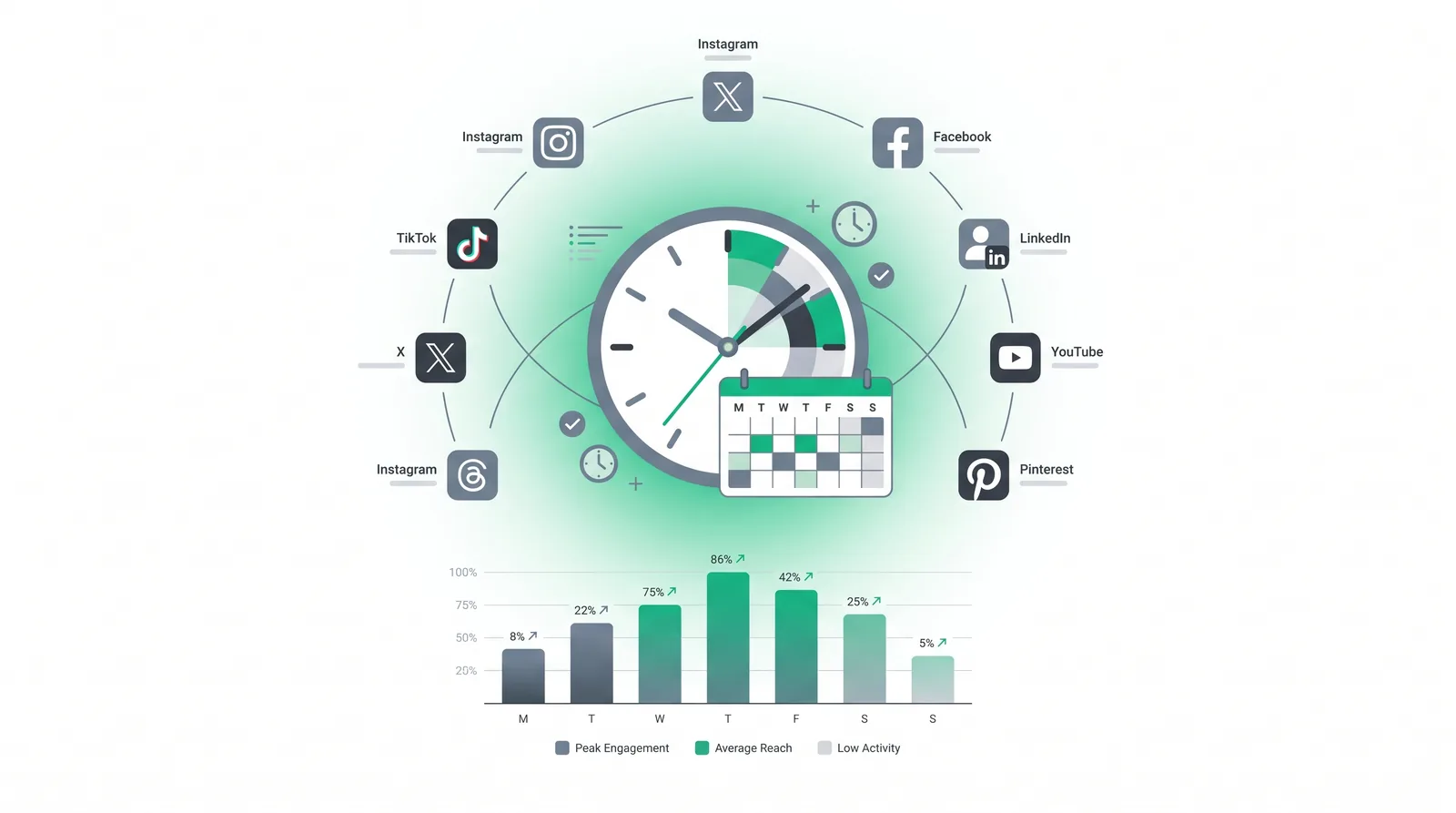
The best time to post on social media is Tuesday through Thursday, 9 AM–12 PM in your audience’s local time zone, with Wednesday the strongest day and Sunday the weakest. That window holds for Instagram, Facebook, LinkedIn, X, and Pinterest. TikTok and YouTube are the exceptions — they peak in the afternoon and evening, not mid-morning.
That headline is the right starting point, but it hides the real story: each platform runs on its own clock, and your specific audience runs on a clock of its own. This is the hub of our best-time cluster — an overall answer, a platform-by-platform summary table linking to every in-depth guide, and a simple method for finding your peak hours, which beat any generic chart.
Table of Contents
- What Is the Best Time to Post on Social Media?
- Best Time to Post by Platform (2026 Summary Table)
- What Is the Best Day to Post on Social Media?
- Worst Times to Post on Social Media
- Why There’s No Single Best Time for Every Platform
- How Much Does Posting Time Actually Matter?
- Why the Studies Disagree (and What to Trust)
- How to Find Your Own Best Time to Post
- Schedule Across Every Platform at the Right Time with Outfeed AI
- Frequently Asked Questions
What Is the Best Time to Post on Social Media?
The best time to post on social media is Tuesday through Thursday, 9 AM–12 PM in your audience’s local time zone, with Wednesday the single best day. Across the largest 2026 datasets, midweek mornings and midday win for most platforms, and weekends — Sunday especially — lose.
This is the consensus average, not a guarantee. Sprout Social’s analysis of nearly 2 billion engagements across roughly 307,000 profiles and Buffer’s study of more than 52 million posts both land on the same midweek-daytime pattern. But “average” blends very different platforms together. The day-by-day table below is the blended overall view; the per-platform table after it breaks it apart so you can act on it.
Overall best windows, Monday–Sunday, in your audience’s local time zone. Source: Sprout Social 2026 (~2 billion engagements, ~307,000 profiles).
| Day | Best window (overall) | Notes |
|---|---|---|
| Monday | 10 AM–5 PM | Slow start; ramp-up |
| Tuesday | 11 AM–6 PM | One of the two strongest days |
| Wednesday | 11 AM–6 PM | Strongest single day across most platforms |
| Thursday | 11 AM–5 PM | Consistently strong |
| Friday | 11 AM–2 PM | Engagement tapers after lunch |
| Saturday | 11 AM–6 PM | Low overall — exception: TikTok & YouTube |
| Sunday | No optimal window | Worst day overall; lowest engagement |
Local time · as of June 2026. The takeaways are simple: the best days are Tuesday and Wednesday, the worst is Sunday, and a reliable cross-platform baseline runs from roughly 9 AM–12 PM (the morning peak, where platform-level studies like Buffer cluster) through the wider 11 AM–6 PM window in Sprout’s overall data. Treat that as the floor, then tune per platform below.
Best Time to Post by Platform (2026 Summary Table)
There is no single best time across all platforms — each has its own peak window. Use the table as your tested starting hypothesis per network, then click through to the full guide for day-by-day data, format-specific timing, and the worst slots to avoid.
Times are in your audience’s local time zone. Windows synthesize the largest 2026 studies; treat each as a starting point and verify against your own analytics.
| Platform | Best window (audience local time) | Best day | Full guide |
|---|---|---|---|
| Wed 12 PM, Thu 9 AM, weekday 6–9 PM | Wednesday | Best time to post on Instagram | |
| TikTok | Tue–Thu, 2–6 PM (Sun 9 AM secondary) | Tuesday–Thursday | Best time to post on TikTok |
| Tue–Thu, 9 AM–1 PM | Wednesday | Best time to post on Facebook | |
| Tue–Thu, 10 AM–2 PM (peak 11 AM) | Wednesday | Best time to post on LinkedIn | |
| YouTube | Weekdays 2–4 PM (long-form), evening (Shorts) | Tuesday–Thursday | Best time to post on YouTube |
| X (Twitter) | Tue–Thu, 9–11 AM, 12–6 PM | Wednesday | Best time to post on Twitter / X |
| Tue–Thu, 10 AM–1 PM | Wednesday | Best time to post on Pinterest | |
| Threads | Tue–Thu, 9 AM–12 PM, evening | Wednesday | Best time to post on Threads |
| Bluesky | Tue–Thu, 9 AM–1 PM | Wednesday | Best time to post on Bluesky |
Local time · as of June 2026. Two patterns jump out. First, the consumer feeds (Instagram, TikTok, YouTube) reward afternoon and evening slots when people are relaxing; the professional and discovery platforms (LinkedIn, Facebook, Pinterest, X) reward weekday daytime. Second, Wednesday is the recurring best day almost everywhere — if you can only optimize one slot a week, make it Wednesday morning to midday.
What Is the Best Day to Post on Social Media?
Wednesday is the best day to post on social media, with Tuesday and Thursday close behind. This midweek trio wins across nearly every platform and every major 2026 study. Sunday is the most reliably weak day.
The reason is rhythm. Monday is lost to inbox triage and week-planning, Friday attention drifts toward the weekend by early afternoon, and Sunday is the lowest-energy scrolling day for most networks. That leaves Tuesday–Thursday as the dependable core. TikTok is the standout exception — its Saturday and Sunday mornings can outperform, which is exactly why a per-platform schedule beats a one-size-fits-all calendar.
Worst Times to Post on Social Media
The worst times to post on social media are overnight (roughly midnight–5 AM), early Monday morning, and Sunday across most platforms. Posting into these dead zones means your content collects almost no early engagement, so the algorithm never picks it up — and even strong content stalls.
Here’s the breakdown:
- Overnight, midnight–5 AM — your audience is asleep; the early-engagement window opens onto an empty feed.
- Early Monday — people are clearing inboxes and planning, not scrolling.
- Sunday — the lowest-engagement day across Instagram, Facebook, LinkedIn, X, and Pinterest.
- Friday late afternoon — attention drains as the weekend starts, especially on professional networks.
The big exception is TikTok, where weekend mornings can be a genuine opportunity. Never assume a “worst time” on one platform applies to another.
Why There’s No Single Best Time for Every Platform
Each platform serves a different mindset, so its peak hours differ. People open LinkedIn to work, TikTok to unwind, and Pinterest to plan — and those mindsets cluster at different hours of the day. A single cross-platform schedule pushes content into the wrong moment on most of your accounts.
Consider the contrast. LinkedIn peaks in weekday business hours because it’s a professional network. TikTok peaks on weekday afternoons and evenings, when people relax and watch. Instagram blends midday with the 6–9 PM wind-down. YouTube wants long-form uploaded in the early afternoon so it’s indexed before the evening viewing rush. Same calendar, four different optimal windows. That’s why the platform guides linked above each go deep on day-by-day data and format-specific timing rather than repeating one rule.
How Much Does Posting Time Actually Matter?
Posting in a peak window typically earns 20–40% more engagement than posting at a random time — but timing amplifies content, it doesn’t rescue it. Most feeds measure early interaction in the first 30–90 minutes and use it to decide how widely to distribute a post. Landing that window onto a live audience stacks the deck in your favor.
Keep it in proportion, though. A strong post in an average slot still beats a weak post at the “perfect” minute. Timing is a multiplier on quality, not a substitute for it. Get the content right first, then use timing to squeeze out the extra reach — and remember that consistency in your windows matters more than chasing one magic hour. The same sense of proportion applies to the other dial people over-tune — our platform-by-platform verdict on whether hashtags still work in 2026 finds they now classify a post rather than distribute it.
Why the Studies Disagree (and What to Trust)
The studies disagree because they measure different audiences, not because the data is wrong. Sprout Social leans midday weekday. Buffer’s larger dataset flags rising afternoon and evening signals on several platforms. Later and SocialPilot land on slightly different peak minutes. None of them is your audience.
So why the spread? Three reasons:
- Different user bases — a B2B-skewed dataset peaks at 10 AM; a creator-skewed one peaks in the evening. Same platform, different crowds.
- Time-zone normalization — some studies convert everything to one zone, others report raw local times, which shifts the apparent peak.
- Metric definitions — “engagement” can mean clicks, comments, saves, or impressions, and each peaks at a slightly different hour.
The honest through-line across all of them, confirmed by both Sprout Social’s best-times-to-post research and Buffer’s 52-million-post analysis: midweek daytime is the safe default, and your own analytics are the real answer.
How to Find Your Own Best Time to Post
Your best time to post is when your audience is online — and every platform’s native analytics get you most of the way there for free. Published charts are the hypothesis; here’s how to confirm it across your accounts.
- Find where your audience lives. In each platform’s analytics, open the audience or follower demographics to see top locations and when followers are active. Convert every window above to that time zone.
- Cross-reference your own top posts. Look at your best-performing recent posts on each network and note what time they went out. Patterns emerge fast.
- Run a two-week A/B test per platform. Pick one format and post at two different windows — say 9 AM versus 6 PM — alternating across two weeks.
- Track engagement rate and first-hour velocity. Velocity (interactions in the first 30–90 minutes) is the leading indicator the algorithm reacts to; the others follow.
- Lock the winner, then test the next variable. Keep the better window, then test a second slot or a second format. Once the windows are locked they become your cadence — our five-step social media planner method turns fixed slots into a repeatable month you can fill in one sitting.
For a distributed audience, weight your windows by location share. If your followers are 40% US, 30% EMEA, 20% APAC, schedule for the largest segment’s daytime first, then add a secondary slot for the next region — don’t try to satisfy all three with one post. To draft content fast before you schedule it, try our free social media post creator.
Schedule Across Every Platform at the Right Time with Outfeed AI
Converting time zones by hand, running a separate optimal-time test per network, and remembering seven different peak windows is exactly the busywork that makes people give up on optimal timing.
Buffer, Hootsuite, Later, and Sprout Social are all capable schedulers — we rank them and four others on queue model, bulk capacity and real post caps in our guide to the best social media scheduler — but they still expect you to operate a dashboard, one platform at a time. If you would rather let an AI social media scheduler pick the window, it helps to know what data each one actually scores first.
This is where Outfeed AI takes a different approach. It’s chat-first: tell the AI your audience’s top locations and it picks the right window per platform, then drafts and cross-posts across all 9 networks from one conversation — adapting each post to that platform’s peak time and your brand voice. You can say “schedule this for Wednesday in my audience’s time zone and post it everywhere at each platform’s best hour,” and it’s handled. Plans start at $29/month, and Pro is $59/month with 3 team members included. Start scheduling with Outfeed AI, or learn more on the Outfeed AI homepage.
Frequently Asked Questions
What is the best time to post on social media?
The best time to post on social media is Tuesday through Thursday, 9 AM–12 PM in your audience’s local time zone, with Wednesday the single strongest day and Sunday the weakest. This holds across Instagram, Facebook, LinkedIn, X, and Pinterest. TikTok and YouTube are the exceptions, peaking in the afternoon and evening.
What is the best day to post on social media?
Wednesday is the best day to post on social media across almost every platform, with Tuesday and Thursday close behind. Sunday is consistently the worst day for most networks. The exception is TikTok, where Saturday and Sunday mornings can outperform — proof that platform and audience beat any universal rule.
Is there one best time to post on all social media platforms?
No. There is no single best time that works across every platform. LinkedIn peaks in weekday business hours, TikTok peaks on weekday afternoons and evenings, and Instagram blends midday and early-evening windows. Using one schedule for every network leaves engagement on the table — tailor timing per platform, then verify against your own analytics.
How much does posting time actually matter?
Posting in a peak window typically earns 20–40% more engagement than posting at a random time, because most feeds reward early interaction. But timing only amplifies content — a strong post in an average slot still beats a weak post at the perfect minute. Treat timing as a multiplier, not a fix.
How do I find the best time to post for my own audience?
Open each platform’s native analytics to see when your followers are online and where they live, convert published windows to that time zone, then run a two-week A/B test posting at two different times. Track engagement rate and first-hour velocity. Your own data beats any generic chart every time.
Conclusion
The best time to post on social media is Tuesday through Thursday, 9 AM–12 PM, peaking Wednesday — but that’s only the average. Each platform runs on its own clock: LinkedIn on business hours, TikTok on afternoons and evenings, Instagram on a midday-plus-evening blend. Use the platform guides above as your tested starting points, confirm them against your own analytics, and stay consistent in the windows that work.
Then let Outfeed AI handle the timing — picking the right slot per platform and cross-posting across all 9 networks from a single conversation.
Next steps: Dive into the best time to post on Instagram and TikTok guides for your highest-volume platforms, then draft your next post with the free social media post creator. Once your windows are set, pair them with a tag set that fits each network’s current cap — our guide to the best hashtags for every platform and niche lists them all.